Ann Arbor

Ann Arbor’s CytoPherx raises largest VC in state since 2009

Want to read a big number? $34 million is a pretty big number, isn't it? That's how much CytoPhrex has raised in venture capital, which pretty much sets the record for 2011. And 2010 for that matter. Excerpt: "Ann Arbor-based CytoPherx Inc., a clinical-stage medical device company initially focused on acute kidney failure, announced today that it has raised $34 million in venture capital, the largest round of such funding for a state company since Ann Arbor-based Lycera Corp. raised $36 million in April 2009." Read the rest here.

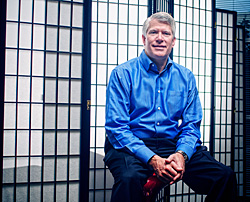
Are You Satisfied? A Conversation with ForeSee Result’s Larry Freed

Ann Arbor-based ForeSee Results has seen growth every quarter of its existence. That's a pretty impressive track record for this U-M spin out. CEO and co-founder Larry Freed talks about his home grown approach to hiring, our area's startup climate, and what we need to keep and attract more young talent.

First hybrid electric-biodiesel-powered buses roll at U-M

New hybrid buses that run on a combo of biodiesel fuel and electricity are getting the University of Michigan's students and employees around this week, and more of the eco-style vehicles will go into operation in coming days. The 40-foot buses are adding to the U-M's fleet of alternatively-powered vehicles and stand out as they've been plastered with new maize and blue graphics that advertise the buses part of U-M's Planet Blue initiative. The buses are also recognizable because of the power packs they carry on their rooftops. "The addition of hybrid buses to our fleet is another step in our commitment to sustainability," says Keith Johnson, associate director of transportation operations. "By the end of 2012, one in six buses on campus will be a hybrid." One hybrid diesel-electric bus went in to service last week. Three others are in are at the campus sign shop having their special graphics added. One of those will be ready to roll this week, and the the other two should be ready sometime this month, says Steve Dolen, executive director of parking and transportation services for U-M. Another three will be in service by the end of fall, he says, and a total of seven buses will be on the streets around campus by the end of the fall. A grant from Clean Energy Coalition and the Department of Energy paid for the first of the buses. More alternative energy buses are sure to be bought, Dolen say, as the university has a long-term plan to continue moving away from buses as well as all university vehicles that rely solely on gasoline. "The technology is always changing," Dolen says. "We are watching those changes so that we make the best financial decision and the best environmental decision." Source: Steve Dolen, executive director of parking and transportation services, University of Michigan Writer: Kim North Shine

Are You MPowered?

The student-run MPowered is U-M's startup for startups. Living up to its name, it has not only prodded the university into offering more classes in entrepreneurship, it has also attracted a community of business-minded students through its 1000 Pitches Summit and annual Career Fair. This year they debut "Startup Weekend," a 54-hour event which seeks to create a web or mobile applications business in a weekend.

Take me to the river. U-M’s Flume Room studies 150 mini Huron Rivers

A former University of California researcher and professor lured to the University of Michigan by the prospect of creating his dream project is behind the "Flume Room", a series of 150 mini Huron Rivers located at the School of Natural Resources and Environment. The Flume Room, a step up from a project run by Bradley Cardinale at U-C, is designed to determine what the most serious stressors are on rivers and streams. Cardinale, an assistant professor at the School of Natural Resources and Environment and principal investigator of the flume project, relocated to U-M in January 2011 with the promise that the indoor controlled water quality studies could be done in a larger, more controlled, more meaningful environment. "I'm very happy U-M gave us the money to do this," he says. "At the University of California, it was nothing like this…There were some shortcomings, some cut corners in terms of having a facility that was controlled." "The benefits for the University of Michigan is it wants to become experts on water sustainability. Water is going to be one of the single biggest bottlenecks facing humanity in the next century…We're sitting right here on the Great Lakes. Michigan wants to be a leader in preserving water and maintaining the quality of of water. Aside from that, the research brings in top dollars," he says. Immediately after the flume room was constructed, he says, the National Science Foundation awarded the project a $2 million grant. Each of the artificial streams in the "one-of-kind-facility is completely enclosed and re-circulating, which makes it possible to examine how each form of environmental stress impacts the production of oxygen, the removal of pollutants from water, and the decomposition and recycling of wastes in a closed system. The flumes run around the clock every day and water temperature is maintained at 65 degrees Fahrenheit to simulate fall temperatures in the Huron. What sets the research apart from other studies, he says, is the capability to subject 150 bodies of water to various variables - erosion, chemical pollution, invasive species, etc. all at once and in a controlled environment 150 times. It's what's called high replication. "The problem is so far we study the heck out of this,but we're comparing apples to oranges," says Cardinale, who is also an assistant professor of ecology and evolutionary biology in the U-M College of Literature, Science, and the Arts. Within about four months, he says, he expects to be able to rank the top concerns for the Huron River. The next step, he says, is to "get into nature into the real steams and see if we get the same answers." In one to two years, if there is agreement between the lab and the field, he says the top 4-5 stressors on the Great Lakes watershed in Michigan could be identified. Source: Bradley Cardinale, principal investigator, the Flume Room at University of Michigan Writer: Kim North Shine

Three multi-story apartment buildings coming to AA in 2012

Construction on three multi-level apartment buildings that will range from three stories to 12 and house hundreds of residents, mostly students, has begun in downtown Ann Arbor. The most controversial of the trio of projects that aim to bring density to downtown is CityPlace on Fifth Avenue near Packard on the southern border of the Central Business District. Foundation work is going on now and the two buildings each of three stories should be ready for occupancy by December, says Ralph Whelton, chief development official for the city of Ann Arbor. Parking will also be built. Residents living near the project objected to the the developer's plans to raze homes but also opposed early plans to preserve them as part of a bigger project known as Heritage Row. The homes were mostly rentals for college students. The other two apartment buildings, the 12-15 story Varsity Apartments on Washington and Division, and the City Center Apartments on First and Washington west of Main, should be ready for move-in by September, Welton says. The Varsity Apartments will likely be 12 stories but could go as high as 15, Welton explains, and have a first floor of commercial space. The Ann Arbor City Center apartments will be eight stories on top of four stories of parking, two above ground, two below. Some parking will be for the public. Ann Arbor's Downtown Development Authority will own the parking structure. "It's very unusual," to have three large apartment buildings coming in within such a short span. But it appears the need and the market is there. "It'll be good for business," he says. "The residents may be students, but they still need to eat, buy things." Source: Ralph Welton, chief development official, city of Ann Arbor Writer: Kim North Shine

3.7 Designs aims to hire 2-3 as it releases new products

3.7 Designs has traditionally made its money through hourly billing for its software and website work. These days the Ann Arbor-based firm is moving toward creating more training products and other software programs that provide more reliable revenue streams. "Our focus now is how do we create a product we can maximize our time," says Ross Johnson, CEO of 3.7 Designs. He adds that these sorts of training products and software programs come with steady customer bases that should allow for more growth. 3.7 Designs currently employs four people, including an intern. That team is currently working to develop and release three products over the next year and improve three of its existing products in the same period. Johnson hopes to add another 2-3 people with that new work. "We're focusing on developing something with a steady customer base," Johnson says. Source: Ross Johnson, CEO of 3.7 Designs Writer: Jon Zemke Read more about Metro Detroit's growing entrepreneurial ecosystem at SEMichiganStartup.com.

Ann Arbor’s CytoPherx lands $34M in venture capital

CytoPherx pulled down one of the largest venture capital rounds in recent memory, raising $34 million from the likes of Early Stage Partners, ONSET Ventures and Capital Midwest Fund. David Weaver, chairman & founder of Great Lakes Angels, a group of about a dozen angel investors based in Bloomfield Hills, first reaction to the amount of money raised by CytoPherx was "Wow, that's a lot of money." He said a seed round that big will give the start-up a lot of flexibility to commercialize its product. "That gives them room to breathe," Weaver says. "That's a big deal to have that much money around." The Ann Arbor-based bio-tech start-up plans to use the funds to complete its clinical trials and gain FDA approval for its anti-inflammatory therapy for acute kidney injuries. CytoPherx's therapy can be used to ease the pain of intensive care unit patients with kidney injuries, such as Renal failure, suffering from extreme inflammation. It is also expected to help patients recover and live more full-filling lives. CytoPherx spun out of the University of Michigan in 2007. It has raised several million in seed capital before this latest financing round, including a $5 million raise in 2010. The start-up has its eyes on the more than 2.7 million hospitalized patients in the U.S. diagnosed with acute renal failure. Approximately 160,000 receive Continuous Renal Replacement Therapy, which CytoPherx hopes to make it technology a part of, representing what it claims is a multi-billion dollar potential market. Source: CytoPherx and David Weaver, chairman & founder of Great Lakes Angels Writer: Jon Zemke Read more about Metro Detroit's growing entrepreneurial ecosystem at SEMichiganStartup.com.

Great Lakes Angels invests in Ann Arbor’s Blaze Medical Devices

Blaze Medical Devices recently closed a $250,000 seed capital round that was led by a handful of investors from the Great Lakes Angels Group. The Ann Arbor-based startup is developing a product that focuses on quality control and optimization for the blood banking and transfusion industry. The technology analyzes stored blood to allow clinicians to predict the effectiveness of transfusions by assessing the levels and rates of quality loss during storage for individual units. The investors from Great Lakes Angels moved on investing in Blaze Medical Devices so they could take advantage of Michigan's angel tax credit (it expired at the end of 2011) and because the 5-year-old start-up has also received two patents. That sort of forward progress makes the start-up an attractive company for a future acquisition. "It appears Blaze Medical Devices will need less than $10 million to get to an exit," says David Weaver, chairman & founder of the Bloomfield Hills-based Great Lakes Angels. "That creates the opportunity for less dilution." Weaver adds that Blaze Medical Devices is aiming to be acquired by 2015 or 2016. By then it should have $40 million in sales, proving the products viability but still leaving a high ceiling for  future sales. Source: David Weaver, chairman & founder of Great Lakes Angels Writer: Jon Zemke

HealPay scores seed investment for debt collection software

When HealPay's co-founders, Erick Bzovi and Lancelot Carlson, went looking for seed capital to grow their software startup, the pair quickly realized their best chance for finding funding wasn't necessarily with traditional venture capital firms. The Ann Arbor-based start-up found success with angel investors familiar with the debt collection industry. "We went with people who understand the space," Bzovi says. "It was a lot easier." HealPay is developing web & mobile apps that make collecting money easier. The 18-month-old start-up has raised a six-figure seed capital round Bzovi characterizes as worth "a few hundred thousand dollars." "It provides us a runway for the next 12-18 months," Bzovi says. He adds the money will allow Bzovi and Carlson to focus on the start-up full-time, further develop the software and market it. The pair hope to double their staff of two people over the next year as they start to roll out the software. HealPay plans to open-source its invoice application, called BillerApp, to the software development community early this year. The idea is to disrupt the invoice market with our free invoice application. The company plans to use that free software as a launchpad to draw in customers to its SettlementApp, which is plans to monetize. Source: Erick Bzovi, co-founder of HealPay Writer: Jon Zemke Read more about Metro Detroit's growing entrepreneurial ecosystem at SEMichiganStartup.com.

Our Partners

30044
30045
30046
30047
30049
Washtenaw ISD logo
Eastern Michigan University
Ann Arbor Art Center
UMS
U of M Arts Initiative
Engage EMU
Ann Arbor Housing Commission

Don't miss out!

Everything Ann Arbor and Ypsilanti, in your inbox every week.

Close the CTA

Already a subscriber? Enter your email to hide this popup in the future.