Downtown Ann Arbor employers step up for Commuter Challenge

Angelini & Associates Architects isn't standing out because its participating in getDowntown's Commuter Challenge. It's because every one of the nine people in the downtown Ann Arbor firm will be taking part in it this spring.This year at least 63 Ann Arbor organizations are participating in the challenge to see who can log the most sustainable commutes during May, such as riding a bike to work. Kelly O'Doherty, an architect with Angelini & Associates Architects, already makes those trips either taking the bus in cold or riding her bike in the warm.Her home on the southeast side of Ann Arbor is about four miles from her job's downtown office. The distance allows her to ride into downtown 2-3 times during the warm weather months, so participating the in the Commuter Challenge was a no brainer for her and her firm."It encourages people to look for other ways to get around besides using their cars," O'Doherty says. "It also helps reduce congestion and our carbon footprint."That's the idea behind the challenge and the whole getDowntown initiative. Downtown Ann Arbor has struggled with parking issues for years, so local leaders started getDowntown as a way of getting more people to downtown by using sustainable options, like car pooling, mass transit, bicycling and walking. The Commuter Challenge is significant part of that. Its paired with other alternative transit options, like a transit-themed Movie Night at Arbor Brewing Company on May 6th, Bike to Work Day on May 15th and Downtown fitness walksFor information on the Commuter Challenge and other events, click here or call (734) 214-0114.Source: Kelly O'Doherty, an architect with Angelini & Associates Architects and getDowntownWriter: Jon Zemke


U-M regents approve laundry list of projects

The University of Michigan isn't always about the big, flashy projects. Sometimes it's the little ones that need attention, too.The university's Board of Regents approved more than $31 million in new projects. More than half of that money is for smaller projects, such as improving aging mechanical systems and renovating buildings.The university's Chemistry Building is getting a $300,000 chiller for one of its main laboratories. Another $2.2 million is being spent to renovate four laboratories for the departments of Ecology and Evolutiollary Biology and Molecular, Cellular, and Developmental Biology.The big kahuna is the pending renovation of the Varsity Drive and Alexander G. Ruthven Museums of Zoology buildings. This $17.6 million project will renovate more than 50,000 square feet of space, creating a new space for the museum's wet collection. There will be work done on the mechanical systems and architectural aspects of the buildings.Source: University of MichiganWriter: Jon Zemke

Ann Arbor’s Adaptive Materials hires 4 in 10th year of biz

Adaptive Materials has some high expectations for the next decade, now that its first one is behind it.The Ann Arbor-based firm recently celebrated its 10th anniversary with 58 employees, including four hired this year. The company expects to continue that growth in the next decade as it gets ready to put its products in every RV, boat, ambulance and, well, any place that can use a highly efficient fuel cell.Adaptive Materials is the brain-child of University of Michigan grad Aaron Crumm. He came up with a way of turning fuels like propane into electricity instead of heat. That means its technology can convert a small propane tank used for camping into a generator that can keep a fridge going during a blackout. Think an emergency generator strong enough to power appliances but small enough to carry in your pocket.The company started out as a research-and-development firm, but has since grown vertically, taking on more manufacturing. It recently moved to a 60,000-square-foot space on Ann Arbor's south side, allowing manufacturing to take up about half of the firm's resources."We'll continue down that path," says Michelle Crumm, chief business officer for Adaptive Materials.Adaptive Materials' plan is to roll out its products into more and more niche markets. It would like to see it used in places, like third-world countries, by soldiers, by first responders and ever for things like border protection.Source: Michelle Crumm, chief business officer for Adaptive MaterialsWriter: Jon Zemke

U-M’s Wolverine Venture Fund makes $2M from HandyLab sale

There was a little bit of skepticism when the University of Michigan's Ross School of Business started its own student-run venture capital fund in 1997. That's gone today now that the fund has notched a number of investment hits, including a home run with the recent sale of HandyLab.The Wolverine Fund has recorded profits as big as the low seven-figures in the past. But the HandyLab sale proved to be the biggest winner so far. It brought in $2 million for the student-run fund, off a $350,000 investment."This is unmatched among other student funds," says Mary Nickson, program manager for the Zell Lurie Institute of Entrepreneurial Studies at the University of Michigan. "We haven't heard of these sorts of returns from similar student funds at our peer schools."The Wolverine Fund invested its share over six rounds between 2000 and 2005 thanks to the efforts of more than 200 business school students. Becton, Dickinson and Company acquired HandyLab earlier this fall for a reported $300 million. The fund is worth $3.5 million and has invested in more than 18 companies in industries like information technology, life sciences and alternative energy. These firms typically have some sort of U-M connection.Source: Mary Nickson, program manager for the Zell Lurie Institute of Entrepreneurial Studies at the University of MichiganWriter: Jon Zemke

NextServices grows to 6 people in Ann Arbor, hiring

NextServices is yet another example of entrepreneurial gown turned into successful town.The Ann Arbor-based firm was founded by a trio of U-M business school students who decided to stick around after graduation and create a few jobs for themselves. Today the IT company focuses on the health care industry while employing six people and a summer intern from U-M's Ross School of Business. It also has a couple job openings right now and plans to hire yet more people next year."We've been doing extremely well the last few years," says Satish Malnik, CEO of NextServices. He co-founded the company with Praveen Suthrum. The third co-founder has stepped aside and is no longer involved with the company.Most of the company's growth has come in the health care sector, especially in network-based services. It expects even more growth in these areas as federal stimulus dollars start to roll out in 2010. "We expect to do tremendously well as long as things are on track," Malnik says.Source: Satish Malnik, CEO of NextServicesWriter: Jon Zemke

Powered By Michigan

Ann Arbor is all about customer satisfaction. But not the way you think. It's the scientific method behind evaluating customer satisfaction that was developed here at the U-M. and spun off into successful companies. They are reminders of how university, state, and local efforts are working together to transform our region into a breeding ground for innovation and entrepreneurship.

MASTERMIND: Tony Lupo

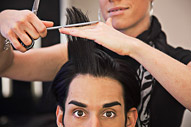
In just a few short years, Tony Lupo, Director of Sales and Marketing for Salon Vox, has become the poster child for youth involvement in Ann Arbor's downtown business and social scenes. And he's gearing up to help the city better understand the needs and desires of young professional talent when planning for its future.

NIGHT & DAY: A Shadow Art Culture

This week's FilterD is filled with secrets and shadows and... gasp!... puppets. Editor Jeff Meyers points you toward six cultural events worth checking out and chats with Shadow Art Fair co-founder Mark Maynard about Ypsilanti's fringe arts scene.

New Zingerman’s coffee shop opens by Ann Arbor airport

Getting a cup of Zingerman's coffee is a little bit easier these days now that the acclaimed eatery has a satellite coffee shop on Ann Arbor's south side.Zingerman's Coffee recently opened its processing site in an industrial area on Plaza Drive, in the Airport Plaza Business Park next to the world-famous eatery's bakehouse and creamery. There's a retail component to the site allowing customers to see how the coffee is made and grab a cup of joe in the process. The Zingerman's brand houses a family of businesses that all specialize in high end food --bread, cheese, chocolate, coffee- as well as customer service. The deli in Kerrytown accounts for about one third of the company's business. The rest of their products are made elsewhere in Ann Arbor where there is more room to operate. A common philosophy to these businesses has been that everyday customers can buy what is being made for retail outlets, grocers and restaurants at the site."These are businesses," says Ari Weinzweig, co-founder of Zingerman's. "We want to make it easy for people to buy from us."Another important aspect of the Zingerma's  business model is to demonstrate how the company sticks to its local roots and emphasizes the high quality of its products. One of the other ways it does this is by offering site tours. These will soon be available at Zingerman's Coffee's new home.For years Zingerman's has stood its ground at its original location, turning down opportunities to franchise or open new locations outside Washtenaw County. Zingerman's has even looked at the idea of opening a Ypsilanti location, because so many of its employees live in the up and coming community. It has the kind of do-it-yourself culture the founders identify with. Nothing has yet to come from that idea, however. Zingerman's would also like to expand its Kerrytown location.Source: Ari Weinzweig, co-founder of Zingerman'sWriter: Jon Zemke

MDOT replaces U.S. 23 rest area north of Ann Arbor

Ann Arbor's little rest area that could no longer can, now that the state is replacing it.The Michigan Department of Transportation is razing and rebuilding the Northfield Church rest area on U.S. 23 just north of Ann Arbor. The small rest area, which services southbound U.S. 23 traffic, will become bigger and more efficient thanks to an infusion of $2.8 million.The new rest area will be 3,903 square feet and offer dual restroom facilities on both north and south sides of building. There will also be a family restroom and changing station. The parking lot will be able to accomodate 90 cars, 30 trucks/RVs and two bus pull-up parking spots. Picnic tables will also be added.The rest area was originally built in 1967 and was 1,156 square feet. It was expanded in 1984 to 2,025 square feet and able to accommodate 48 cars and 21 trucks/RVs. Construction is expected to wrap up by next June when a short work project that will shut down half of the lanes on U.S. 23 is finished.Source: Kari Arend, spokeswoman for the Michigan Department of TransportationWriter: Jon Zemke

Our Partners

30044
30045
30046
30047
30049
Washtenaw ISD logo
Eastern Michigan University
Ann Arbor Art Center
UMS
U of M Arts Initiative
Engage EMU

Common Ground Is Brewing

Support local stories and receive our signature roast straight to your door when you join at the Standard level (or above).

Drink Better, Read Local

Close the CTA

Don't miss out!

Everything Ann Arbor and Ypsilanti, in your inbox every week.

Close the CTA

Already a subscriber? Enter your email to hide this popup in the future.