
University Research Corridor’s economic impact on Michigan is $14.8B

The University of Michigan and its two sister research universities, Wayne State University and Michigan State University, are expanding their economic impact on Michigan, according to a recent benchmark study by the Anderson Economic Group.Overall economic impact is up from $12.9 billion in 2006 to $14.8 billion in 2009, according to the 2010 Empowering Michigan report. That has helped produce an extra $50 million in state taxes, totaling $401 million -- slightly less than half of what the state spends on its research universities each year.The three research universities have partnered to create the University Research Corridor, a collaboration between the institutions that will in turn spur more economic growth. The organization has also created a new alliance with Business Leaders for Michigan, one of its goals being to align university research with the state's major business interests."We're poised for more significant growth as the economy rebounds," says Jeff Mason, executive director of the University Research Corridor. He adds that the improving economy and efficiencies captured from the new alliances will play critical parts in Michigan reinventing its economic paradigm and further establishing the University Research Corridor as one of the premier R&D clusters in the world.The University Research Corridor is in the Top 3 for generating patents. Its licensing revenue is double that of the most widely recognized research cluster, the Research Triangle in North Carolina. The combination of Wayne State, the University of Michigan, and Michigan State is also the No. 1 cluster in the U.S. in terms of enrollment, and No. 3 in terms of high-tech degrees. Source: Jeff Mason, executive director of the University Research CorridorWriter: Jon ZemkeRead more about Metro Detroit's growing entrepreneurial ecosystem at SEMichiganStartup.com.

Campfire Interactive grows sales 60%, makes Inc. 5000 list of fastest growing private U.S. companies

Downtown Ann Arbor-based Campfire Interactive is having quite the year, growing its sales numbers, revenues, staff. It was recently named to Inc. magazine's 2010 list of the 5000 fastest growing private companies in the U.S.That's the second year in a row the 8-year-old company specializing in sales forecasting has made the list, primarily because of its revenue growth. The company has watched its revenue increase by double digits and expects it to grow by another 50 percent over the next year. Four hires have been added, expanding the staff to 30 employees and the occasional intern and independent contractor."Sales are up about 60 percent over last year," says Bill Steiniger, director of sales for Campfire Interactive. "We continue to offer a unique capability when it comes to sales forecasting. That where a majority of our sales are coming from."Campfire Interactive plans to add five more hires for project management and computer programming positions. It also plans to grow its computer product line cycle management services."We need additional people," Steiniger says.Source: Bill Steiniger, director of sales for Campfire InteractiveWriter: Jon ZemkeRead more about Metro Detroit's growing entrepreneurial ecosystem at SEMichiganStartup.com.
Velesco Pharmaceutical Services hires 6, opens plant in Kalamazoo

Six is an important number for Velesco Pharmaceutical Services these days in regard to its growth. The Ann Arbor-based firm has added six employees to its existing staff of six people over the last year. It also plans to hire six more within the next year.The 3-year-old startup began when Pfizer pulled up stakes from Ann Arbor, leaving the co-founders to pursue their own entrepreneurial ambitions. It now offers pharmaceutical consulting and laboratory services and just opened a plant in Kalamazoo that makes dosage forms for clinical trials. The company hopes to continue its revenue growth pace of 30-40 percent."It really depends on how the business goes and whether the economy cuts us a break," says Gerry Cox, COO of Velesco Pharmaceutical Services. "We're a small business that is working hard on growing."The company also recently moved to the Michigan Life Science Innovation Center in Plymouth. Ann Arbor SPARK manages the former Pfizer wet lab as a place to help get Washtenaw County startups going and growing.Source: Gerry Cox, COO of Velesco Pharmaceutical ServicesWriter: Jon ZemkeRead more about Metro Detroit's growing entrepreneurial ecosystem at SEMichiganStartup.com.

U-M grad students launch surgical device company

A quartet of University of Michigan graduate students are looking to make their fortune by licensing one of their inventions, specifically, a surgical tool called Endocutter. The engineering students (Taarif Jafferi, Rahula Rattan, Zach Weingarden, and Raghunath Katragadda) came up with a device that helps break down and suck up abdominal blood during surgery, allowing doctors to see what's happening."You can see what you're sucking," says Rattan, a PhD candidate at U-M. "Because the things we are sucking are too big, this will cut them up (with a small tool at the tip of suction tube), too."The students created the device during a year-long graduate bio-medical design class and are now trying to patent it. They have received $10,000 in seed funding from the U-M Medical Innovation Center and hope to find a business to partner with and license the technology out by the end of the year.Source: Rahula Rattan, co-inventor of EncocutterWriter: Jon ZemkeRead more about Metro Detroit's growing entrepreneurial ecosystem at SEMichiganStartup.com.

Visual translation software firm is latest U-M spin out

Meet L.I.F.E, one of the latest innovations getting ready to spin out of the University of Michigan. The technology was developed in the university's 3D Lab and is aimed at helping medical professionals better communicate with their patients. The idea is to avoid the language barrier and lost-in-translation scenarios.Specifically, it helps rehabilitation patients in rural communities to communicate with medical professionals through visual images on computer screens. An animation appears on a computer screen, allowing the patient to point to where something hurts or what he or she can and can't do physically.The co-creators of the technology are working with U-M's Office of Technology Transfer to commercialize it. The budding startup hopes to raise $1-$2 million in seed capital for product development by early next year. "It will likely have its own spinoff and its own identity," says Eric Maslowski, co-inventor of L.I.F.E. "Right now, it's part of the university."Source: Eric Maslowski, co-inventor of L.I.F.E.Writer: Jon ZemkeRead more about Metro Detroit's growing entrepreneurial ecosystem at SEMichiganStartup.com.

Where The Digital Meets The Spiritual

Whether it's the front door of a church or the wall on your Facebook page, Ann Arborite David Crumm sees a place for spiritual and religious discourse. It's why he started ReadTheSpirit.com, an Internet-based company and publisher that offers one of the few places left for spirituality-based journalism.

Main St Ann Arbor storefront restores vintage cornice

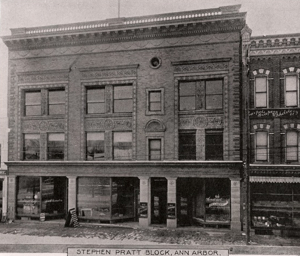
A downtown Ann Arbor building whose historic features were once covered up with paneling will move closer to its original splendor.Ed Shaffran, president of Shaffran Companies, says restoring the original cornice at the top of his three-story building at 306 S. Main St. is the final piece to a renovation that started in 1994.When the company bought the building, the brick facade and windows were covered with porcelain panels. Most of the structure was then restored, minus rebuilding the cornice on the uppermost portion. At the time, about $1.5 million was spent on interior and exterior restoration, Shaffran recalls. About $200,000 of that sum was incurred to restore the facade from damage from the porcelain panels alone."We thought, at some point in time we'll put the cornice back on," he says. "We felt the time was right to finish it all off."With the project's recent historic district approval, they've started by scheduling the removal of the existing metal paneling, which will probably be reinstalled on a wood subsurface. It will likely then be installed in 8- or 10-foot sections. They're pretty sure it was aluminum, or pressed metal, but they haven't been able to turn up historical documentation to that effect, Shaffran says.The building was finished in 1896 and originally housed a corset manufacturer, later serving for years as Kline's Department Store. It now consists of nine apartments over ground-floor retail.Shaffran says the project will probably run about $50,000, and they've come up with a drawing to replicate the egg-and-dart molding based as best they can on an original 1896 photograph of the facade. "We're excited about it," he says. "This is the completion of the building."Source: Ed Shaffran, president of Shaffran CompaniesWriter: Kristin Lukowski

Water Street Trail opens near downtown Ypsilanti

Work has gone better than expected on Ypsilanti's Water Street Trail, which means people are taking advantage of the walking trail while there's still good weather to be had this year.Part of the boost came from $2,000 in funding from the Washtenaw County Department of Health via the Building Healthy Communities program, which makes areas more walkable and accessible to non-motorized transportation. Part of that grant was also used to secure the help of TSP Environmental to do the physical labor to construct the new stretch of trail, work that would have been almost impossible to do by hand, says Andrew Clock, project coordinator for the Water Street Trail."It's actually gone better than we could have possibly imagined," he says. "Everything has fallen into place, from getting the grant to getting the work done."The Water Street Trail, which follows the north shore of the Huron River from the Michigan Avenue Bridge to Park Street, is only about 100 and 150 yards long, but serves as a connector and will likely eventually become part of the Border-to-Border Trail, a larger, county-wide trail network.The path is made of crushed concrete, which allows for it to become a trail bed when it does become part of the Border to Border Trail. "Most of their work is already done," he says. "The trail built can act as a trail bed for a paved area."Washtenaw County Parks and Recreation will be providing signage indicating that the path is a future stretch of the Border to Border trail, and it's planning for a grand opening sometime at the end of October. Another work day is scheduled for Nov. 6, a kind of fall cleanup day to remove any trash that had been hidden by foliage. Clock also expects that trail organizers will meet one more time to talk about what to do in the spring, including what people have interest in, and how to improve. "We're pleasantly surprised at the amount of people already back there using the trail," he says. "There are quite a few people using it already."Clock says part of the goal of the project is to put a positive spin on Water Street, a point of contention between the city and potential developers. "We want developers, we want people to see Water Street as something valuable, something useful, a good piece of waterfront property," he says. "There is still value in the area, and hopefully someday that will lead to development."For information about the plan or to volunteer, e-mail Clock at waterstreetparkypsi@gmail.com or click here.Source: Andrew Clock, project coordinator for the Water Street TrailWriter: Kristin Lukowski

Downtown Chelsea’s Longworth demo delayed until spring; adaptive reuse?

Chelsea's Downtown Development Authority is still working on plans for its Longworth site, and some residents are relieved that the delay comes with a stay of demolition for the three buildings involved.Demolition has been postponed until April for three buildings on the north side of the city, commonly known as the Livery, the Mack building, and the Daniels addition. DDA president Mike Jackson says the group will be hiring an architect to create a plan to be presented to the public.The DDA-owned site has potential even though it's been empty for more than 20 years; a number of developers have looked at it and suggested a range of ideas, many of which included first-floor commercial with residential above. In the end they walked away because of the financial cost, Jackson says.Also complicating things is the odd configuration of the property and the unanticipated historical aspect. "It's a gateway into Chelsea," he says. "It's been this structure that doesn't look very good coming in from the north side. We wanted to make something that looked nice."Jan Bernath, a member of the Chelsea Connection team, which has been working to preserve the site, would like to see the buildings adaptively reused. The livery is one of the few remaining in the state, built in 1906 or thereabouts. The Mack building, to the west, served as a place for car production and other industrial uses, and the Daniels addition, to the front of the property, was built in 1947 as a car showroom and is the only remaining Art Moderne building in town.Bernath points out that with the livery, the Mack building, and the Daniels addition, there is a history of transportation in Chelsea. "It's really where Chelsea started," she says.Although there may be odds as to preserving versus demolishing the site, Jackson says a solution will be reached: "Something good will happen out of there," he says. "Obviously, not everyone is going to be happy. We're going to come up with a good plan, and who knows what might happen between now and then."Source: Mike Jackson, president of the Chelsea Downtown Development Authority; Jan Bernath, Chelsea ConnectionWriter: Kristin Lukowski

Ypsilanti’s RealKidz sells online, plans to hire

RealKidz is changing up its game and getting some points on the board with its new business plan.The 3-year-old firm, based in Ypsilanti's Depot Town, makes clothing that fits larger children, mainly girls. It started out selling these garments with direct sales, a la Mary Kay. It has since moved to a primary e-commerce platform after upgrading its website with a proven Internet retailing platform in August."We're starting to see some growth from that," says Merrill Guerra, founder and CEO of RealKidz. "We have doubled our website traffic and conversion rate over the last couple of months. It's moving exactly in the direction we were hoping."The two-person startup, also a former Ann Arbor SPARK East Incubator tenant, is now looking to raise a round of seed capital so it can flesh out its staff and business infrastructure. RealKidz hopes to hires a COO and webmaster, among other positions over the next year, with this capital.Source: Merrill Guerra, founder and CEO of RealKidzWriter: Jon Zemke

Our Partners

30044
30045
30046
30047
30049
Washtenaw ISD logo
Eastern Michigan University
Ann Arbor Art Center
UMS
U of M Arts Initiative
Engage EMU

Common Ground Is Brewing

Support local stories and receive our signature roast straight to your door when you join at the Standard level (or above).

Drink Better, Read Local

Close the CTA

Don't miss out!

Everything Ann Arbor and Ypsilanti, in your inbox every week.

Close the CTA

Already a subscriber? Enter your email to hide this popup in the future.