
Sakti3, A123 Systems receive Centers of Energy Excellence money

Two promising Ann Arbor-based companies got a boost from Michigan's Centers of Energy Excellence program.The two firms represent different sectors in the development of the electricification of the automobile. A123Systems is the established player, employing a few thousand people in its Ann Arbor office. Sakti3 is the start-up, spun off of University of Michigan research and backed by General Motors.Both companies were two of the original six firms designated in the state's Centers of Energy Excellence program in 2008. Then it meant $43 million in funding. The second phase announced last week means another $30 million in funding.The program helps bridge the gap between companies, academic institutions and the state so all three partners can push forward cutting-edge research and development and pioneer new alternative energy technologies. The idea is to help diversify Michigan's brawn-based economy with more white collar jobs doing what Michigan does best - produce world-class automobiles.Source: Michigan Economic Development CorporationWriter: Jon Zemke

U-M researchers develop key protein in cancer fight

Could the cure for cancer be as simple as turning off a switch? Researchers at the University of Michigan are starting to think so.This research team has discovered that a protein called RIP can play a significant role in activating the death process in cancer cells. The team is led by Yvonne Kapila, associate professor, Department of Periodontics and Oral Medicine at the School of Dentistry."There might be some central switch that tells a cell when to die," Kapila says.U-M scientists believe this protein could be developed into a treatment that can target and execute cancer cells. This is significant because cancer cells don't follow the normal cell death process, creating things like tumors. An RIP treatment could theoritically stop those cells in their tracks before spreading to the rest of the body.But like many cancer advances, this one is still a ways off from becoming a reality. University researchers still need to show the protein can be safely introduced to humans. To get to this point, Kapila and her fellow researchers examined squamous cell carcinoma cells from head and neck tumors and also fibroblasts from mice. The RIP protein is expected to serve as the communicator to these cells, telling them when to begin dying. The theory is expected to apply to other cancer cells because the death process is the same. Source: Yvonne Kapila, associate professor in the Department of Periodontics and Oral Medicine at the School of Dentistry at the University of MichiganWriter: Jon Zemke

Zingerman’s U

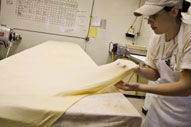
A bakehouse, a creamery, a coffee roaster, a candy manufactory...  As the Zingerman's food empire expands, they want to make you a more informed citizen. From mozzarella cheese-making to four-day baking intensives, the little deli that became a culinary kingdom offers its customers a long list of mouthwatering classes. It's Yum 101.

Start-up Saagara plans for growth in Ann Arbor

One of the main ideas behind Ann Arbor-based start-up Saagara is that proper breathing will lead to a healthier life. The year-old firm also believes it will lead to some new jobs, too.Nagabhjenam Peddi started the company shortly after he left his surgical residency. The firm focuses on providing a holistic approach to better health centered around breathing called Pranayama. "Simply by diet, breathing technique and some exercise you can improve people's health significantly," Peddi says.Today that concept employs Peddi and five independent contractors and the occasional intern. The company hopes to have six employees by this summer when it launches its full service. The goal is to start its customer base this year, taking in a few corporations, health-insurance companies and even people who just want to live healthier lives.Saagara, which is sanskrit for an ocean of ideas, hopes to expand into other languages and both Internet and smart phone applications in the near future. It has already taken in some Michigan Pre-Seed Capital Funds to help accomplish this and is working on bringing in some venture capital."We're speaking to some private-equity firms to get some more capital," Peddi says. "We're doing this in stages."Source: Nagabhjenam Peddi, president of SaagaraWriter: Jon Zemke

The last of ‘Lost’: Complex drama with ties to Ann Arbor starts its final season

Fans of the wildly popular TV show "Lost" are becoming less so now that series is coming to a conclusion and number of ties to Ann Arbor and the University of Michigan are coming to light.Excerpt:In a show known for its elaborate mythology, one of the smaller details has always been special to local fans: the Ann Arbor mentions.Viewers learned in the second season that two University of Michigan doctoral candidates, Gerald and Karen DeGroot, founded the Dharma Initiative. It was described as a communal research compound for experiments in meteorology, electromagnetism and more -- and seemingly one of the keys to the weird things that happen on the island.Last season, there were fresh references to Ann Arbor in scenes showing Dharma members living on the island in the mid-1970s. One character, Daniel Faraday (Jeremy Davies), returned to the island from the college town, where he had been doing research at the Dharma Initiative headquarters.Read the rest of the story here.

U-M plays critical role in Chicagoans’ view of Michigan

When it comes to describing the state of Michigan and all of its nuances to outsiders, expect to hear a lot of references to the University of Michigan. Especially in the Windy City. The world-class university plays a critical part in everything from president Gerald Ford to inventing the phrase "jump the shark."Excerpt:The phrase "jump the shark" was born at the University of Michigan in Ann Arbor. It refers to the point in a TV series when its plot becomes so ridiculous that fans know it is on the way out. The classic example — and the inspiration for the phrase — occurred when Fonzie of "Happy Days" went water-skiing and leapt over a shark. "Jump the Shark" was coined by Sean Connolly in a conversation with Jon Hein at the U. of M. in the mid-'80s. They formed a Web site, which was bought in recent years by tvguide.com and turned into a typical Hollywood celebrity gossip site. At that point, jumptheshark.com jumped the shark.Read the rest of the story here.

Michigan Headache Inst leads way with migraine research

If your head hurts, you probably should check in with the people at the Michigan Headache and Neurological Institute. Even The New York Times knows that. Excerpt:Migraines may be right up there with root canals and childbirth as one of life’s more painful experiences. But unlike childbirth or dental surgery — which can be dulled with standard pain medications — migraines are notoriously tricky to treat.Those who suffer from these disabling headaches often try a dozen or so medications before they find something that works. What’s more, many migraines do not get properly diagnosed, according to the doctors and researchers I spoke with. That can lead to a lot of extra pain — and expense — for the afflicted.A reason migraines are so maddeningly elusive is that they are not simply bad headaches. They stem from a genetic disorder (yes, you have your parents to blame) that afflicts 36 million Americans and manifests as a group of symptoms that besides head pain may include dizziness, visual disturbances, numbness and nausea. Some of the symptoms resemble those from other disorders, like sinus headaches, epilepsy, eye problems or even strokes. And to further complicate matters, sufferers react in varied ways to medications. “What might be a miracle drug for one person could be a dud for another,” explained Dr. Joel Saper, director of the Michigan Headache and Neurological Institute, a treatment and research center in Ann Arbor. “There is no universally effective therapy.”Read the rest of the story here.

Is Domino’s mea culpa gaining traction?

Sorry seems to be the hardest word. But not for Domino's Pizza. So, how many ways can one make amends before consumers believe a business has changed its evil ways? The Ann Arbor-based pizza company is finding that out right now as it makes the public-improvement of its principal product a significant cog in its business plan.Excerpt:Domino's Pizza, ubiquitous as it is, had become more of an inescapable phenomenon than a viable pizza joint. "They" said it was more of a logo in an endless blur of logos than a place of sustenance. It was rarely at the forefront of pizza-centric brains, rarely a first, second or third choice when ordering pizza, always a pizza of last resort. The crust was famously cardboard-y, the cheese tasted processed, the sauce lacked distinction — in the event of famine, a jar of Prego slathered across a Domino's box itself might serve as a respectable imitation. Indeed, ordering Domino's pizza had become the culinary equivalent of wearing sweat pants to work — something you do when you no longer care.They said worse.But so has Domino's."They" were a handful of Loyola University students rounded up with the promise of free pizza. Albeit, free pizza with a catch — they had to eat Domino's pizza, a (cheap) pizza they only order, they said, when they are feeling especially strapped for cash. Specifically, they had to sample the new core recipe that Domino's Pizza recently rolled out. If you haven't heard, to celebrate its 50th anniversary, Domino's, the second largest pizza chain in the country (behind Pizza Hut), decided to scrap its often-maligned standard pizza and reinvent its most basic product "from the crust up." As incoming Chief Executive J. Patrick Doyle explained, the goal was "a pizza dramatically better than the old pizza."Admirable, but not remarkable.The remarkable part is Domino's marketing campaign, which is centered on the startling admission that its pizza has been profoundly lousy — in fact, lousy for a very long time. The TV commercials, which began earlier this month, are that blunt, that confessional.Read the rest of the story here.

iPad could help grow Ann Arbor’s software community

Apple is hoping to hit it big with its new iPad computer tablet. The software development companies in Ann Arbor plan to take their slice of that pie if it does. Excerpt:Software developers in the Ann Arbor region believe that Apple’s long-rumored digital tablet announcement today could generate more opportunities to create and sell mobile applications.Despite a firestorm of rumors about Apple’s announcement, most reports point to a 10-inch device that hastens electronic book reading, allows Internet browsing and introduces a new way to access newspapers, magazines and possibly even TV.Many Ann Arbor software developers are energized by the opportunities that Apple’s tablet could present.“I think absolutely everyone who’s an iPhone developer will also be a tablet developer,” said Ben Kazez, CEO of Ann Arbor-based Mobiata, which reaped more than $1 million in app sales through Apple in 2009. “It does feel like a similar climate to me with the launch of the iPhone.”Read the rest of the story here.

What are the recycling indicators in Ann Arbor?

The environmental staff at the city of Ann Arbor is writing a series of stories on the indicators it uses to make Tree Town a leader when it comes to recycling. This is second part of the series that explores the whole waste stream for the city.Excerpt:With the closing of the 2009 holiday season, and many of us surrounded by lots of new “stuff” – including the associated boxes and packaging – and even a few of us with New Year’s resolutions to “simplify” our life in the coming new year, it seems like a good time to talk about all of the stuff we buy, use, reuse, recycle, and then throw out in Ann Arbor.This year, coincidentally, is also the start of our 40th year of recycling in Ann Arbor, starting with a drop off station at Arborland in 1970, some curbside collection in 1978, and in 1991, an environmental bond that brought curbside collection to all Ann Arbor residents.This installment of the series summarizes our environmental indicators on municipal solid waste (MSW) – the total amount of waste that is landfilled, composted, or recycled in our community.Putting waste into a landfill has financial and environmental costs. So we look to recycling and composting rates as a measure of success, because recycling and composting divert waste from landfills. Recycling is also one of the least expensive ways for the city to reduce its carbon footprint. The energy used to recycle materials is typically far less than the energy used to create products from virgin materials.Achieving our current goal of 60% diversion, and our ultimate goal – to produce zero waste – will require more hard work.Read the rest of the story here.

Our Partners

30044
30045
30046
30047
30049
Washtenaw ISD logo
Eastern Michigan University
Ann Arbor Art Center
UMS
U of M Arts Initiative
Engage EMU

Common Ground Is Brewing

Support local stories and receive our signature roast straight to your door when you join at the Standard level (or above).

Drink Better, Read Local

Close the CTA

Don't miss out!

Everything Ann Arbor and Ypsilanti, in your inbox every week.

Close the CTA

Already a subscriber? Enter your email to hide this popup in the future.