
Jazz luminaries to celebrate 100 years of Miles Davis and John Coltrane in Ann Arbor concert
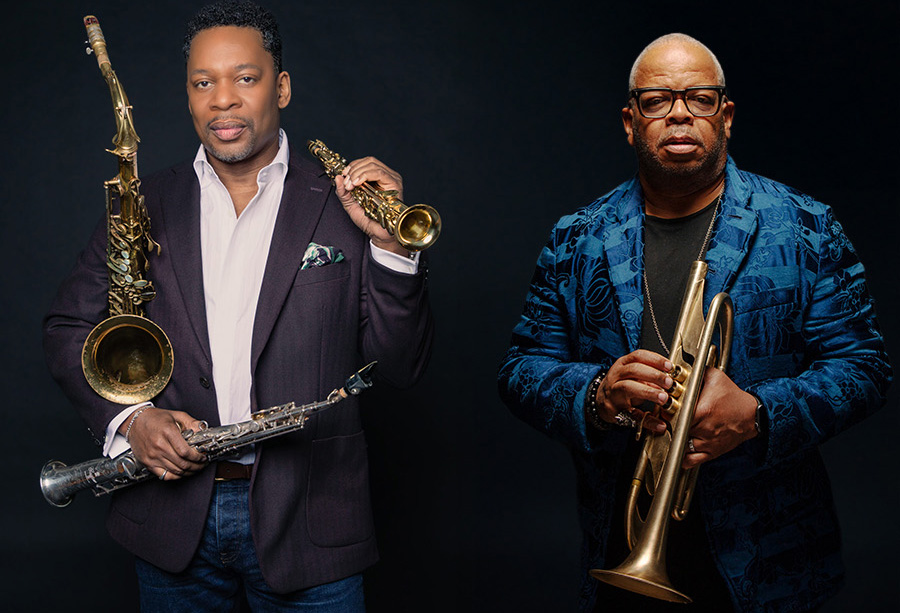
As saxophonist Ravi Coltrane and trumpeter Terence Blanchard embark on a tour celebrating the 100th anniversary of jazz legends Miles Davis’ and John Coltrane’s births, Ravi Coltrane says “the real plan is not to try to recreate the past.”
This story is part of a series about arts and culture in Washtenaw County. It is made possible by the Ann Arbor Art Center, Destination Ann Arbor, Larry and Lucie Nisson, the University of Michigan Arts Initiative, and the University Musical Society.
As saxophonist Ravi Coltrane and trumpeter Terence Blanchard embark on a tour celebrating the 100th anniversary of jazz legends Miles Davis’ and John Coltrane’s births, Ravi Coltrane says “the real plan is not to try to recreate the past.”
For the first stop on their tour, Coltrane, Blanchard, and a handful of other jazz musicians will stop Feb. 15 at Hill Auditorium, 825 N. University Ave. in Ann Arbor, for a show hosted by the University Musical Society (UMS).
Ravi Coltrane (named for renowned sitar player Ravi Shankar) is the son of Alice Coltrane, a jazz pianist/harpist, and John Coltrane, who passed away when Ravi Coltrane was two.
“I don’t spend my time thinking, ‘I’m the son of John Coltrane, so I have to do X, Y, and Z and avoid A, B, and C,” he says.
He says it’s a crucial approach “that every artist needs to take: finding what resonates with them as individuals, and moving toward that.”
But it also casts the centennial tour itself in a funky, apparently paradoxical light. As a celebration of their predecessors’ work, Ravi Coltrane and Blanchard will play arrangements of tunes associated with Davis and John Coltrane. But, Ravi Coltrane says, “We’re not trying to emulate them and recreate what they did.”
It’s also an approach very much in line with both John Coltrane’s and Davis’ own, “where you don’t look back,” Ravi Coltrane says. Instead, he says, “you look inward and then you look forward to try to create something that’s personal and unique to the moment and to oneself.”
“It was kind of a mantra at the time,” Ravi Coltrane says: “You have to play like yourself; you have to find your own voice. It’s really the goal of this music.”
But how do you maintain your own voice at the same time you’re trying to pay homage to another artist?
“Put the homage part in the back,” Ravi Coltrane says. “Keep the focus squarely on what we’re doing in the present — today. The homage part is kind of built in.”
“There’s a balance,” he acknowledges, “but we still have to lean into the moment and lean into ourselves as players.”
For any artist, Ravi Coltrane says, pushing in a new direction “is often easier said than done. We all struggle. We all have our challenges in finding what our voice and our creative purposes are.”
Ravi Coltrane calls Blanchard, with whom he’s frequently collaborated, “one of my heroes.”
“I often say, ‘When I grow up, I want to be Terence Blanchard.'” Ravi Coltrane says. ” …He’s one of the coolest dudes you will ever meet, and being around that energy — it lifts you up, brings up your spirit.”
Ravi Coltrane started out on clarinet, which he played through junior high school and most of high school. In his last year of high school his mother gave him a soprano sax as a birthday present.
Alice Coltrane “never pushed music on any of her children,” Ravi Coltrane says. “She wanted us to find our own directions, whether they be in music or something else.”
He says the sax “was probably the closest hint” she gave as to which direction she thought Ravi would be suited, and he understood it in this way: “Expand your ideas of what’s possible.”
“Music has a great power, and when you tap into it, or when it taps into you, … whatever the process is, it’s a very powerful thing. It kind of consumes you and takes over your life,” Ravi Coltrane says.
As for Davis and John Coltrane, “the work is timeless,” Ravi Coltrane says. “We’re still basking in the light of their efforts. … It’s something that we carry with us wherever we go, all the time.”
Author

Related Articles
From building a train to hosting an alpaca, this U-M facility serves student performers’ needs
For about 50 years, the University of Michigan’s Student Theatre Arts Complex has been quietly providing crucial pre-production support to student-run theater and other performance groups.
Nude Noir brings “celebration of the human form” to Ann Arbor’s Michigan Theater
Nude Noir attendees are invited to roam the Michigan Theater as performances — from burlesque and drag to aerialists and contortionists — unfold around them.
UMS to bring jazz, puppets, square dancing, and more to latest Ypsi residency
The University Musical Society (UMS) will return to Ypsilanti’s historic Freighthouse this fall for a nearly three-week residency.


