
How does public art influence perception of downtown Ann Arbor?
Public art is playing a growing role in how people experience Ann Arbor’s downtown, not just as decoration but as an integral part of what makes the district special and memorable to visitors.

This story is part of a series about arts and culture in Washtenaw County. It is made possible by the Ann Arbor Art Center, Destination Ann Arbor, Larry and Lucie Nisson, the University of Michigan Arts Initiative, and the University Musical Society.
Public art is playing a growing role in how people experience Ann Arbor’s downtown, not just as decoration but as an integral part of what makes the district special and memorable to visitors. Hannah Kirkpatrick, director of the Art in Public program at the Ann Arbor Art Center (A2AC), says murals and installations can influence how residents and visitors move through the city and how they feel about the spaces they encounter.
“Public art helps orient people as a wayfinding tool and adds to placemaking,” Kirkpatrick says.

Placemaking, as defined by the national nonprofit Project for Public Spaces, is a collaborative, community-driven process that reimagines and redesigns public spaces to improve urban vitality, health, and happiness. In Ann Arbor, Kirkpatrick says murals have become one of the most visible ways that concept takes shape.
A2AC’s Art in Public initiative, made possible through the support of Lucie and Larry Nisson, oversees mural and alleyway installations across the city. Through partnerships with artists, business owners, and property owners, the program has helped transform blank walls into landmarks that influence how people understand downtown Ann Arbor.
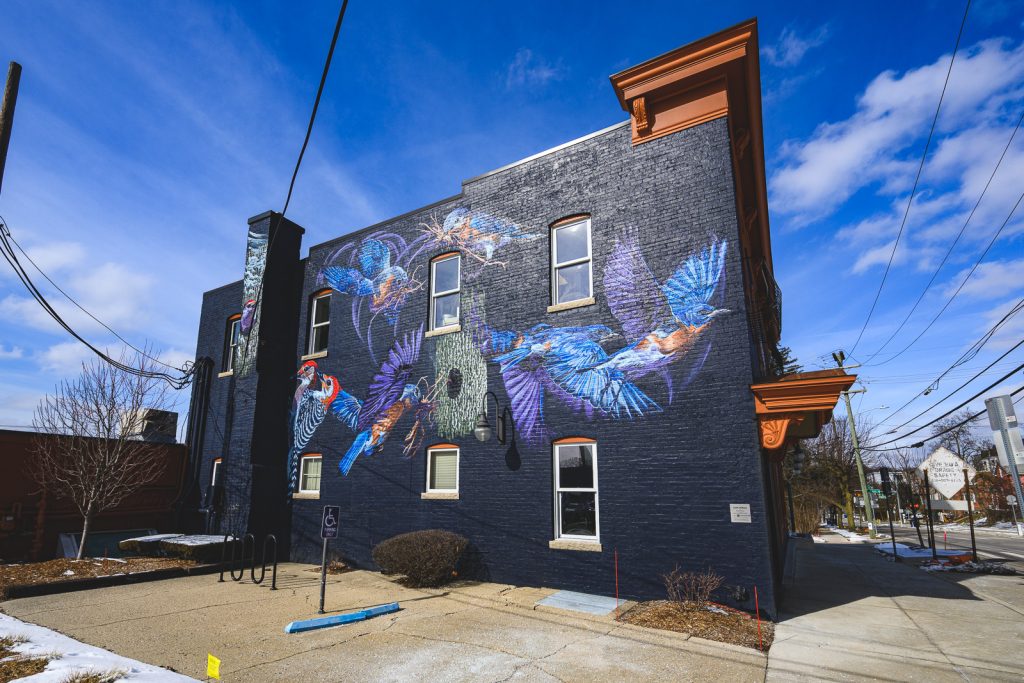
For property owners, the impact of public art often becomes clear once a mural is installed. Tyler Kinley, president of Praxis Properties in Ann Arbor, partnered with A2AC to install a mural on the Phoenix West building at 117 N. First St. in Ann Arbor. The piece, titled “Symbiosis of the Red Bellied Woodpecker & the Eastern Bluebird,” was painted by muralist Jacob Dwyer. It depicts two birds sharing a nesting space, a metaphor Kinley says resonated with tenants and passersby alike. Kinley says murals have the power to reshape how people remember a place.
“Public art creates a sense of a place,” he says. “It creates a different type of memory of a place than simply a blank white wall might.”
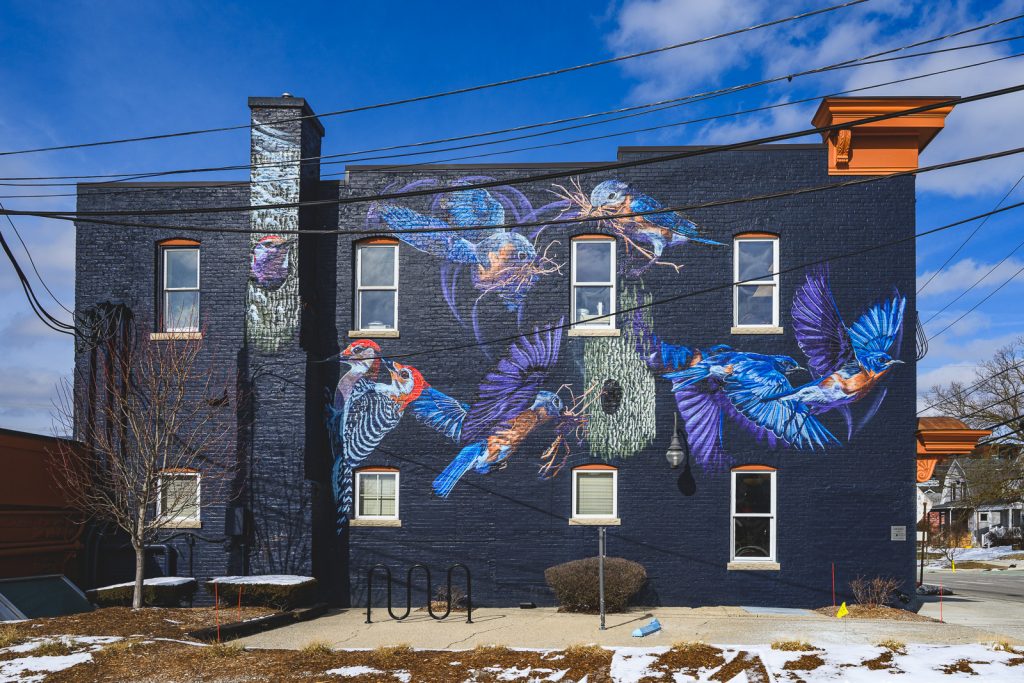
Kinley adds that murals often serve as informal landmarks, helping people navigate downtown while also forming emotional attachments to the spaces around them.
“When you’re wayfinding in a downtown space, something as striking as a mural creates a different connection to a place and a different vibe,” Kinley says.
Kinley says the mural on his building has prompted feedback from tenants and visitors who now refer to the structure as “the building with the birds,” illustrating how art can quickly reshape a structure’s identity. He says the appeal of murals is also practical. Compared with large development projects, public art can change how a space feels at a relatively modest cost while still having a strong visual impact.
“It dramatically changes the energy of a space,” Kinley says.
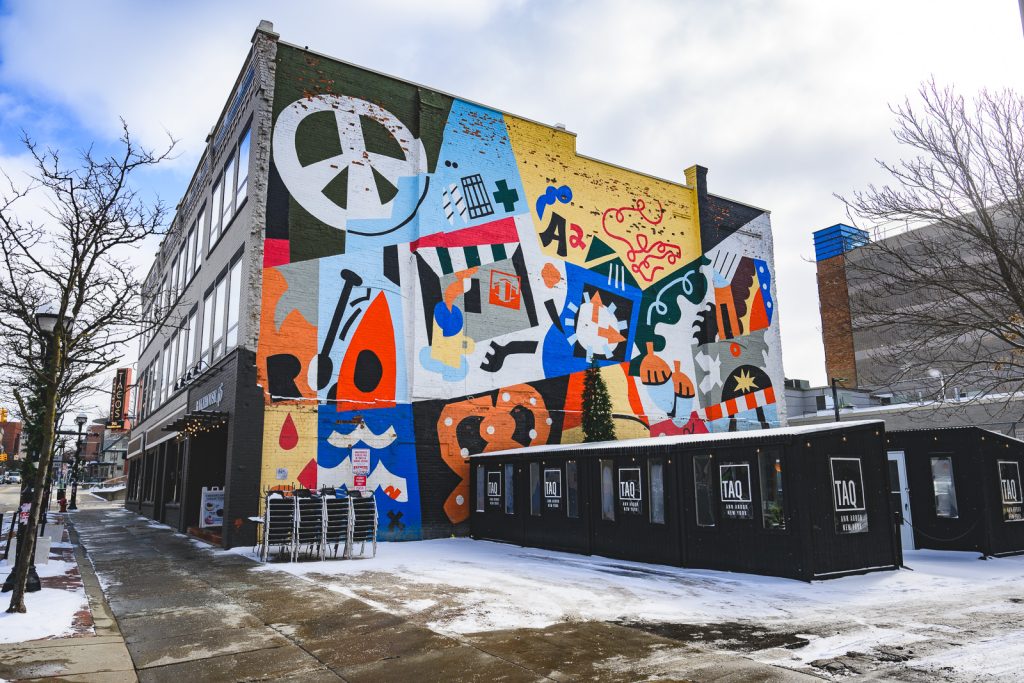
Another downtown property owner who has worked with A2AC is Edward Shaffran of Shaffran Companies. Shaffran says his interest in public art grew from conversations with local arts supporters and from recognizing how murals could make buildings more inviting. One of his most visible collaborations is the mural painted by Jesse Kassel at the Pretzel Bell building on East Liberty Street in Ann Arbor, which depicts a stylized collage of community-related symbols.
“It becomes a conversation piece,” Shaffran says. “It’s something different and looks nice. It brings attention to art in general.”
He says the installations also function as a form of community investment, even when they don’t directly influence spending at Shaffran’s or his tenants’ businesses.
“I don’t make money off people walking by saying the mural is nice,” Shaffran says. “But it isn’t about that. This is about giving back to the community.”
Both Kinley and Shaffran say public art contributes to downtown identity in ways that go beyond aesthetics. Murals can become meeting points, navigational markers, and visual symbols tied to the city’s culture. For Kirkpatrick, that shift in how people experience a space is at the heart of placemaking. She says murals often signal that a city is investing not only in development but in the experience of being there.
“It shows there’s care and intention in the space,” she says, adding that the installations often inspire creativity, spark conversations, and encourage people to linger longer in an area. She says feedback from mural tours frequently reinforces that idea, especially from residents returning to Ann Arbor after time away.
“Some people say they moved back here recently and these murals are really changing the look of downtown,” Kirkpatrick says.
As new public art projects continue to be proposed in Ann Arbor, Kirkpatrick says interest from property owners and community members suggests that public art is becoming an expected part of how the city grows.
More information about A2AC’s Murals and Alleys programs is available here and here. A map of all current murals, including “Symbiosis of the Red Bellied Woodpecker & the Eastern Bluebird” and the Pretzel Bell Building mural, can be found here.
“People are recognizing how much value art adds to an area,” Kirkpatrick says. “It makes a place feel more welcoming and builds placemaking and community and uniqueness.”
Author

Related Articles
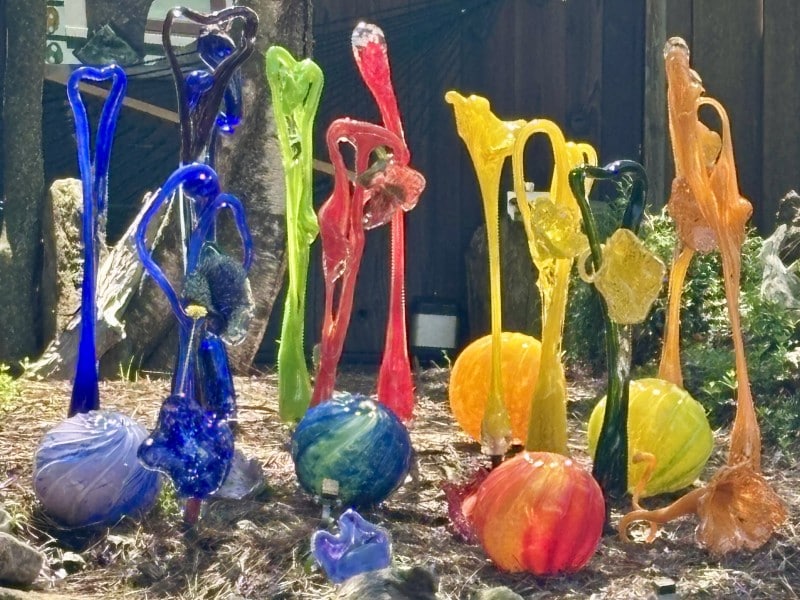
Ann Arbor artist hosts annual outdoor sale to benefit public art program
Glass artist Larry Nisson hosts an annual sale of his work from noon to 5 p.m. on Sept. 27 at his Ann Arbor home.
The Ann Arbor Symphony Orchestra brings its concert series to Ypsi for the first time
The 2026-27 season offers many firsts for the Ann Arbor Symphony Orchestra, from an Ypsilanti footprint to a live accompaniment of Disney’s ‘Frozen.’
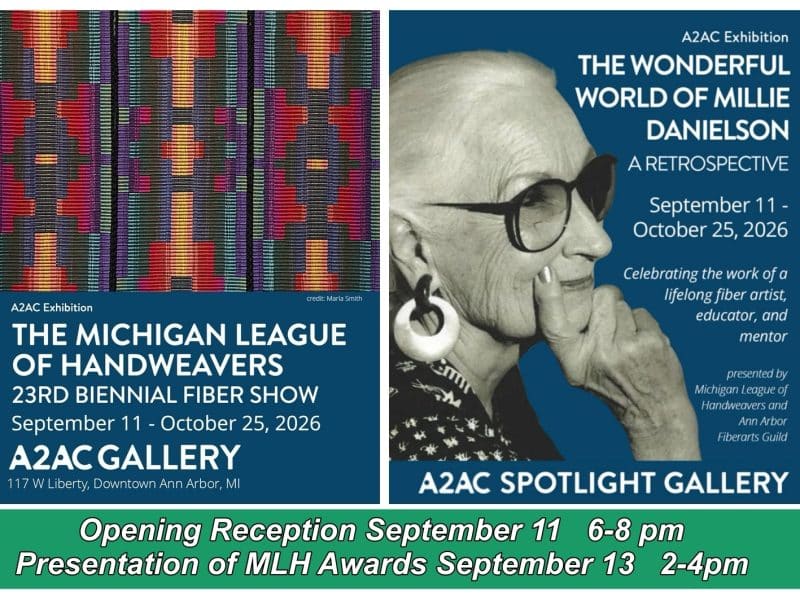
Michigan League of Handweavers’ biennial show in Ann Arbor will feature myriad disciplines
From weaving to doll-making, a broad range of craftsmanship will be featured in both exhibitions and public demonstrations at the Michigan League of Handweavers’ 23rd Biennial Fiber Show.


