
10 pianists to perform all 20 of Philip Glass’ piano études in Ann Arbor show
A single evening will bring together 10 pianists, 20 short compositions, and a wide spectrum of musical voices.
This story is part of a series about arts and culture in Washtenaw County. It is made possible by the Ann Arbor Art Center, Destination Ann Arbor, Larry and Lucie Nisson, the University of Michigan Arts Initiative, and the University Musical Society.
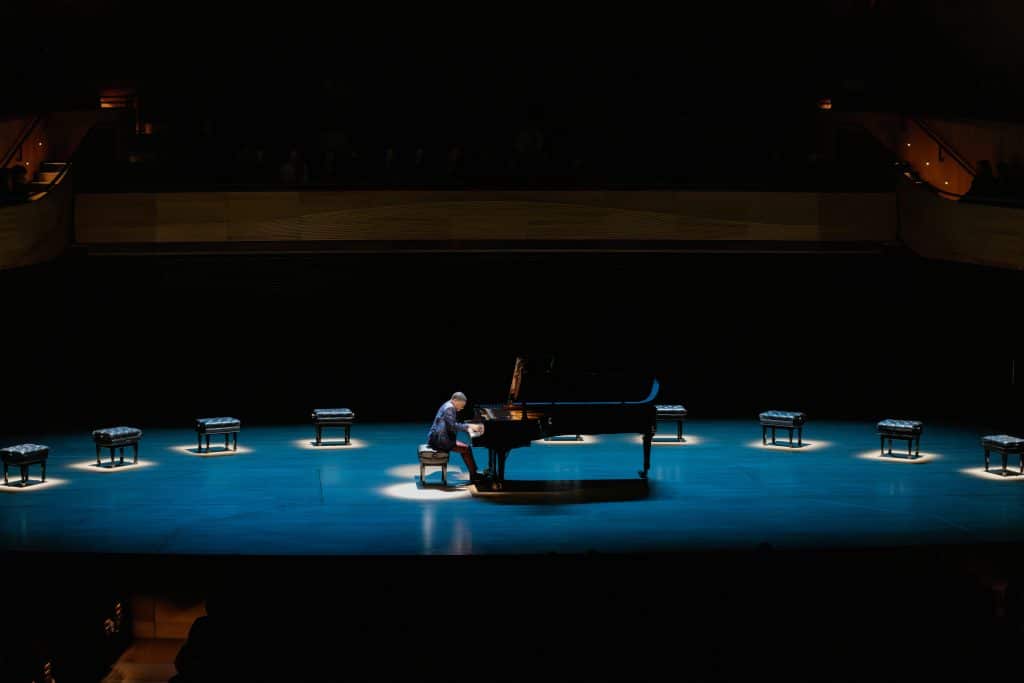
A single evening will bring together 10 pianists, 20 short compositions, and a wide spectrum of musical voices as the University Musical Society (UMS) and the Kalamazoo-based Gilmore Piano Festival present a performance of composer Philip Glass’ complete piano études. The program, which will take place at Hill Auditorium in Ann Arbor on April 18 at 7:30 p.m., offers a rare opportunity to hear Glass’ études interpreted by a wide range of performers. The concert will also be streamed live at ums.org/live, and will be available on demand for a 10-day period following the live performance.
Glass, a highly influential American composer and pianist, is known for his minimalist, repetitive style and his many operas, symphonies, and film scores. Études are musical compositions designed to help musicians practice a particular skill, and Glass composed his études over many years as exercises to improve his own technique. However, they have since come to be viewed as some of his most personal works.
For pianist Janice Carissa, a Gilmore Young Artist award recipient who will perform in the April 18 show, that openness translates directly into performance.
“These études are only convincing or not. There’s no right or wrong way to play it,” she says. “You’ll hear a lot of different personalities come through.”
Carissa says the project’s collaborative structure is what initially drew her to it.
“It’s such a unique opportunity,” she says. “Every étude is very different, and every pianist that plays them brings their own twist to the narrative.”
The April 18 performance will feature each pianist performing two études. Carissa will perform Études No. 3 and No. 4, which she describes as contrasting in character. One, she says, carries a “raw, passionate energy of resilience,” driven by an insistent, almost meditative pulse that builds toward a cathartic release. This will be Carissa’s second time performing the two études.
The concert’s format, with pianists rotating through the études in near-continuous succession, creates what Carissa describes as a very “immersive listening experience” as both a musician and as an audience member. Rather than a traditional recital, the evening unfolds as a kind of evolving soundscape shaped by multiple perspectives.
“It’s almost a kaleidoscope,” she says. “You’re looking at this image, but if you tilt it, it refracts light very differently.”
Glass’ signature use of repetition and shifting musical structures presents both a challenge and an opportunity for performers. Without a single prescribed interpretation, pianists are encouraged to experiment and discover their own approach.
“With Philip Glass, the umbrella doesn’t exist. You create it yourself,” Carissa says. “There’s no right or wrong. There’s just what you believe in at the moment.”
That freedom, she adds, allows performers to engage with the music in a more exploratory and even playful way, revisiting pieces with fresh ideas each time.
“If I wanted to hear things exactly how they were meant to be played, I’d listen to a recording,” she says. “You can’t feel something new if you’re not willing to play.”
For Carissa, bringing together pianists with diverse musical backgrounds further expands those possibilities of exploration and play. She notes that while her classical education greatly informs the way she plays and performs, working with and listening to the other performers in this project has reminded her of her history of performing in jazz settings, and has allowed her to see both Glass’ music and the act of creation in a different light.
“It’s not often you’re backstage with 10 pianists,” she says. “Everyone has their own specialty, and seeing it played has allowed me to tap into this forgotten side of me.”
Tickets and more information about the performance can be found at UMS’ website.
“Buckle up. It’s going to be a rollercoaster,” Carissa says. “There’s so much nuance in each piece. Be open. Have fun.”
Author

Related Articles
Ann Arbor artist hosts annual outdoor sale to benefit public art program
Glass artist Larry Nisson hosts an annual sale of his work from noon to 5 p.m. on Sept. 27 at his Ann Arbor home.
The Ann Arbor Symphony Orchestra brings its concert series to Ypsi for the first time
The 2026-27 season offers many firsts for the Ann Arbor Symphony Orchestra, from an Ypsilanti footprint to a live accompaniment of Disney’s ‘Frozen.’

Michigan League of Handweavers’ biennial show in Ann Arbor will feature myriad disciplines
From weaving to doll-making, a broad range of craftsmanship will be featured in both exhibitions and public demonstrations at the Michigan League of Handweavers’ 23rd Biennial Fiber Show.


