
The University of Michigan has stopped gender-affirming care for minors. Here’s how that affects local trans youth.
Michigan teenagers are now seeking alternative sources of treatment after the University of Michigan ended gender-affirming health care for minors.
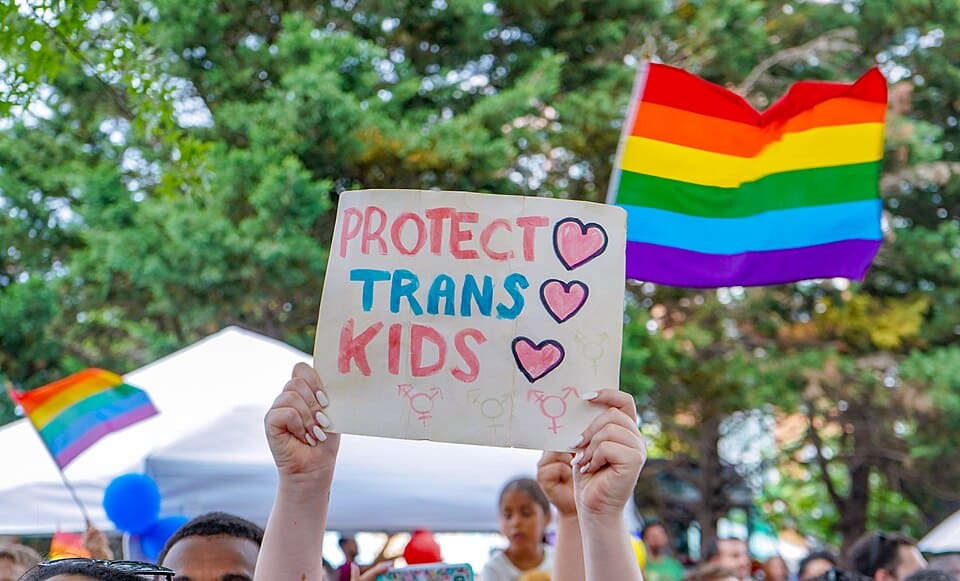
This article is part of Concentrate’s Voices of Youth series, which features stories written by Washtenaw County youth with guidance from Concentrate staff mentors, as well as adult-written stories spotlighting local youth perspective. In this installment, student writers Jihyun Ko and Tova Weiss report on the impact of the University of Michigan ending gender-affirming care for minors.
Ann Arbor Pioneer High School senior Fenn R. (surname abbreviated at his request to protect his privacy) was sitting at home when an email from the University of Michigan’s gender clinic arrived in his inbox. He had gone to Michigan Medicine earlier this year for menstrual suppression, a treatment he used to ease gender dysphoria. During the last few months, Fenn had started to consider beginning hormone therapy treatment (HRT) to receive testosterone with his parents’ consent. Then, he received the message.
“It basically was announcing the recent policy change,” Fenn says. Under Michigan Medicine’s new policy, he cannot start hormone therapy until he is 18, adding that, even then, scheduling complications could postpone treatment further. “Even if I can legally start at 19, I might not till I’m like 20 or 21.”
Fenn R. is one of the Michigan teenagers now seeking alternative sources of treatment after the state’s largest academic health institution terminated the distribution of principal forms of gender-affirming health care for minors.
The context of Michigan Medicine’s decision
On August 25, 2025, the University of Michigan’s (U-M) public affairs office and Michigan Medicine posted statements announcing the health system would no longer provide puberty blockers or gender-affirming hormone therapy for minors, citing a federal subpoena and what it described as “escalating legal and safety risks.”
Michigan Medicine said it was among multiple institutions nationwide that received a subpoena as part of a criminal and civil investigation into gender-affirming care. “In light of that investigation,” the statement said, the institution would cease distributing those medications to minors.
The announcement came amid a broader federal ban against providers. In July 2025, the U.S. Department of Justice said it had issued subpoenas to doctors and clinics involved in providing gender-related medical care to minors, including investigations into potential health care fraud and other allegations. An Associated Press report later outlined subpoenas that sought extensive patient and employee information from more than one hospital, prompting concern among privacy and civil rights advocates. The result has been a sudden cutoff of gender-affirming treatment in Michigan despite its continued legality.
“The University of Michigan’s decision … has had a devastating impact on the trans community and their families,” says Emmy Zanotti, senior director of movement building and political affairs for the Equality Michigan Action Network. She points to patients who now traveled across Michigan, including to the Upper Peninsula, due to a lack of facilities in Ann Arbor.
While Michigan Medicine justified its decision as a matter of compliance with federal mandates, Zanotti says that there is an underlying civil rights case.
“These kids are the ones whose rights are being trampled on at the end of the day,” she says, arguing that large institutions like U-M have more leverage than they chose to employ in resisting the federal directive.
Gender-affirming care in practice
Gender-affirming care is an umbrella term that can include mental health support, primary care, social transition support, and, for some adolescents, medications such as puberty blockers (clinically referred to as puberty suppression) or gender-affirming hormone therapy.
The American Academy of Pediatrics has supported access to “comprehensive gender-affirming and developmentally appropriate health care,” and the Endocrine Society’s clinical guidance explains that these treatments are specialized, involving constant assessments and monitoring.
Sarah Wiener, a clinical social worker who has worked with transgender young people since 2011, adds that clinicians generally rely on WPATH standards – research-based clinical guidelines for treating transgender patients – when evaluating minors for puberty suppression or hormone therapy. “The guidelines are clear about the criteria,” she says.
For Fenn, his journey to therapy has entailed a sequence of appointments and decisions. He says his initial goal was menstrual suppression, and he continues to have access to those treatments. But the clinic’s new limits, he explains, were a hard stop on the next step he had begun preparing for.
“The waiting lists and the process for that kind of stuff is usually really extensive,” he says. “It takes a long time to really get any form of gender-affirming care.”
Zanotti says that the abrupt policy changes also undermined the need for continuous treatment.
“When you have a good provider, you should be able to continue to see them,” she says. “So having that interrupted is gross and dangerous in and of itself.”
A clinician in Michigan Medicine
John Randolph, a professor of obstetrics and gynecology at the University of Michigan and a subspecialist in reproductive endocrinology, has been involved with Michigan Medicine’s Comprehensive Gender Services Program since its inception in 1994.
While Randolph focuses on adult clinical treatment, he believes that Michigan Medicine’s August decision had and will continue to have an effect throughout the institution, both for patients and providers.
“Fortunately, so far what has happened has not directly impacted my practice and my patients,” Randolph says. “But they certainly have been impacted by the stress involved in, and the worry of what may be coming down the road. And I worry about that every day.”
Randolph believes that, from a medical perspective, the most significant distinction in gender-affirming care for minors is whether a patient has begun puberty.
“Biologically, that’s a real big divide,” he says. “For gender-nonconforming individuals who would like the option of directing how their bodies develop with puberty, the capacity to delay puberty to allow time to consider what the right decision is, that’s a very big distinction from what we deal with with adults.”
For adolescents who have already undergone puberty, Randolph says the medical approach is “essentially the same as with adults,” adding that legal consent requirements are the primary distinctions between adolescent and adult treatment.
Randolph says the withdrawal of services creates a degree of strain for providers.
“In some ways it’s almost worse than what it was before,” he says. “It was available and then it was snatched away. Losing something, in some ways, is even worse than never having it in the first place.”
He adds that clinicians have expressed deep concern about the mental health implications for patients in the aftermath of the decision. “I truly worry about the safety of so many of these individuals,” Randolph says. “The frustration, the sadness, the stress. All of that weighs heavily.”
Wiener, from a clinician’s perspective, adds that losing access to care can send a damaging message to young people. Older children, she says, may wonder why they cannot see their doctor and internalize it as evidence that “there is something wrong with them.” She says adults should make clear that there is nothing wrong with being transgender or needing gender-affirming care.
Randolph emphasizes that the decision was heavily deliberated within Michigan Medicine. “Lots of tears have been shed over this from caregivers,” he says. “People really, really do care and are very upset with how things have shaken out.”
He explains that, in the current, unpredictable environment, clinicians are balancing various legal and medical requirements. “It gets really complicated,” he says.
The legal backdrop
The politics surrounding adolescent gender-affirming care have grown increasingly divisive over the past several years, and not only in the United States. In the United Kingdom, for example, the National Health Service England moved away from a standard prescription of puberty blockers for patients under 18 with gender dysphoria, pointing to limits in evidence and suggesting that “access should instead be through clinical research.” In late 2024, the UK government said it would make restrictions on puberty blockers indefinite, citing expert advice that “there is currently an unacceptable safety risk in the continued prescription of puberty blockers to children.”
Those decisions have not been made without dispute. A Yale affiliated policy critiqued the Cass Review’s approach to evidence assessment as flawed and argued that it should not be considered as a basis to restrict treatment.
In the United States, the legal terrain has also altered. By mid-2025, the Supreme Court upheld a state ban on certain gender-affirming care for minors in Tennessee, a ruling widely viewed as giving states greater latitude on restrictions. At the same time, President Donald Trump’s administration’s decisions and agency statements have signaled increased federal scrutiny of providers, including warnings that Medicare and Medicaid could be revoked. Advocates say this move prompts health facilities to limit or reassess services even in states without a ban, “citing sustainability concerns and the ongoing risks of losing federal funding.”
By December 2025, Democratic-led states sued the U.S. Department of Health and Human Services over a declaration describing treatments including puberty blockers and hormone therapy as unsafe for children and possibly excluding them from federal health programs.
Zanotti says the goal is to make care harder to access. She draws a parallel with reproductive health care.
“The less accessible it is, the more dangerous it becomes or the less safe it becomes,” she explains.
Ripple effects across the industry
Michigan Medicine is not the only major institution to scale back gender-affirming care in response to federal mandates. In September 2025, Corewell Health, one of Michigan’s largest health establishments, announced it would end puberty blockers and hormone therapy for minors, explaining the move was motivated by legal and regulatory ambiguity.
Nationally, other hospitals have followed suit. For example, the Washington Post reported that Children’s National Hospital in Washington, D.C. planned to end gender-transition medication for minors.
For advocates, the concern is not only the immediate impact on patients, but the precedent it establishes. Wiener says that, for many patients she serves, the concern goes beyond the minors who are directly being affected. Even transgender adults, she says, are anxious that their care could be restricted, or that their providers may consider it too difficult, despite its legality in Michigan.
“It puts these health care systems in a really hard spot,” Zanotti says, but she adds that those constraints “mean nothing to the trans community” if services are curtailed.
A Michigan Public report said families “have been reaching out” to Stand with Trans, a Michigan organization supporting trans youth and their families, after Michigan Medicine’s announcement. Stand with Trans Executive Director Roz Keith told Michigan Public, “Emails, messages, phone calls – it’s been pretty much off the hook all day.”
Gender care pathways after the decision
Zanotti says families have attempted to safeguard available services, including “exit appointments” and last-minute prescriptions. She emphasizes that access will not end completely, but that pathways to care will be more individualized.
Instead of a public list of providers, she says, families may increasingly need to connect through advocacy and community organizations to find clinicians, while also protecting those clinicians from harassment and legal jeopardy.
Equality Michigan Action Network describes its mission as engaging and educating lawmakers and voters, and advocating for equality regardless of sexual orientation, gender identity, or gender expression. Equality Michigan is its affiliated nonprofit.
In Washtenaw County, Corner Health, a youth-focused clinic based in Ypsilanti, issued a statement after Michigan Medicine’s announcement, saying it would remain committed to providing gender-affirming care for current and new patients. Corner Health describes itself as a health center for adolescents and young adults, with services including primary and behavioral support.
For teenagers like Fenn, this decision has implications deeper than many people realize. He describes the impact of dysphoria. “It’s harder to go out, make friends, do the activities that you enjoy,” he says. “It’s hard to feel confident in your body.”
If he could speak directly to Michigan Medicine executives, he says, he would ask them to consider their patients’ need for treatment alongside the potential legal penalties.
“I’m a little disappointed that U of M caved so quickly,” he says. “I think they have a responsibility to their patients to give them the care that they need.”
In schools
Cianna Chen, youth member of the Corner Health Youth Leadership Council, believes that Michigan Medicine’s decision shows the gradual attrition of transgender youth’s rights.
“This is concerning and frankly lacks some empathy, as transgender youth specifically have been increasingly stripped of their rights across the U.S.,” Chen says. “How someone deals with identity medically, no matter what age, should only be the business of their doctor and them.”
At the same time, Michigan is in the midst of renewed debate over students’ health education regarding LGBTQ+ identities and relationships. In November 2025, the Michigan State Board of Education approved updated Health Education Standards, the first major update since 2007. The Michigan Department of Education emphasized that the standards are a guidance, not a mandate, and are intended to help districts align their curriculum with current best practices.
Supporters have argued that updated standards allow districts to provide more accurate, relevant content such as in mental health and substance use. Opponents have argued that standards impact practices and can intensify conflicts over topics such as gender identities.
Deekshitha Ravu, a sophomore at Huron High School, says that health class had not been “detailed enough to apply outside of class.”
She says she doesn’t “remember most of what we learned in health class,” and that “I think we went over LGBTQ – like, you know, what it stands for, but nothing else.”
Taryn Gal, executive director of the Michigan Organization on Adolescent Sexual Health, explains that public debate over Michigan’s health education standards has been fueled by “myths” about the standards.
“The standards are not required,” Gal says. “They’re not curriculum, they’re not law. They are just guidance.” Michigan education officials have similarly explained that districts maintain “local control” and parents retain opt-out rights for sex education.
Response from state leadership
In Michigan, Democratic state leadership has emphasized nondiscrimination protections for LGBTQ residents. Gov. Gretchen Whitmer signed legislation in 2023 expanding the Elliott-Larsen Civil Rights Act to include protections for gender identity.
After Michigan Medicine’s August announcement, Attorney General Dana Nessel reissued guidance to health care providers and patients, reiterating that Michigan law does not ban gender-affirming care for minors.
Still, advocates have argued that states’ defenses can conflict with federal investigations and funding withdrawals.
Public implications
Fenn says it can be easy to regard transgender health care as affecting only a minority group.
Trans people make up 1% of Americans age 13 or older. Despite the fact that that statistic can sound negligible, Fenn points out that, “1% of, say, the global population is a huge amount of people.”
“Even if it doesn’t seem like it’s impacting that many people, trust me, it is,” he adds.
He also warns that U-M has set a precedent. If legal coercion can drive a major health institution to end a legal service, he says, other treatments are also vulnerable to politics.
“It’s a more general sign that our country is … heading downhill in terms of health care and just human rights as a whole,” he says.
For Zanotti, there is an immediate need to provide treatment, as well as the long-term question of whether health care systems can collectively resist political liabilities.
“Where the administration seems hellbent on destroying everything we have,” she says, “I know this community is … significantly more focused on building.”
Concentrate staffer Patrick Dunn served as Jihyun and Tova’s mentor on this article.
To read more from the Voices of Youth series, click here.
Related Articles

Expanded mental health crisis services have big results in Washtenaw County
Washtenaw County is serving more people experiencing mental health crises, as well as reducing arrests and hospitalizations, through two new mental health crisis response services.

How Medicaid supports early education and child development
Experts in Ann Arbor say health care access is inseparable from academic success.

Inaugural State of the County address celebrates Washtenaw County’s recent achievements
The event marked the county’s bicentennial and looked back at its pre-colonization roots while highlighting recent government achievements.


