
Tall Vs. Wide
To build up or spread out? That is the question. With plans for a 26 story high rise near U-M’s campus, some locals are protesting that Ann Arbor is no place for big buildings. Supporters, however, point out that it’s a text book case of smart growth: increase the density of the core while restoring the student ghettos to family friendly neighborhoods. Concentrate looks at both sides of the argument.
There isn’t much Jordan Gonzalez can do to his front yard to make it more stereotypically student. It has all of the tell-tale trademarks of an
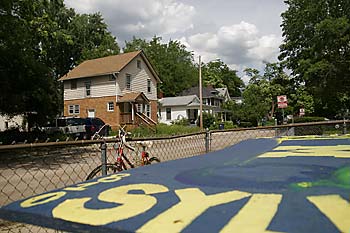
But the coup de grace is the large beer pong table stationed prominently out front. It sits above overgrown grass supported by an end table on one side and a desk on the other. The address of the house is painted on top in maize-and-blue to help protect it from theft.
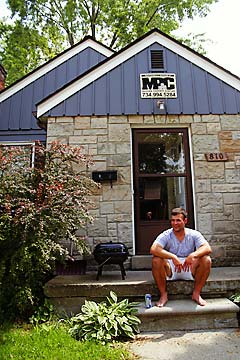 Four people live in the small three-bedroom bungalow on
In fairness, Gonzales’ abode is pretty tame in comparison to the stereotypical Animal House-style student rental. It serves its purpose as a cheap place to live relatively close to campus.
“I just want my own house with my own room and my own kitchen,” says Gonzales, a junior at the
Diana Johnston also just wants her own home. The educational consultant lives in a strikingly beautiful Victorian home on a hill that is practically surrounded by fraternity houses.
A tall, dense wall of cedar trees hides a manicured lawn lined with carefully pruned flowerbeds. It also blocks the view of a frat house across the street that has replaced its front yard with Astroturf. Nearby is a frat house with boarded up windows and another where students take bong hits on the front porch.
The behavior of
 Johnston
“They’re poorly kept and maintained,”
Shrinking the student ghetto
That scenario just might play out for some townies living on edge of the student ghetto. More than half a dozen high-rise rentals targeting mostly students are either planned for or under construction in
All of these buildings promise to add thousands of beds to a rental market where 54 percent of its residents are renters but only 43 percent are in multi-unit dwellings. Rental vacancy rates for the city typically hover around 3 percent. The prevailing conventional wisdom is this flood of new housing will cause the student ghetto to do something it hasn’t done in decades – contract.
 Student housing has progressively sprawled away from the campus, gobbling up single-family homes occupied by families for as long as anyone can remember. Those homes either become year-long boarding houses for the 18-22 crowd or are torn down to make way for bland apartment buildings. Most of those buildings receive lots of tenant turnover, even more wear and tear and little improvement.
Margaret Dewar is also surrounded by the type of student housing that habitually drives townies crazy. The U-M professor of urban and regional planning is hopeful that projects like 601 Forest
“In general that housing is not very well maintained,” Dewar says. “The students tell me those types of substandard living conditions aren’t a pleasant way to live.”
High-rise rental units could very well spell the end of that type of housing thanks to the basic principals of supply and demand, or so thinks Jeff Helminski.
Helminski is the man behind The Madison development, a 14-story high-rise proposed just south of downtown overlooking Madison Street and Fingerle Lumber Co. Although he is targeting young professionals for The Madison’s 161 apartments, it’s still only a few steps from central campus. Helminski can easily see some students (mostly graduate-level) taking up residence there.
 He points out building all of the proposed high-rises could create an apartment commodity. That glut would be magnified in the thousands of units aimed at students with wealthy parents that charge upwards of $1,000 a bed.
“How deep is that market?” Helminski says. “I don’t know but I am going to guess that 601
Once it’s reached prices will fall, making luxury high-rise living accessible to more students. Many of them in theory would choose to live closer to campus if the price is competitive. That could cause more of the student-housing slumlords to make decisions they haven’t had to make before: find new clientele or sell.
“The value of those old homes goes down and they will have to start putting money into them, which nobody has had to do for 20 years,” Helminski says, adding such a situation is a recipe for some of those homes to revert back to single-family houses.
Changes in scenery
Many townies would cheer such a contraction of student housing but such a scenario doesn’t come without costs. Many decry the city’s changing skyline. They say it takes away from Ann Arbor’s small, college-town charm and disrupts its neighborhoods.
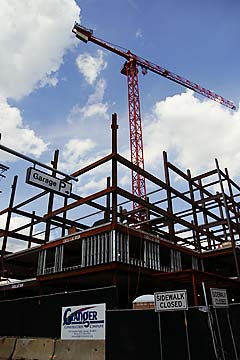 Ray Detter, a downtown-area
“
The fear is that the city’s beloved identity is susceptible to change from something as simple as an evolving skyline. It’s a fair point. Detter points out that people enjoy places like Kerrytown or the Old West Side because of their unique character. Plunking a high-rise down in the middle of those areas or tearing down historic buildings like the old Anberay Apartments to create Zaragon Place Lofts diminish such perceptions. Many people voiced similar concerns about the initial designs for 601
However, Detter doesn’t see a problem with such things as long as they are near other groups of high-rises and are aesthetically pleasing. He points out that the high-rise kitty corner from 601
“Height is an issue,” Detter says. “We’re all concerned about it no matter the impact. I’m not disturbed about height as long as it doesn’t negatively impact the neighborhoods. They (high-rises) shouldn’t be shutting out people’s light or creating wind tunnels.”
Pros of living it up
The positives to these types of developments hold great promise, especially in a progressive, environmentally conscious city like
First off, these buildings will significantly increase the tax base on small parcels without demanding a dramatic increase in services. For instance, building the 342 rental units in 601
High-rise buildings also help to create density downtown. All of those feet on the sidewalks drive up the demand for more businesses, such as grocery stores and retail outlets. That type of activity also makes for a more vibrant urban area that attracts young people, something
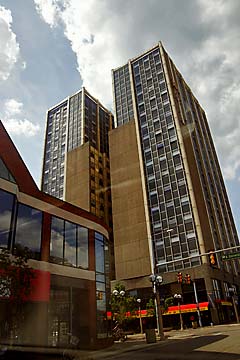 “A lot of it goes back to the idea of our stated needs to do more to attract and retain young professionals,” Helminski says. “That market is terribly underserved. … If you don’t want sprawl you need cities that are desirable for people to live in.”
And then there are the environmental considerations. Most of these buildings are promising to be greener than Kermit the Frog when it comes to environmental awareness and LEED ratings.
These buildings are also much more efficient when it comes to utilizing and sharing resources compared to the older housing stock of student rentals. The high-rises allow more people to live a car-less, or practically car-free lifestyle. they also provide an alternative for luxury living that isn’t named McMansion.
All of this will play a critical part in
“Change is inevitable,” Dewar says. “We have a choice between sprawl, destroying natural areas and increasing the amount people drive and pollute. Or we could have people live centrally and prevent a lot of that.”
Jon Zemke is the New Editor for Concentrate and Metromode. He is also a longtime Ann Arbor resident who misses the old Tree Town of his youth but is amazed at how quickly the city is growing up.
Photos:
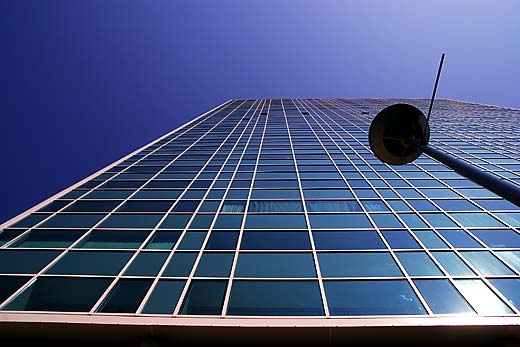
One of the Few Existing High-Rises in Ann Arbor-Tower Plaza
Jordan Gonzalez Sits on his Porch on Sylvan Street-Ann Arbor
The Ever Present Beer Pong Table Overlooks Sylvan Street-Ann Arbor
Margaret Dewar-Urban Planning Professor at U 0f M-(Photo Courtesy U of M)
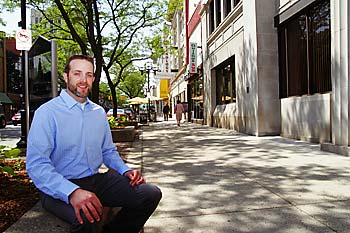
Jeff Helminski-Developer of The Madison-Ann Arbor
Building Up in Ann Arbor
South University Will Now Have Two High-Rises- Ann Arbor
All Photos by Dave Lewinski
Dave Lewinski is Concentrate’s Managing Photographer. He also shoots for Hour Detroit Magazine and Ambassador Magazine. He got a new camera this week.
Related Articles
As ICE comes to Ypsi, residents organize to protect neighbors and prevent misconduct
Community advocates are urging residents to organize, prepare, and support one another as enforcement actions become more visible and more aggressive.
Ann Arbor Comprehensive Land Use Plan approved by planning commission, advances to city council
Ann Arbor City Council will consider allowing massive land use changes intended to improve affordability in the city, following the Ann Arbor Planning Commission’s unanimous Wednesday night vote to pass the draft Comprehensive Land Use Plan 2050.
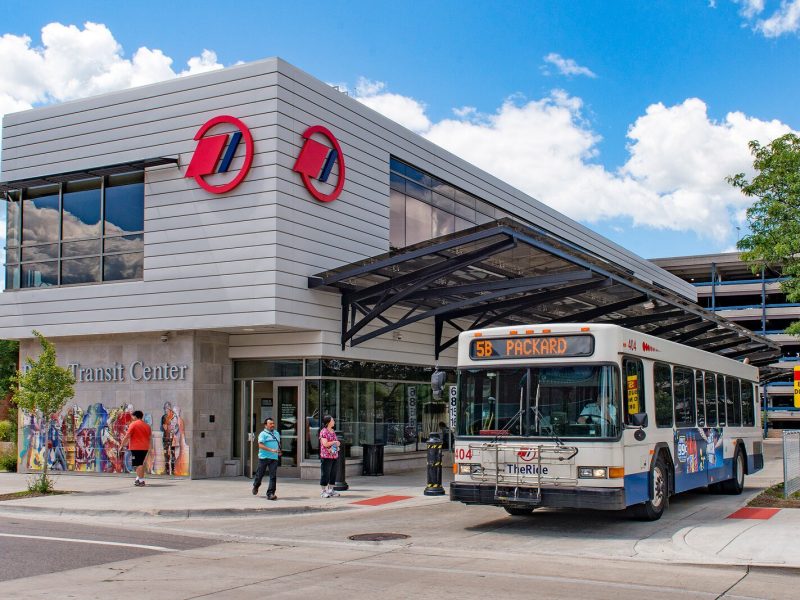
Ann Arbor receives $4.3 million grant for placemaking projects around Blake Transit Center
The city of Ann Arbor recently received a $4.3 million grant to fund placemaking projects as the block surrounding Blake Transit Center is redeveloped.


