
The Economic Upside Of Historic Preservation
Everything old is new again. And profitable. Historic preservation is more than just a longing for the old ways. It can be an economic driver for communities that know how to leverage what they’ve got with where they’re going.
 Matt and Kelly Grocoff picked the ugly ducking of houses when they bought their century-old Old West Side abode two falls ago. Most of the other house hunters who looked at it saw an old, dilapidated structure with all of the buzz words that make homebuyers run, like lead and asbestos.
Not the Grocoffs. They saw an opportunity to do something special at bargain rates. They saw history, and they made their own mark on it.
“It’s one of those things where people didn’t see what was beneath the lead paint and asbestos,” Matt Grocoff says. “You have a structure that has lasted 100 years and could easily last another 100 years if it’s maintained.”
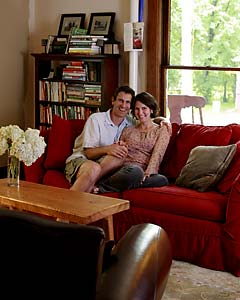 Less than two years later the couple has transformed the Folk Victorianesque home on the western edge of one of Ann Arbor’s most celebrated historic neighborhoods into a greenie’s dream house.
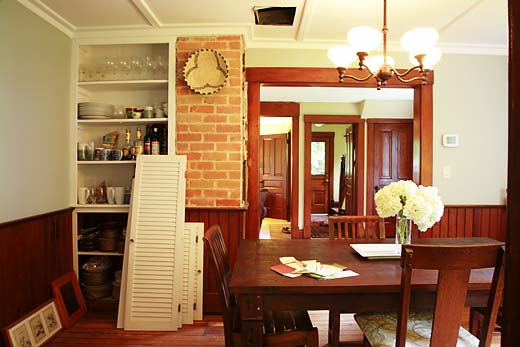
First off, the house is about as green as it can get. It utilizes so many environmentally friendly features, such as a geothermal heating and cooling system, that its annual utility bills are $525. To staunch the renovation’s waste stream to a trickle, the Grocoffs preserved many of the 1902 structure’s original features, such as the original windows and wood flooring. Even the varnish on the trim is original. [Editor’s Note: Look for an expanded feature on the Grocoff’s house at the end of the month]
They wanted to restore the home to the way it was, not the way they wished it was. Add in a touch of modern convenience and today it largely resembles the way it was when the old woman they bought it from was born in the front parlor.
“You have a house that comes with a story,” Matt Grocoff says. “We have original photographs of the original owner who owned a saloon where Grizzly Peak stands today. We can see the squares where the potbelly stove once stood. You can really walk through our house and see how people lived for more than 100 years.”
 And that’s what these young, uber environmentalists want. They wanted a historic home with a good story to tell. A house in a neighborhood where residents sit on their front porches and wave to neighbors walking by on well-worn sidewalks. A place designed for people to interact and know each other so well cats run off their front porch to get a belly rub from a passing neighbor.
“You can’t get that in a suburb without any sidewalks where you need to drive your car everywhere,” Grocoff says. “It’s important that we maintain the stories of who we are and the way we lived. It’s important to preserve the architecture and the neighborhood. It’s important to the environment. Instead of continuing this bad habit of tearing everything down we should preserve what we have for another 100 years.”
The battle over Generica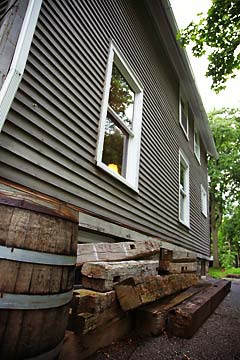 That bad habit of razing the old in favor of the new gave birth to modern day Generica – a land of fast-food drive throughs, strip malls, surface parking lots and starter castle McMansions that are equally indistinguishable and unremarkable.
“Generica isn’t just a California phenomenon or just a city or suburban phenomena,” says Donovan Rypkema, a renowned historical preservationist. “Generica is happening everywhere and I would suggest it is at the heart of the challenge of economic development, smart growth and place economics. Generica undermines all five senses – the sense of place, of evolution, of ownership, of identity and of community.”
Rypkema is principal of PlaceEconomics, a Washington, D.C.-based real estate and economic development-consulting firm. He also authored “The Economics of Historic Preservation” and is an unabashed historic structure hugger, making intricate arguments for preserving America and against Generica.
“Generica diminishes each of the five senses. Preservation of the historic built environment enhances each of the five senses, and constitutes the physical manifestation of a community of memory,” Rypkema says. “Historic preservation builds both community and place. Generica destroys both community and place.”
The numbers behind his arguments are staggering. Those numbers all revolve around money that provides jobs, household income, tax base and tourist dollars.
 He points out that for every $1 million in manufacturing production in Michigan results in an average creation of 14 jobs and $571,000 in local household income. Put those same dollars into rehabbing a historic structure and 20.5 jobs are created with $800,000 in local household income. On top of that a community can employ its building trades workers by renovating 2 to 3 percent of its building stock each year.
Preserving those historic places also brings in more money through vehicles like tourism. Rypkema says people visiting historic sites spend 2.5 times as much money compared to other visitors. They tend to stay longer, spend more per day and have a greater economic impact.
“After decades of declaring that communities had to choose between historic preservation and economic development, professionals in the field are finally realizing that is a false choice,” Rypkema says. “That instead historic preservation is an excellent vehicle for economic development.”
For both short- and long-term. Property values for buildings in historic areas increase more on average than those that are not. Not to mention the prices for those properties are more stable in turbulent times. The more stringent the historic district usually results in the higher appreciation and better price stability because they preserve the context of the neighborhood.
 “Nobody is paying a premium for the privilege of having to go and appear before some goofy historic district commission,” Rypkema says. “Rather it is the assurance that the lunatic across the street isn’t going to be allowed to do something with his property that will have an adverse impact on the value of your property.”
And then there are the feel-good arguments for historic preservation, like sustainability, smart growth, attracting a creative class and affordable housing.
For instance, 25 percent of everything that goes into a landfill is construction waste, much of which comes from razing buildings. Tearing down one building erases the environmental benefit of recycling 1.344 million aluminum cans, Rypkema says.
“We’ve not only wasted an historic building, we’ve wasted months of diligent recycling by the good people of our community,” Rypkema says. “Now why doesn’t every environmentalist have a bumper sticker saying ‘Recycle your aluminum cans AND your historic buildings.'”
Even though the 1990s was the decade environmentalism really started to come into its own, 772,000 housing units were razed. Five hundred and seventy seven units of mature housing stock were torn down each day on average over the last 30 years. A vast majority of those were not victims of natural disasters but human discretion. Replacing all of the pre-1950s housing in America would cost $335 billion dollars or basically another Iraq War.
These are the neighborhoods that were built on the principals of density, walkability, mass transit and proximity to life’s necessities, like schools and businesses. Think all the things new urbanists try to replicate in cornfields in exurbia with a plastic Noviesque Generica.
 No wonder the creative class and those seeking opportunity flock to historic neighborhoods filled with established character and low housing costs. Most of the existing building stock built before World War II can accommodate those short on cash and long on sweat equity looking for solid places to live and do business.
“It is no accident that the creative, imaginative, small start-up firm isn’t located in the corporate office campus, the industrial park or the shopping center – they simply cannot afford the rents there,” Rypkema says. “Older and historic commercial buildings play that role, nearly always with no subsidy or assistance of any kind.”
The Maurer Empire restoration
Case in point; The Maurer Family. Karen and Eric Maurer began restoring Victorian homes in the heart of Ypsilanti more than a decade ago because they liked the stately old structures.
Turning those 19th Century mansions into luxury apartments serving nearby Eastern Michigan University and downtown Ypsilanti quickly became their jobs and then their careers as Maurer Management & Properties. They essentially went from struggling film makers to one of the biggest landowners in Ypsilanti, possessing some of the city’s most sought-after real-estate.
“It’s very challenging but at the same time it’s very rewarding because there is a lot you can do with them,” Eric Maurer says.
The Maurers see themselves as sort of stewards of not only the buildings but the community that separates Ypsilanti from the rest of college-town America. Most of the buildings they have renovated weren’t restored in the purist sense of the word, but they go a long way toward protecting the context of the neighborhood and legacy of those who came before them.
 As Eric Maurer points out there were people in Ypsilanti way before them and there will be more in the future. Preserving the structures is one of the few things that can bridge the gap between those generations.
“It’s important to preserve the history we have for the next generation,” Eric Maurer says. “And it feels good knowing we’re preserving something for another 100 years. There is a lot of personal satisfaction in that.”
The age advantage
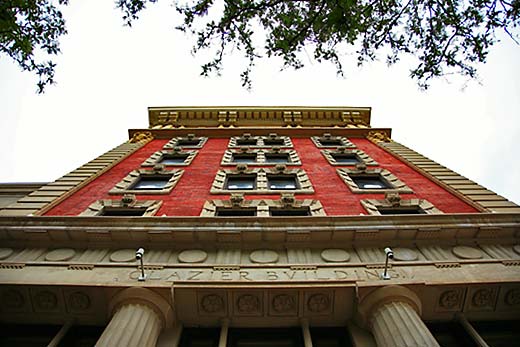
That type of satisfaction goes beyond historic district stewards like the Maurers. Those feelings spread to the people who live in those communities and even to the people who visit them. It’s that type of connection to the past that gives older communities an advantage when it comes to competing with Generica Township and one of the principal reasons the Glazier Building in downtown Ann Arbor was restored to its original appearance and the Sudworth Building (also downtown) is being renovated.
Tear down all of the old buildings in downtown Ypsilanti, build the standard disposable, car-centric new buildings in place of them and what separates Ypsilanti from its surrounding townships besides higher taxes and more bureaucracy?
It’s nearly impossible to build that again. America is littered with the wreckage of downtowns that communities tried to force and build from scratch in old corn fields. The absence of history and the historical design principals where pedestrians were king make downtown’s work.
“I cannot identify a single example of a sustained success story in downtown revitalization where historic preservation wasn’t a key component of that strategy. Not a one,” Rypkema says. 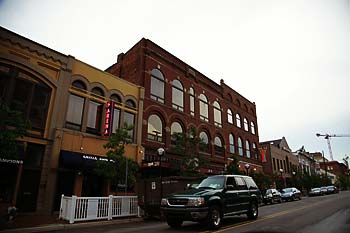 “Conversely the examples of very expensive failures in downtown revitalization have nearly all had the destruction of historic buildings as a major element.”
Those old buildings are the key component to the disciples of Jane Jacobs who want to live the Seinfeldesque lifestyle. These are the people who are abandoning suburban bland and fueling the back-to-the-inner-city movement. They’re looking for communities with a unique character that says they have a long track record for success.
“Our communities – the places we live – ought to be strong, vigorous, in good health,” Rypkema says. “The places we live ought to be valuable places, places with significance, places with meaning. Historic preservation adds significance, adds meaning, and importantly adds value. That’s why historic preservation needs to be a central strategy of every community.”
Jon Zemke is the News Editor for Concentrate and metromode. His family owns a handful of historic homes in Ann Arbor it has preserved for decades and it’s no accident he lives in a turn-of-the-century car dealership converted into lofts.
Photos:
The Glazier Building Renovation by Quinn Evans Architects-Ann Arbor
Matt And Kelly Grocoff Thinking About Their Future Child by Building Green-Ann Arbor
An Interior Look at the Grocoff’s Renovation-Ann Arbor
Old Materials, New House- Ann Arbor
Donovan Rypkema Principle of PlaceEconomics- Photo Courtesy PlaceEconomics
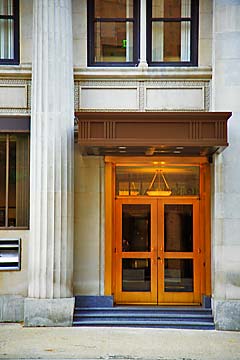
Classical Look for the Glazier Building’s New Entrance-Ann Arbor
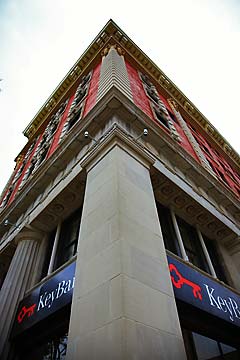
The Glazier Building’s New Cornice-Ann Arbor
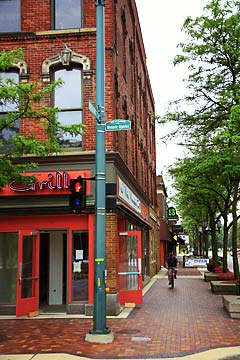
The Maurer’s Renovated 200 W. Michigan-Ypsilanti
The Sudworth Building Nearing Completion- Ann Arbor
All Photos by Dave Lewinski
Dave Lewinski is Concentrate’s Managing Photographer. He also shoots for Ambassador Magazine.
Related Articles
New Ypsi-based program offers free training for women entering or re-entering workforce
Dress for Success Michigan is launching a new, free, four-week workforce development program designed to help women move directly from education to employment.

National swimming and rowing events to bring thousands to Ypsi area
Thousands of athletes and their families will be in Ypsi and Ypsi Township this month for the USA Artistic Swimming Junior Olympics and the RowFest National Championship.
On-Demand Coaching helps Ypsi’s government and small businesses build a winning team
A Michigan Municipal League program helps Ypsi and other municipalities connect small businesses and entrepreneurs with existing capital and technical assistance.


