
AI has transformed Ann Arbor’s tech sector, but what will businesses do if the bubble bursts?
Many in Ann Arbor are working to leverage the community’s creativity, academic excellence, and humming tech sector to land on the soft side of AI’s economic whirlwind.

This article is the first in a three-part series about the impacts of artificial intelligence (AI) in the Washtenaw County community. You can read the second installment, about AI’s impact in the education world, here. The final installment, focusing on data centers in Washtenaw County, is available here.
The rapid rise of AI brings both opportunities and challenges, and many in Ann Arbor are working to leverage the community’s creativity, academic excellence, and humming tech sector to land on the soft side of AI’s economic whirlwind. Maximizing AI’s potential is a top priority at Ann Arbor SPARK, the nonprofit business incubator that has played a large role in attracting so many tech jobs to the Ann Arbor area.
“The adoption and utilization of AI has been heavy and has been useful,” says Bill Mayer, SPARK’s senior vice president of entrepreneurial services. He says AI is like having “100 interns who don’t need to eat or sleep,” allowing startups to increase their capacity.
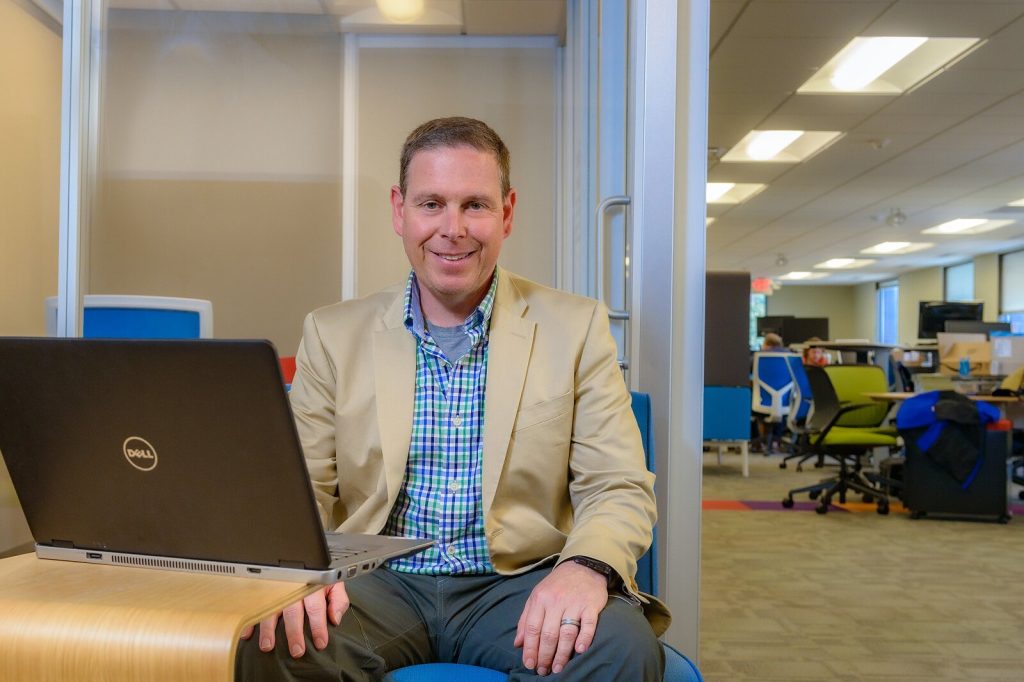
“What it really comes down to is: the earlier a company is in their life, the more unstructured they are,” Mayer says. “So, in the early days of a startup, you can leverage AI to do a lot of fundamental research, modeling, [and] what-if scenarios that are extremely labor-intensive when you have a founder or small founding team that’s trying to do a lot of activities that they don’t have a foundation or skillset in.”
While many Ann Arbor tech businesses are now using AI to support their operations in some capacity, an ever-growing list of local companies specialize in it. Their presence here makes especial sense in the context of the Brookings Institution’s recent “Mapping AI Readiness” report on the state of the evolving American AI industry. That study put Ann Arbor in a group of 28 “Star Hubs” where AI is thriving, alongside Seattle; Austin, Tex.; and Boston. Ranked just below “Superstar” communities like San Francisco, the report characterizes “Star Hubs” as having “uniformly strong AI ecosystems.”

MJ Cartwright and Khalid Mahmood Malik, respectively the CEO and chief technology officer of the Ann Arbor- and Flint-based AI deepfake detection company ProbeTruth, say more AI education opportunities are needed to help America compete in the AI world. In light of that need, they describe the University of Michigan as a major boon to Ann Arbor as an AI hub. Spencer Vagg, chief technology officer at Ann Arbor-based AI startup Initium, says Ann Arbor SPARK is “a big help” for area startups, offering incubator space and helping small businesses thrive.
Mayer says local startups are using AI in a fundamentally different way than big companies. He says startups are usually trying to solve something noble, like curing cancer or increasing transparency. He adds that new AI startups must be studious, do their due diligence on assessing demand and customer base for their product, and take advantage of the “prolific amounts of literature on AI.”
“Keeping in mind that AI is typically in the plumbing, or in the technology stack, of most of the startups that we work with, they’re using AI to deliver some kind of solution or product to the market,” Mayer says. “A lot of times we’re not so much looking at the AI. We’re looking at ‘What problem are you solving?’ The reality … is that you have to be a relentless student of the changes happening around you.”
Solving problems through AI
Local startups are using AI to solve a variety of the specialized problems Mayer references. For example, Ann Arbor-based Initium helps nonprofits and academic outfits speed up and refine their grant-writing processes. ProbeTruth, launched through the University of Michigan, helps identify deepfakes. And Ann Arbor-based Ready Signal focuses on improving AI accuracy. ProbeTruth and Ready Signal are among four Michigan AI companies that received $550,000 in Ann Arbor SPARK grants this past November.
Local AI entrepreneurs tend to think of their products as an assistant to, rather than a replacement for, humans. For example, Initium bills itself as “a copilot” in the grant application process. The company’s end-to-end encryption platform is designed to lighten “the busy work” of writing a grant application.
All of the entrepreneurs interviewed for this piece agreed that AI does pose a threat to jobs in certain ways. They anticipate that some jobs will disappear as a result of the technology but others will be created, while others will simply change – like bank tellers’ roles after the rise of the ATM. Initium founder Rada Mihalcea compares the situation to when a computer first beat a human at chess.

“People were at the same kind of decision point, like, ‘Now what?'” she says. “And eventually over time, it was adopted at scale, but really at the benefit of making people better at playing chess. So there is still human mastery and people are still enjoying the game while using chess to get better.”
One of AI’s biggest challenges is its tendency to produce incorrect information or nonsense, often referred to as “hallucinations.” At least two local AI companies are focused on solving that problem. Ready Signal claims to reduce business modeling errors by half, touting an “extensive collection of external datasets” that inform its AI product. Ready Signal’s services range from cataloging data to providing “market intelligence” to providing recommendations on your next business move.
Similarly, Saginaw-based Swept AI, another recipient of SPARK’s November grants, helps to verify the accuracy and reliability of AI output. Swept clients include U-M, the United Way, the insurance specialization firm Vertical Insure, and other AI companies, like the marketing firm Chipp.
For example, the California-based rare disease research company Forma Health used Swept technology to check and verify the accuracy of AI-generated information. Forma Health CEO German Scipioni says Swept helped detect biases in Forma’s AI that “could have corrupted” Forma’s clinical trial data. Scipioni says these are “the kind of issues you absolutely must catch before deployment.”
“Every decision must be explainable, every data point trustworthy,” he says. “Swept’s ability to find the hidden patterns gives us that confidence — and the evidence to back it”.
Scipioni says his experience working with a Michigan-based AI company versus a firm “on one of the coasts” has been “better in many ways.”
“SweptAI treats us like partners, willing to explore and get smarter together [rather] than pretend like they’re the smartest people in the world and just sell you service,” he says. “It’s funny that in the world of AI the premise is that AI harnesses the collective wisdom of people before it, but some startups then isolate themselves and ignore that fact. SweptAI doesn’t. They learn and iterate over time and are willing to invest in their natural curiosity.”
AI is moving so fast that it can be hard to keep up. Mayer says the best course of action for entrepreneurs is to follow the literature on the newest developments in the AI space, and to go to as many in-person AI conferences as they can. The Michigan Institute for Data and AI in Society held its yearly summit at the Michigan Union last November, and similar events are happening all the time.
“If you’re trying to build software in the AI space in Ann Arbor, there’s literally hundreds of other entrepreneurs trying to do the same thing, usually not in competition with each other,” Mayer says. “There’s a bit of a brain trust effect where people really have a good network that can feed their ambition, stay up to date, and keep pace with how randomly things are changing.”
What to do if the AI bubble bursts?
Local entrepreneurs are already strategizing about how to respond to a potential bursting of the AI industry “bubble,” which has been widely speculated upon by media outlets and industry analysts. In October, Matteo Wong and Charlie Warzel noted in The Atlantic that the global investment in artificial intelligence “is projected to hit $375 billion by the end of the year and half a trillion dollars in 2026.”
“Three-quarters of gains in the S&P 500 since the launch of ChatGPT came from AI-related stocks; the value of every publicly traded company has, in a sense, been buoyed by an AI-driven bull market,” they wrote. “To cement the point, Nvidia, a maker of the advanced computer chips underlying the AI boom, [in 2025] became the first company in history to be worth $5 trillion.”
Nvidia is among a group of companies known as the Magnificent Seven, which are collectively worth $21.62 trillion – or about a third of the S&P 500’s total value. Most of the others are also heavily invested in AI in some way, leading to growing concern that the AI boom will follow the same pattern as the ’90s dot-com boom and eventual bust.
Mayer acknowledges that the labor market “is soft right now” because of multiple economic factors, but “in the meantime they’ve got a stopgap” in AI. Whether the AI future is sustainable remains an open question for Mayer.
More specialized firms like Initium are more likely to be insulated from any sort of crash. Vagg says his company’s “niche vertical” is a strength.
“Now we’re starting to also focus on creating more non-AI features to our platform that still assist in the grant application process to position ourselves for it to be just a bump in the road if AI is a bubble,” he says.
Mihalcea says AI is “still in the super-hype moment,” but she thinks “some of it is starting to wear down and we are getting more to the reality [of] really adopting this tool.”
“I would say that in general, the AI that we see now is broader, but I think it’s something that we can really use to our benefit – for very repetitive tasks, to help us in our education process, so we can get better at what we do,” she says. “That’s what I see in 10 years. Right now, we are seeing where the borders are, … but I think eventually it will settle down and be used to our benefit.”
Author

Related Articles

Generative AI summit at EMU aims to present diverse views on disruptive technology
Organizers of an upcoming regional GenAI Summit at Eastern Michigan University are seeking to facilitate productive conversations across a broad range of disciplines, ages, and approaches to generative AI.

Ann Arbor SPARK to promote Midwest tech hubs at SXSW
Ann Arbor SPARK and Innovation Partnerships at the University of Michigan will present at South by Southwest next month, bringing two sessions and a networking reception to the LINE Hotel in Austin, Tex., on March 18.

AI’s impact in Washtenaw County, from tech boom to data centers
Our new three-part series digs into AI’s impacts in Ann Arbor’s tech industry, its utilization in Washtenaw County’s educational world, and the ongoing debate about data centers in several Washtenaw County communities.


