
AI is creating rapid change in Washtenaw County education, from elementary school to higher ed
AI has had transformational effects in education throughout Washtenaw County.
This article is the second in a three-part series about the impacts of artificial intelligence (AI) in the Washtenaw County community. You can read the first installment, about AI’s effects on Ann Arbor’s tech industry, here. The final installment, which focuses on data centers in Washtenaw County, is available here.
The rise of AI has been an obvious game-changer for Washtenaw County’s tech-heavy business community, but it’s also had rapid, transformational effects in education throughout the county.
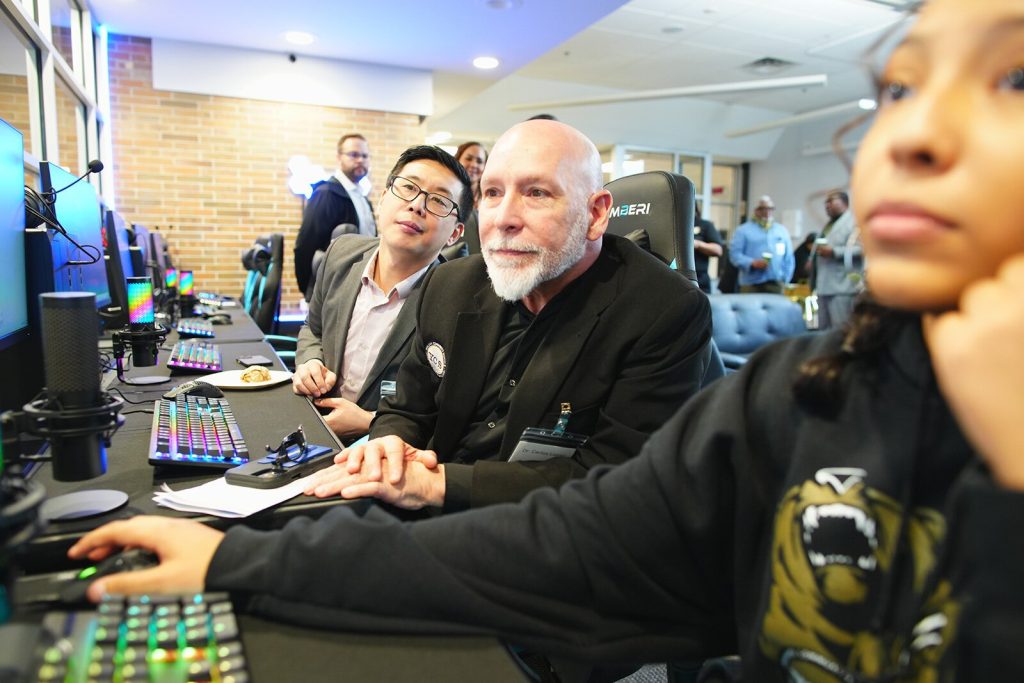
“When people are fearful about AI they should ask: ‘If not me, then who?’” says Dr. Carlos Lopez, assistant superintendent of Ypsilanti Community Schools (YCS). “If I’m not willing to step into the gap, then who will? Because the train has left the station and you’re going to be left behind.”
Lopez says that at least 85% of YCS teachers use AI for at least some of their instruction. He says AI has proven a great leveler in academic outcomes, furthering equality and helping to dent the achievement gap between students of different races. The most positive impact has been for multilingual learners and special education students.

Lopez recalls recently visiting a YCS classroom full of students learning English as a second language. He says the students were “doing algebra at the highest level,” using the AI app Khanmigo as a translation tool.
“I was mesmerized,” Lopez says. “… Back in the day, I remember people were trying to teach me English, and so my content suffered. And now, with the AI tools that we have, it’s allowing the students to meet both of those needs … and guess who’s driving that? The teachers.”
AI in higher education
AI tools have also rapidly permeated higher education in Washtenaw County. The University of Michigan (U-M) started creating its own AI tools for students and faculty last year, and the university claims to be the world’s first to “provide a custom suite of generative AI tools to its community.” The university now offers U-M GPT, which offers free access to major AI tools; Go Blue and MiMaizey, which offer students personalized assistance to navigate campus life; and the U-M GPT Toolkit, which offers advanced tools for software developers.
“We have two ways of looking at it,” Ravi Pendse, U-M’s vice president for information technology and chief information officer, told Detroit PBS. “One way was we could say, ‘We’ll step back and let’s wait out and see what the world will do, and then maybe we can react.’ The other way was, let’s thoughtfully approach this technology and let’s lead.”
U-M also has programs dedicated to AI, including an AI and Machine Learning certificate program. The school also hosts regular generative AI events.
Similarly, Eastern Michigan University (EMU) faculty and staff have been active in the AI world since 2022. The university offers a blog guiding professors on how to use AI, allowing professors and lecturers “significant latitude in setting classroom policies for its use.”
EMU faculty are also utilizing AI in their research. Dr. Yunting Yin, an assistant professor of computer science at EMU, has developed an AI program that analyzes video of soccer games to improve performance. She is actively engaging with EMU students both to further the program’s effectiveness and provide training for the students to advance their careers. She is currently preparing to submit her research to computer science and computer vision conferences.
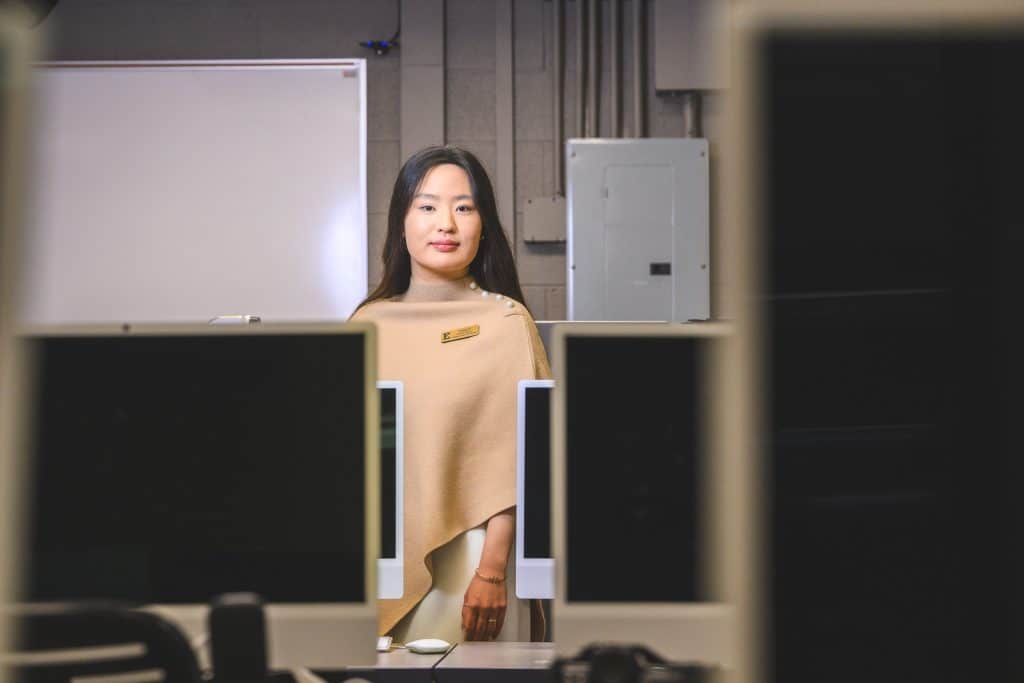
“Students have shown a lot of interest in sports-related projects because they already watch and care about the games, which makes the research engaging and relatable,” Yin says via email. “At the same time, they are gaining hands-on experience with advanced AI techniques, which supports their long-term academic and career development.”
Challenges of AI in education
Cheating is an obvious problem when it comes to integrating AI into education. Software is being developed to detect and punish simply using ChatGPT, or a similar system, to do the work for you. But such solutions are not foolproof. A high school senior wrote about how easy it is to get ChatGPT to do your homework in seconds, and how ubiquitous AI can be among students, for The Atlantic last September.
The other potential problem on the horizon is a lack of fundamentals. Those interviewed for this article agreed that there’s nothing wrong with students using AI as a shortcut, so long as they’re still learning the basic skills they’ll need to succeed. But there’s concern about ensuring that students can think critically enough to solve a problem on their own, rather than just getting really good at talking to AI.
“ChatGPT can do homework. Is the next generation of humans coming up going to be able to critically think, be literate, have done the research, ingested the homework that they did in school?” asks Bill Mayer, Ann Arbor SPARK‘s senior vice president of entrepreneurial services. He adds that he thinks the technology is still “in this growth phase that hasn’t been fully thought out.”

Lopez says using AI to cheat on schoolwork is not a problem in the classrooms he oversees. Rather, he says AI has been a boon that boosts students’ learning speed and comprehension when used properly.
As a co-founder of the Ann Arbor-based deepfake detection company ProbeTruth, Khalid Mahmood Malik is an expert in using AI to detect misuse of AI. Malik, who is also a professor at the University of Michigan – Flint, agrees that AI poses a danger of lessening future generations’ understanding of educational fundamentals. But he says those who embrace the technology will have a fundamental advantage compared to those who don’t.
“The best thing I like about AI is I give it my code and say ‘fix it.’ It removes all the complication errors. … We don’t now spend hours and hours correcting them,” Malik says. He adds that he’s “redesigned” his cybersecurity classes to teach students to use AI in responsible, increasingly complex ways.

“Last semester we were using ChatGPT to make a calculator,” he says. “Now we are using it to make something bigger. So AI is going to be a great assistive tool, regardless of whether you’re in STEM.”
In Yin’s world of academic research, similar steps must be taken to ensure the reliability of AI tools. In the current stage of her research, she says AI errors “are easier to quantify” because the AI is trained on well-annotated data sets. But she anticipates a “higher risk of errors” and possible AI “hallucinations” as her work progresses. She says limiting what her AI model is “allowed” to talk about, manually reviewing its output, and conducting user studies will be key to ensuring its clarity and accuracy. Yin says the end result will be worth the work.

“Traditional approaches to improving soccer often rely on summary statistics and on qualitative observations from coaches and analysts,” she says. “These methods are valuable, but they are limited by scale. Human analysts naturally have to be selective, while a well-trained AI model can apply the same level of detailed analysis to every moment of a match and across many matches, without fatigue. Rather than replacing human expertise, AI can serve as a tool that helps professional coaches and analysts work more efficiently, and many sports analytics companies are already using these technologies in practice.”
It can be challenging to accurately predict the future of any technology, but for the time being, learning how to use AI is as vital as knowing how to use a computer has been since the ’90s. Lopez says it’s important to get on board now, and today’s students aren’t hesitating to do so.
“This group of children are just amazing in this AI world,” he says, adding that his students are “excited about learning, about creating things, innovating.”
“I’ve been in education for 45 years, and when [Generation Beta] hits adulthood, boy, is this world in for a group of young people who are just going to grow into phenomenal adults with vision [and] purpose,” Lopez says.
Author

Related Articles
Ann Arbor PTO Council fundraiser aims to close equity gap for schools serving low-income families
The Ann Arbor PTO Council is seeking donations of $30 or more for a fundraiser benefiting Ann Arbor’s Title I schools, or those that receive federal funding to support low-income students.
Since Great Depression, Ann Arbor preschool has offered low-cost child care and supportive services
For over 90 years, Foundations Preschool of Washtenaw County has not only provided high-quality, affordable, and accessible child care, but also served as a community resource for enrolled families.
Ypsi schools’ Resiliency Center expands significantly over five years serving families in need
Since 2020, Ypsilanti Community Schools’ Resiliency Center has been quietly serving hundreds of families who are experiencing housing insecurity and other challenges.


