
All-Indigenous big band’s Ann Arbor performance will celebrate history of Native people in jazz
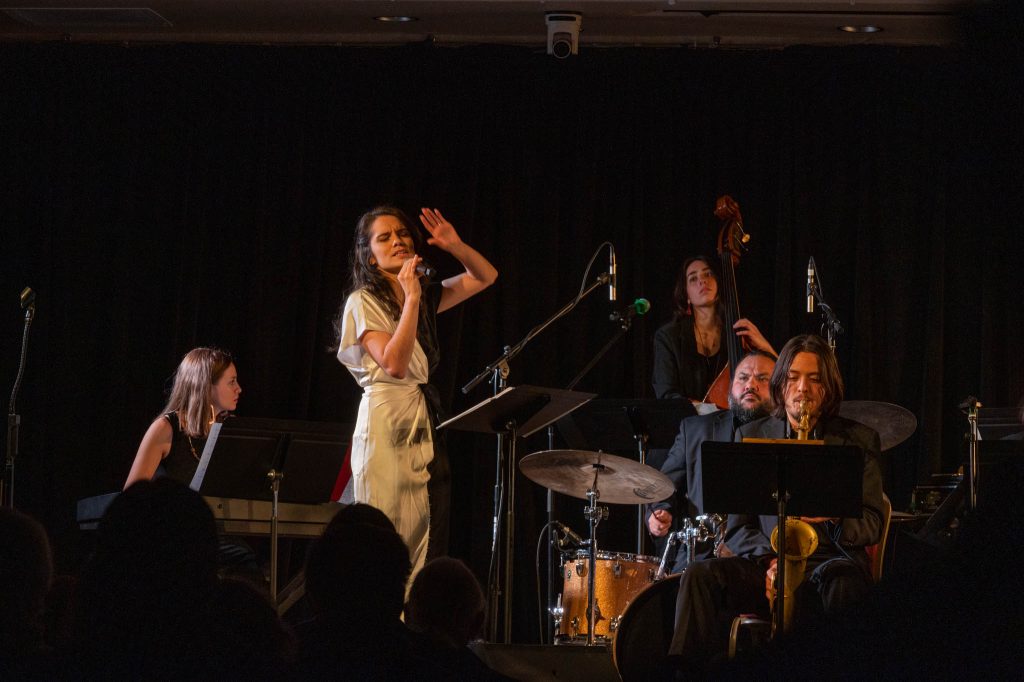
Bandleader Julia Keefe describes her group’s mission as “to celebrate the diversity and vitality of Indigenous people in jazz — past, present, and future.”
This story is part of a series about arts and culture in Washtenaw County. It is made possible by the Ann Arbor Art Center, Destination Ann Arbor, Larry and Lucie Nisson, the University of Michigan Arts Initiative, and the University Musical Society.
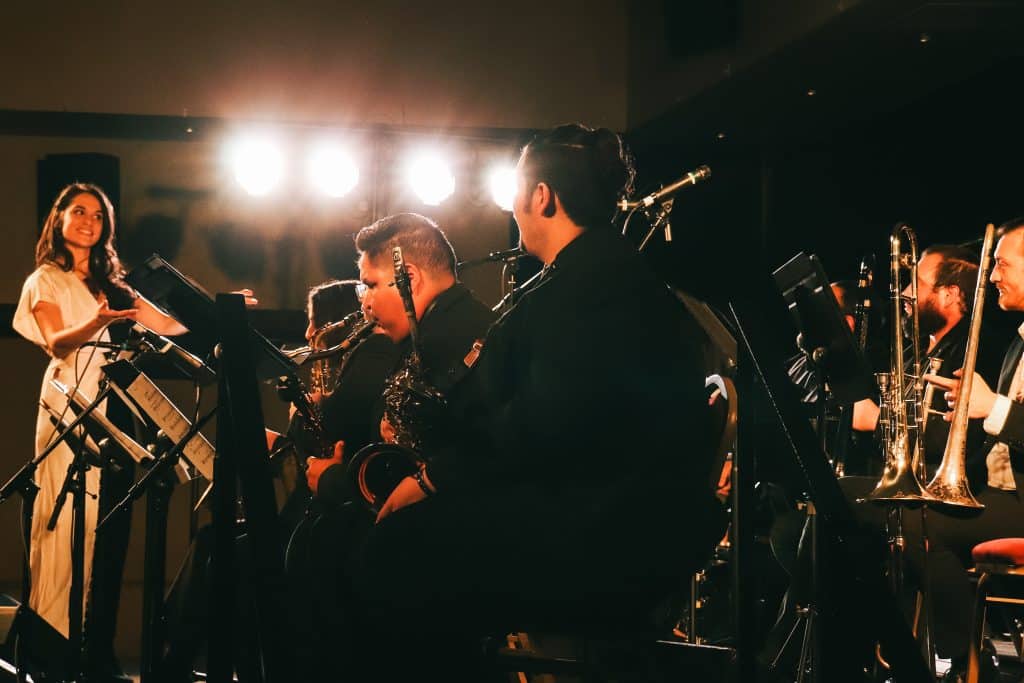
“We’re building something much bigger than a band. It really is a community and a movement,” says Julia Keefe, jazz vocalist and bandleader for the Julia Keefe Indigenous Big Band.
The 16-piece band, which is entirely composed of Native musicians, will perform at 8 p.m. on Jan. 29 at the Michigan Theater, 603 E. Liberty St. in Ann Arbor, in a performance hosted by the University Musical Society. Keefe describes the group’s mission as “to celebrate the diversity and vitality of Indigenous people in jazz — past, present, and future.”
“What we do is guide listeners through the history of jazz from the Indigenous perspective, celebrating historical figures in jazz history who were Indigenous,” says Keefe, a member of the Nez Perce tribe who grew up in Spokane, Wash.
That tour includes stops to appreciate the work of artists like Mildred Bailey, a member of the Coeur d’Alene tribe who sang with Duke Ellington’s band; and Jim Pepper, a saxophonist/composer/vocalist of Kaw/Muscogee heritage who played fusion-style jazz in the 1970s.
“When you look at the evolution of jazz and how it’s played a role in American popular music, you do see Indigenous people there,” Keefe says. “We are very much part of that evolution.”
But, she adds, “Not only do we have a place in jazz, but jazz has a place in our communities, from a historical context.”
For one thing, Indigenous students forced to attend boarding schools “would come back to their tribal nations with this knowledge of Western music,” Keefe says. In the early decades of the 20th century, that music was big band and jazz. Some of those students went on to form big bands and jazz ensembles of their own back at home.
Keefe says her own exposure to jazz came “very, very early” in her life. She says her “earliest musical memory” was listening to her mother’s Billie Holiday collection. She grew up singing in church and at tribal ceremonies, but she says Holiday “haunted” her “in the best possible way.”
Keefe says she didn’t study music in any “formalized” way until her family moved from their reservation to Spokane when she was in junior high. At that point, she started singing in choir and getting interested in jazz.
“I loved the music, but in those early years, I didn’t know of any Native American or Indigenous jazz musicians,” Keefe says.
Then she happened to come across Mildred Bailey, a figure with more than a few points in common with Keefe. Both were from tribes based in Idaho, and both had moved to Spokane. Bailey was an accomplished jazz vocalist and Keefe was an aspiring one.
“I saw these parallel tracks between myself and Mildred Bailey, and it was the first time that I had seen myself as an Indigenous jazz vocalist reflected in the music and as a young musician,” Keefe says.
“Being able to highlight [Bailey’s] legacy through my work has become a huge part of my identity as a jazz musician,” she adds.
Keefe says she’d been somewhat idly daydreaming about an all-Indigenous big band, an idea she’d “brainstorm[ed] and geek[ed] out” about with friend/jazz trumpeter Delbert Anderson, when she noticed a call for grant proposals during the initial COVID-19 lockdowns. She submitted a “behemoth of a proposal” and was thrilled to receive funding.
“But then, of course, I was like, ‘Oh my God,’” Keefe says. At the time, she says the only other Native jazz musician she knew was Anderson himself, “and two people does not a big band make.”
Keefe put out a call for artists on social media and visited colleges and universities looking for Native student musicians.
“I was just sort of calling people, like, ‘Hey, do you happen to know anyone who is Native or Indigenous who plays jazz?’” she says.
She says the response “was overwhelming.”
“We had folks as young as 14 all the way up into their 90s, from all over the U.S. and Canada, reaching out and saying, ‘I thought I was the only one,’” Keefe says.
At one point, she says a 14-year-old from rural Oklahoma reached out to say, “I thought I was the only Native person who loved jazz. I had no idea.”
“What’s wild is that it’s always one or two of us from our tribes, and we’re all spread out across the continent,” she says. “So now it’s like: How do we bring us all together, and how do we get us all connected?”
Keefe estimates that she gathered 16 musicians for her band’s premiere performance in Olympia, Wash.
“It was like a big group of cousins who had never met each other before … got to play music together,” she says.
By the end of the show, she says “everybody who was up on the bandstand [was] like, ‘This isn’t just a one-off thing, right? We’re gonna keep doing this? Because this was awesome.’”
Keefe felt the same way. In May, the Indigenous Big Band will release its first studio album.
“It’s become a project with such purpose, because it’s beyond making music,” Keefe says. “It really is building community.”
Tickets for the Julia Keefe Indigenous Big Band’s Ann Arbor performance are available here.
Author

Related Articles
Washtenaw County summer reading: Local literary leaders share favorite recent books
We asked booksellers, publishers, librarians, and others in the Ann Arbor/Ypsilanti literary community for their personalized summer reading recommendations.
New improv festival will bring 50 comedy troupes to Ann Arbor
The Yes, Ann Improv Festival will debut in Ann Arbor June 24-27, bringing together more than 50 improv troupes from 12 states for four days of performances, workshops, special events, and afterparties.
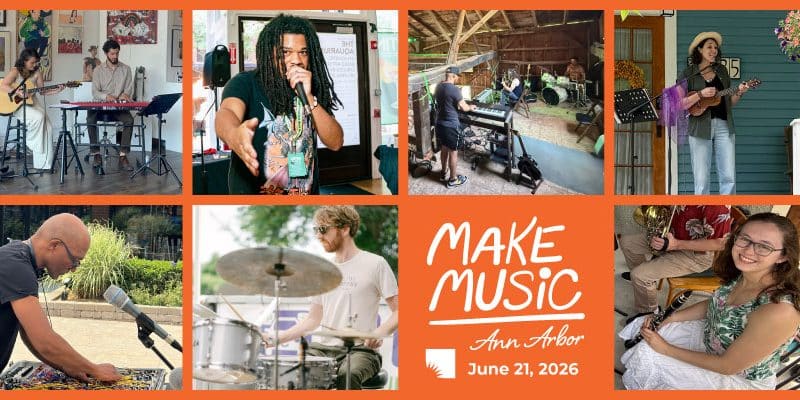
Make Music Day will bring a variety of music programs to Ann Arbor venues
Make Music Day, an international free celebration of music, will return to the Ann Arbor District Library and locations throughout Ann Arbor on June 21.


