

Author

Tanya Muzumdar

Tanya Muzumdar's Latest Articles

WALLY commuter rail station design work gets the green light

The Ann Arbor Transportation Authority board's vote last week to release funding for all WALLY (Washtenaw and Livingston Railway) expenditures means the station design phase will now get underway. The total AATA budget for the fiscal year ending Sept. 30, 2012 was $230,000, most but not all of which will be applied to the station design, says Michael Benham, AATA's special assistant for strategic planning. WALLY is a planned 26-mile north-south stretch of commuter railway spanning from downtown Howell to Ann Arbor. The rail line would run on existing track largely owned by the Great Lakes Central Railroad. The end point in Ann Arbor, however, is yet to be determined. Track ownership changes on the north side of Ann Arbor to the Ann Arbor Railroad, which has objected to providing passenger service, according to Benham. The Great Lakes Central Railroad terminates in the Plymouth and Barton Road vicinity. That stop could serve the U-M Medical Center, the North Campus Research Complex, the Environmental Protection Agency, and other employers, Benham says, but, "Ideally we'd continue to go downtown and then that would open up a whole separate market for the service, namely the downtown businesses." Site evaluation and station design work will start in either start late summer or fall, after contract negotiations with the design consultant are complete, Benham notes. Once design work is done, the next step, assuming continued public support, would be to develop management plans in preparation for a federal funding grant request. Meanwhile, 24 rail cars, many intended for use on the WALLY line, are being rehabilitated by the Great Lakes Central Railroad. "That project continues to move along. Those cars recently passed some federal tests that qualified them for service." Whether WALLY will evolve past the design phase remains to be seen. The project, Benham says, is in the "out years" of Washtenaw County's 30-year transit master plan. "It's something we need to do the development work on now in order to prepare a fit for possible implementation in the future. So we're kind of taking it one step at a time." Source: Michael Benham, AATA's special assistant for strategic planning Writer: Tanya Muzumdar
The Forge forges new collaborative workspace in Ann Arbor

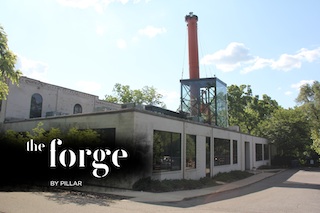
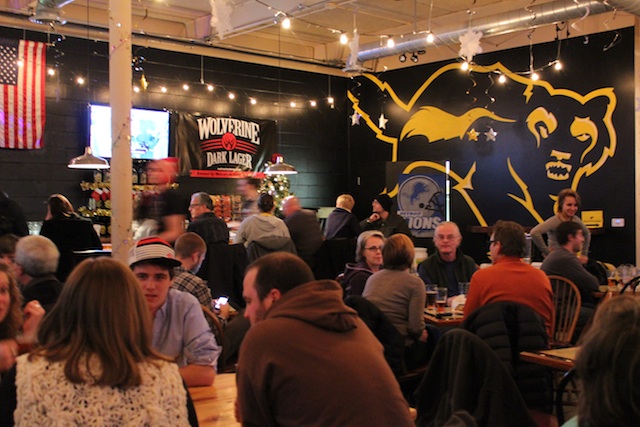
The beer barrels are gone, and now a think tank has moved into the walk-out basement of a circa-1894 building that formerly housed the Northern Brewery. The Forge, a new collaborative workspace open for user groups, events, and other mind-sharing purposes, has opened at 1327 Jones Drive in Ann Arbor, also home to Tech Brewery. The Forge is also the first office space for Pillar Technology, a Brighton, Mich.-based tech consultancy that employs 45 in Michigan, 45 in Ohio, and another 30-40 in six states around the U.S., according to Pillar Technology CEO Bob Myers. "We have more work than we have people, so we could probably add anywhere from 20-30 people if we could find the talent," Myers says, adding, "So there'll be a lot of training and instruction and community events where we're helping people to learn how to do IT and put them to work." The roughly 4,000 square-foot space can field about 30-40 workers. The company renovated the interior from scratch, installing windows, a stairwell, a kitchen area, enclosing the walls, and furnishing it with big screen TVs and collaborative-style furniture made by Steelcase. There is no charge to use the facility, "but there's gotta be a purpose. You've gotta be in here trying to accomplish something to advance the cause ... that's what the only requirement is," Myers says. The cause being? "The cause is innovation and bringing innovation to the area, creating jobs, helping people to figure out what constraints are real and which ones are perceived, and breaking those off. Innovation and incubation, really a place to go where you can learn and fail and it's okay. Just to really better yourself." Source: Bob Myers, CEO, Pillar Technology Writer: Tanya Muzumdar

WALLY commuter rail station design work gets the green light

The Ann Arbor Transportation Authority board's vote last week to release funding for all WALLY (Washtenaw and Livingston Railway) expenditures means the station design phase will now get underway. The total AATA budget for the fiscal year ending Sept. 30, 2012 was $230,000, most but not all of which will be applied to the station design, says Michael Benham, AATA's special assistant for strategic planning. WALLY is a planned 26-mile north-south stretch of commuter railway spanning from downtown Howell to Ann Arbor. The rail line would run on existing track largely owned by the Great Lakes Central Railroad. The end point in Ann Arbor, however, is yet to be determined. Track ownership changes on the city's north side to the Ann Arbor Railroad, which has objected to providing passenger service, according to Benham. The Great Lakes Central Railroad terminates in the Plymouth and Barton Road vicinity. That stop could serve the U-M Medical Center, the North Campus Research Complex, the Environmental Protection Agency, and other employers, Benham says, but, "Ideally we'd continue to go downtown and then that would open up a whole separate market for the service, namely the downtown businesses." Site evaluation and station design work will start in either start late summer or fall, after contract negotiations with the design consultant are complete, Benham notes. Once design work is done, the next step, assuming continued public support, would be to develop management plans in preparation for a federal funding grant request. Meanwhile, 24 rail cars, many of which are intended for use on the WALLY line, are being rehabilitated by the Great Lakes Central Railroad. "That project continues to move along. Those cars recently passed some federal tests that qualified them for service." Whether WALLY will evolve past the design phase remains to be seen. The project, Benham says, is in the "out years" of Washtenaw County's 30-year transit master plan. "It's something we need to do the development work on now in order to prepare a fit for possible implementation in the future. So we're kind of taking it one step at a time." Source: Michael Benham, AATA's special assistant for strategic planning Writer: Tanya Muzumdar

Smokehouse 52 BBQ restaurant to open in Chelsea this fall

Downtown Chelsea is getting its dining chops on this fall. Pork chops and barbecue, to be exact. Phil Tolliver, who has worked with barbecue pitmaster Mike "The Legend" Mills, is planning to open Smokehouse 52 by late October or early November. Tolliver also owns a Bear Claw Coffee shop on U.S. 12 and recently sold his True North Jerky business, the proceeds of which he is investing in Smokehouse 52. Smokehouse 52 will be located at 121-125 Main St. The 1890 building, which still retains much of its original interior, will undergo a sensitive renovation. "Whatever I can leave, I'm going to leave," Tolliver says. The tin ceiling stays. And the original maple plank flooring, currently tiled over, will be re-exposed. The biggest effort will involve converting the kitchen into a restaurant-grade kitchen, "and then we have to figure out how to get a 3,000-pound barbecue pit to the inside walls," he adds. The restaurant will have vintage Americana on display, such as an 1878 flag and a school bell. Its main floor will seat 180-190 for lunch and dinner, with full bar service. Tolliver expects to add 45-50 new jobs. Source: Phil Tolliver, owner of Smokehouse 52 Writer: Tanya Muzumdar

Dexter Wellness Center to open doors, create at least 100 jobs

At long last, the Dexter Wellness Center is getting in shape to open its doors. The Chelsea-Area Wellness Foundation has signed on to operate the center, which will be constructed by A.R. Brouwer at 2810 Baker Road, a half-mile's walking distance from downtown Dexter. The 46,000-square-foot family center will be a full-service facility with a swimming pool, a therapy pool, mind-body space for pilates and yoga, massage therapy, a gym, and strength and aerobic conditioning equipment. Programming for children of all ages will be offered, as will assistance for medical patients. "We'll work with local providers to transition patients from the hospital ... We have programs for them when they're discharged so we can help with strengthening and make their quality of life better," says Amy Heydlauff, executive director of the Chelsea-Area Wellness Foundation (CWF). A physical therapy practice run by Medical Rehabilitation Specialists, but not affiliated with CWF, will occupy 2,000 square feet in the building. Construction will commence after the builder removes some existing structures on the property. "We're anticipating an opening date of either summer or early fall of '13," Heydlauff says. Usage fees have not been set yet, but will be commensurate with comparable facilities in Ann Arbor and Chelsea. She figures the center will employ, at minimum, 100 people. Source:  Amy Heydlauff, executive director, Chelsea-Area Wellness Foundation Writer: Tanya Muzumdar

LiveYpsi program to offer forgivable home loans for EMU employees

Helping to shore up Ypsilanti's ranks of homeowners is LiveYpsi, a new home loan program being rolled out for Eastern Michigan University employees. The program offers $7,500 grants to buy primary residences within Ypsilanti city limits. The proceeds may be used towards a down payment or other purchase costs and are forgivable on a pro-rata basis, at 20% of the amount each year; after five years, the entire amount is forgiven. Funded by EMU, Washtenaw County, and the DTE Energy Foundation, the new program is a smaller-scale version of Live Midtown, which offers forgivable loans for employees of Wayne State University, Henry Ford Health System, and the Detroit Medical Center, to purchase homes in Midtown Detroit, according to Leigh Greden, EMU's executive director of governmental and community relations "We believe that having EMU employees live in the city of Ypsilanti is a win-win-win for everyone," Greden says, in reference to the city, the university, and its employees. "It's a win for the city because it assures that our employees, who tend to be highly educated and to have stable employment with the university, will own a home in the community, they'll take care of the home, they'll pay taxes, they're more likely to walk to work, they're more likely to become involved in the community, and they're more likely to shop at local businesses here in Ypsilanti." The pilot project becomes official and will begin taking applications within the next week, says Greden. Current funds available total $70,000, or enough for nine home purchases. EMU will continue to seek additional funding sources and partners. "Based on the interest we've received so far...we think we'll run out of the money quickly because there's a lot of demand amongst our employees." More information on the program is available here. Source:  Leigh Greden, EMU's executive director of governmental and community relations Writer: Tanya Muzumdar

Edible gardens crop up at Ann Arbor schools

Look at the grounds of many elementary schools around Ann Arbor, and besides the standard-issue playground equipment and flora, you'll see another type of landscaping: edible gardens. "To the best of our knowledge, there are eight or nine school gardens at the elementary level," says Elissa Trumbull, a founding board member of Agrarian Adventure, an Ann Arbor nonprofit that supports school gardening and food production efforts. The Ann Arbor Preschool and Family Center also has raised garden beds, while Tappan Middle School has a garden, fruit trees, and a passive solar greenhouse. "The growth in school gardens that we're seeing in Ann Arbor Public Schools is reflective of what we're seeing on a nation-wide level," she adds. There is no count of aggregate food production between all the schools, Trumbull says. Crops are being used for class lessons, special events, and donations to food gatherers and food pantries. The produce grown is not currently being served in cafeterias. In a pilot program last year, salad greens and radishes grown for 7th grade coursework at Tappan Middle School were served in all the middle school cafeterias in the Ann Arbor district. "That is unprecedented in the country as far as I know, working with a district of this scale [that already has] a contracted food service provider," she says. The district contract with Chartwells. "Nationwide, school gardeners are convening and working towards finding safe and healthy ways to have school garden-grown food included in school lunch programs." Source: Elissa Trumbull, founding board member of Agrarian Adventure Writer: Tanya Muzumdar

Ann Arbor’s Mani Osteria & Bar to get new Mexican eatery neighbor

It is con mucho gusto that Adam Baru, owner of the hip Mani Osteria & Bar, will be extending his culinary reach to south-of-the-border cuisine with the impending opening of his new Mexican restaurant next door to Mani, at the intersection of E. Liberty and S. Division streets. The yet-to-be-named eatery, with a planned early fall debut, will share a wall and an interior connection with Mani, Baru says. Later this month, he will travel with his chef, Brendan McCall, to Mexico City on a food and cultural tool to derive inspiration for the menu and décor. Baru anticipates the menu will be a modern mix of traditional Mexican cuisine and antojitos (street food). The 2,600-square-foot restaurant will have 75-80 seats. "The space is currently unoccupied and has been for a period of time, so it's really just a ceiling, a floor, and a door, so we'll be doing a full renovation to the space," says Baru. "The design really will be very much in the spirit of what we've done at Mani." The restaurants will share the same architect, design team, and contractor. "We've had a really wonderful year at Mani. Being right next door, I think it [will create] some nice synergies between the two restaurants." Source: Adam Baru, owner, Mani Osteria & Bar Writer: Tanya Muzumdar

Specialty bike shop expands into larger downtown Ann Arbor storefront

Instead of Belgian waffles at 217 S. Fourth Ave. in downtown Ann Arbor, it'll be eye candy in the form of bikes from Italian, Swiss, and American companies on offer at the new Transition Rack bike shop. A previous deal to open a waffle shop in the space fell through, making room for the specialty bikes to move in. Majority owner Will Jurkowski, who has been running Transition Rack from a lower-level space below Afternoon Delight on E. Liberty St. since January, is more than doubling his shop size with the new location. The store specializes in triathlon, road, and cyclocross bikes made by BMC, Colnago, and Quintana Roo, as well as shoes, helmets, gloves, and other accessories. The shop also has a fitting studio and large repair area. It's open Monday through Saturday to start; Sunday hours may be added, Jurkowski will likely hire more staff, but is still determining needs. "We want it to be a welcoming atmosphere, [where] anyone can come and learn about bikes, whether they're a beginner or they're experienced ... We all had help when we began doing triathlon and cycling, and that we'd like to pass that along to everyone else who is interested," Jurkowski says. Source: Will Jurkowski, owner, Transition Rack Writer: Tanya Muzumdar

Wolverine State Brewing Co. to expand taproom and production space

Patrons of the Wolverine State Brewing Co. can drink to a newly completed addition this fall. In November 2010, the microbrewer moved into a warehouse formerly occupied by Big George's Home Appliance Mart. Work has just begun on the addition of another 3,500 square feet to the existing 6,400-square-foot brewery, a 50% expansion of space. The lager-only microbrewer will be bumping back into extra warehouse room at its facility at 2019 W. Stadium Boulevard in Ann Arbor. The new addition will be evenly split between more production space and a taproom expansion, according to E.T. Crowe, the company's marketing director. The project is in response to sales growth of 400% growth in wholesale and 40% in the taproom, according to the company. The production side of the expansion will add new offices, a mill room, more storage, and a more efficient pickup system for wholesale distributors, and will make room for more fermenters. Fermentation capacity has tripled since the brewery opened, Crowe says. In August, the microbrewer will add a third bottling: "Wolverine Amber Lager". In October, "Massacre", a bourbon barrel-aged imperial dark lager, will be released. The rest of the expansion will consist of an overflow tap room available for private rentals. It will have its own bar, a staging area for caterers, and separate entrance. Restrooms will also be reconfigured. Crowe has been fielding weekly requests to rent the existing taproom, which went into the decision to add a room available for rent. "We have so many regulars and so many people who expect to come during open hours, I don't anticipate ever wanting to close the taproom for any private party, unless the president rolls into town and needs a beer, you know what I mean?" She hopes to have the overflow taproom open in September: "Football season is the goal." Source: E.T. Crowe, marketing director, Wolverine State Brewing Co. Writer: Tanya Muzumdar

Our Partners

30044
30045
30046
30047
30049
Washtenaw ISD logo
Eastern Michigan University
Ann Arbor Art Center
UMS

Don't miss out!

Everything Ann Arbor and Ypsilanti, in your inbox every week.

Close the CTA

Already a subscriber? Enter your email to hide this popup in the future.