
MASTERMIND: Russ Collins
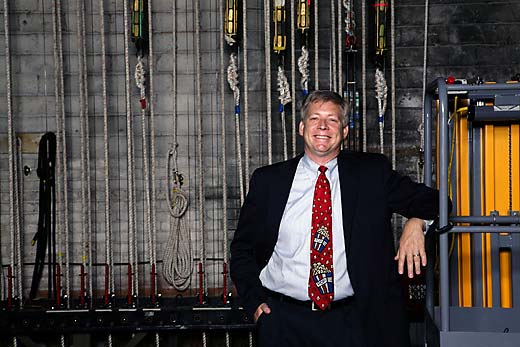 By corporate standards, Russ Collins’ office is off the charts – the wrong way. It’s modest even for a non-profit. The Michigan Theater Executive Director and CEO barely has room for his desk, a bookcase and a couple of visitor’s chairs.
It doesn’t reflect the theatre’s budget – this year at $2.6 million – or its importance in the community. Memberships, major gifts, grants and in-kind contributions bring in almost $1 million per year. Film revenues are projected to be $590,000 in 2008.
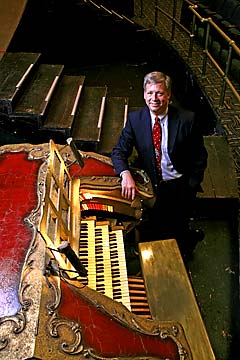
The 1928 historic structure is owned and operated by the Michigan Theater Foundation. It was brought back from the brink of demolition in 1979-80 and restored to its palatial red-white-and-gold grandeur over the next 20 years. The historic auditorium boasts the Barton Theater Organ, one of the few remaining theater organs still in its original location. It’s played regularly before film screenings.
Collins has been there since the beginning of the rebirth.
 “An old theater manager once told me that a total movie-head is not a good theater manager. They program what they like, not what the audience wants to see. When I started (in 1982), the Michigan Theater wasn’t showing movies,” he recalls.
“After while, I took over programming films. I took a couple of film classes in college – I took a couple of everything in college. But I’m not the movie-trivia guy people expect to meet.”
He’s filled with respect for the medium, nonetheless: “The motion picture is a profound art form. Sitting in a darkened room full of strangers waiting for the film to unfold is profoundly affecting – the same as (live) theater,” he says.
Movie attendance at the Michigan is down about 20% compared to last year – and not just at the Michigan or in Ann Arbor. It’s because of a “karmic disconnect” between the films studios are putting out and the films audiences wish to see, Collins says.
Donations down, too? Yes, but the biggest supporters are hanging in. It’s another challenge to be greeted with relish, even after 26 years on the job. His office may lack executive perks, but Collins’s executive activities know no limits. His approach is all-out.
“I started out thinking this would be an entrepreneurial job,” he explains.
Reality set in quickly – the pride that makes Ann Arborites regard the Michigan Theater as a treasured local landmark –even if they never go there– makes Collins feel responsible to the 112,000 people who live in town, as well as to the Michigan Theater Foundation’s board of directors.
What’s it like having 18 bosses?
 “A not-for-profit board is an odd and wonderful institution, odd because the things that typically motivate people – money and power – don’t come into play. When an organization is going well, people are easy to satisfy. When things aren’t going well, you have to steel yourself to skepticism.”
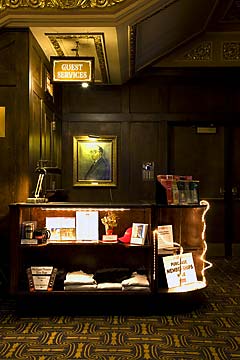
The theater shows films, presents live theater and concerts, hosts events for other presenters, provides the venue for corporate meetings. Its glorious Grand Foyer is the location for a great many weddings over the course of a year.
If the adjacent Cadillac Building is redeveloped, even more possibilities come into play. It’s now home to the spacious restrooms – especially treasured by long-time Michigan fans who remember the bad old days – and the Screening Room, a 200-seat auditorium with its own vintage theater organ.
New dressing rooms, backstage tech support space, improved handicap access between the stage and the historic auditorium, additional performance spaces, even a ballroom are on the wish list, Collins said.
Taking care of the theatre building and making sure it’s Mission Accomplished is more than a full-time job. In spite of that, Collins has lots of things to do outside the building, as well.
 In 2006, Governor Jennifer Granholm appointed him to board of directors of the Michigan Humanities Council, the state’s independent, non-profit affiliate of the National Endowment for the Humanities. He’ll serve through the end of 2009.
He is also an Arts Administration Fellow of the National Endowment for the Arts, and a graduate and Professional Theatre Program Fellow of the University of Michigan. Collins was knighted by the Republic of Italy for his promotion of Italian film culture in the USA.
In his spare time, as the old joke goes, Sir Russ serves on the board of Ann Arbor’s Downtown Development Authority and teaches arts administration and film studies at Eastern Michigan University.
He hosts the weekly film show, “Cinema Chat,” on WEMU-FM and is a regular guest on Martin Bandyke’s morning radio program on Ann Arbor’s 107One-FM.
Meanwhile, back at the office, he wrestles with that karmic disconnect between films and audience.
“There’s no shortage of films – the shortage is in ‘No films that I like,'” Collins says. “It’s a matter of aligning product with audience.”
 As part of the Sundance Film Institute Art House Project, the Michigan Theater is one of a dozen similar places around the country that are trying to build or rebuild an audience for independent films.
“We are helping to articulate how a specialty film theatre operates in a community. They’re mission-driven by the community’s desire to have that kind of organization in the community, as expressed through their contributions.”
Given his increasingly heightened professional profile, why does Collins decline what must be a stream of tempting offers to go elsewhere?
“I grew up in Ann Arbor. I like Ann Arbor a lot. This job has been challenging and I want to be challenged…and I have family here,” is all he’ll say.
What if there was no Michigan Theater in Ann Arbor – what would Collins be doing? A far-away look comes into his eyes.
“When I finished school, all my arts administration colleagues headed off to New York and Broadway. Before I came to the Michigan Theater, there was this little theatre company I set up as a grad student…..”
Constance Crump is an Ann Arbor writer whose work has appeared in Crain’s Detroit Business, The Ann Arbor News, The Detroit Free Press and Billboard Magazine. …And as a matter of full disclosure, Constance occasionally does event PR work for the Michigan Theater.
Related Articles
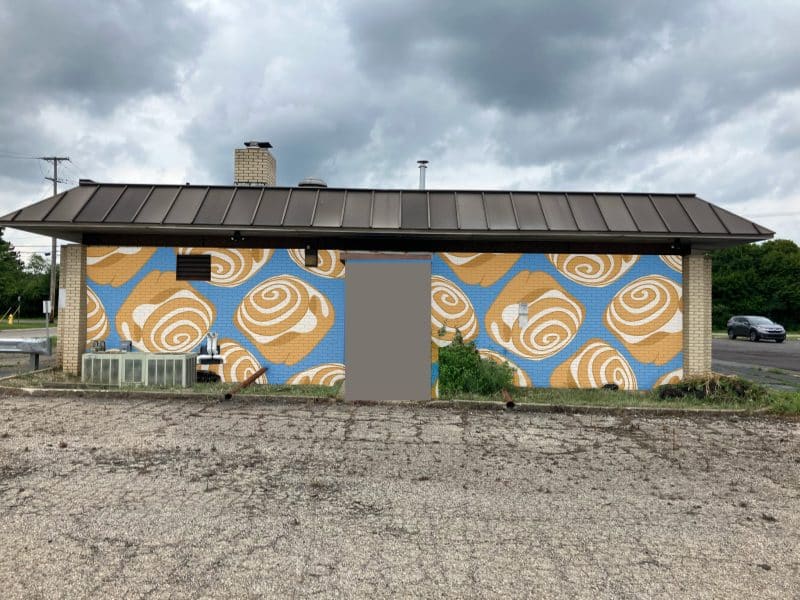
Residents plan mural for Ypsi Township bakery
Residents of Ypsilanti Township’s Gault Village neighborhood plan to show love for locally-owned B-Cubed Bakery by painting a mural on the bakery building.

Michigan Water Color Society to showcase signature members’ work in Ann Arbor exhibition
The Michigan Water Color Society will showcase its members’ work in Ann Arbor for the first time in decades in an upcoming exhibition at the Ann Arbor Art Center.

20 years of FestiFools: Founder Mark Tucker looks back on Ann Arbor’s beloved puppet parade
We chatted with FestiFools founder Mark Tucker about the unlikely origins and enduring spirit of the community puppet parade.


