
Neighbors for More Neighbors: Group’s vision of denser, more affordable Ann Arbor advances with draft city plan
Ann Arbor’s draft comprehensive land use plan would result in a denser city with more housing and transit options.
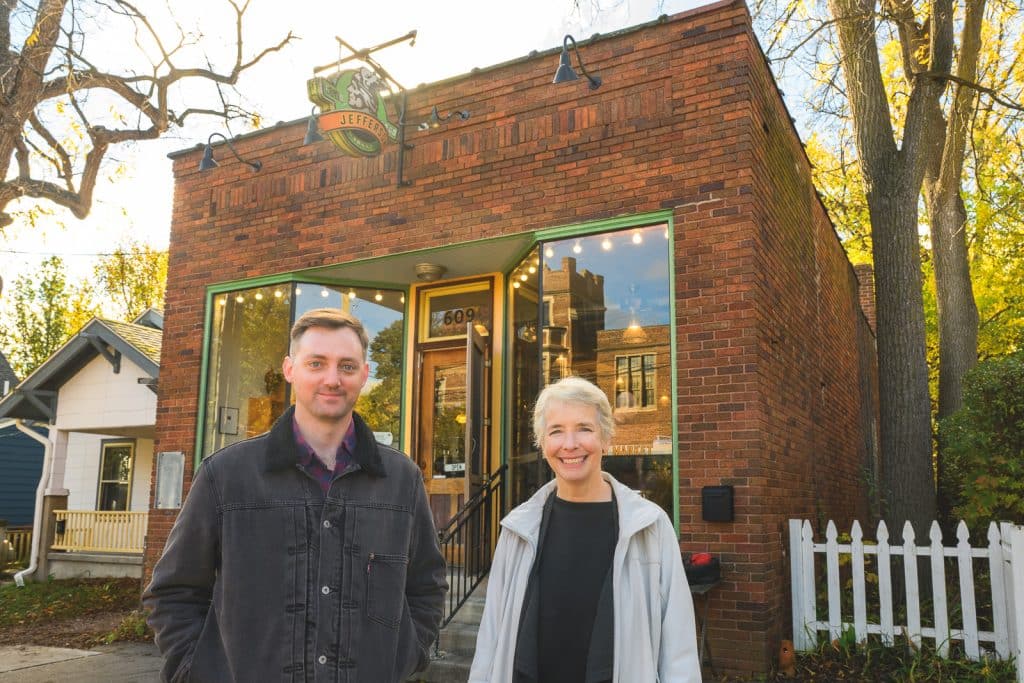
Last week the Ann Arbor City Council voted to start a 63-day public comment period for its draft revision of the city’s comprehensive land use plan (CLUP), which governs what kind of structures can be built where. This vote was a bit of a triumph for Neighbors for More Neighbors (N4MN), a special project organized under the Washtenaw Housing Alliance. N4MN advocates for what it describes as “ethical zoning” that prioritizes greater housing density in Ann Arbor by increasing the number of use options for plots zoned for single-family use by allowing duplexes, triplexes, and other “missing middle” housing options.
The proposed CLUP update would result in a denser Ann Arbor designed more for public transit over cars, a greener city, more tall buildings downtown, and more mixed residential and commercial development along major thoroughfares like Washtenaw Avenue, Plymouth Road, and Stadium Boulevard. The strip malls that currently define those avenues would be replaced gradually with taller buildings and fewer parking lots. This would spread density outward from the city’s core, but with the tallest buildings remaining concentrated in downtown.
“The goal is to make Ann Arbor an even more vibrant and exciting place for even more people to enjoy,” says SaraEllen Strongman, one of N4MN’s organizers.
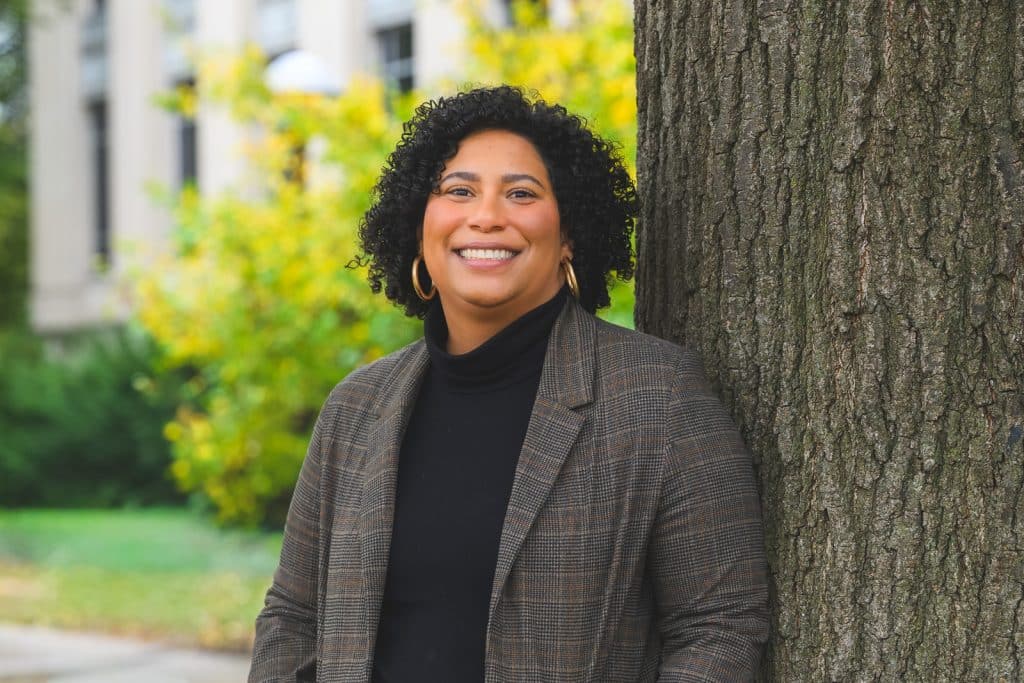
Strongman describes N4MN as “a group that has a very positive vision of the city’s future.” At the moment, zoning laws across Ann Arbor nearly exclusively favor single-family housing (designated as R-1 in zoning laws). As it stands now, 52.1% of Ann Arbor is zoned R-1, according to Ann Arbor Deputy Planning Manager Hank Kelly. N4MN wants to encourage new construction of housing units such as duplexes (zoning designation R-2), triplexes and townhouses (R-3), or small apartment buildings (R-4). In so doing, N4MN members hope to massively expand the available pool of homes in Ann Arbor and lower the average cost of housing as a result – particularly for renters, who represented 52% of the city’s population in 2023.
“Restrictive zoning not only increased minimum lot sizes and decreased the number of units … [but] also eliminated other uses other than residential in R-1 and R-2 zones, and that has a negative impact on people’s finances,” says Greg Matthews, another N4MN organizer. “One of our greatest expenses per household is transportation, and walkability has a cost-of-living impact. I live next to an Argus Farm Stop, and I can walk over there for a cup of coffee or some food, and that decreases my transportation costs. A lot more people want to live car-light or car-free than they have in the past, and that has a great impact on their cost of living.”

N4MN envisions an Ann Arbor where every neighborhood offers as many walkable amenities as Matthews’. The group also hopes to reverse the segregation often associated with the predominance of single-family housing. As Strongman teaches in one of her classes at the University of Michigan (U-M), a big part of the motivation behind suburbanization in the mid-20th century was to exclude people based on race and income level, and to make travel between neighborhoods car-dependent and therefore expensive.
“I think sometimes people think about what we’re discussing as only more housing, but importantly … it’s more types of housing too,” Strongman explains. “People want and need different types of housing at different times in their life, whether it is retired seniors thinking of downsizing, or young professionals who are seeking to move out of roommates and in with a partner. Those people should also have different options and there should be more availability for those options.”
Kit McCullough, a professor of urban design and architecture at U-M, says that land values driven up by high demand currently incentivize either expanding smaller homes for the upwardly mobile, or tearing them down and replacing them with new construction that maximizes the lot usage.
McCullough also pointed out that decision-making by in-town investors versus larger out-of-town investment firms has different effects. Investment conditions since the 2008 financial crisis have meant that in order for most housing projects to get funding, hundreds of units need to be built at once, resulting in cookie-cutter development, rapid hyper-densification, and a sudden boom of high-rise building in downtown Ann Arbor.

“The process right now is that if you want to develop eight units or 300 units, you have to go through the same expensive, politically fraught, risky, and time-consuming process,” McCullough says. “The only developers who can go through that are the big ones.”
McCullough says the city could “level the playing field” by making it easier for residents to sub-divide a home to live in one part of it while leasing out the other part to a renter, or to create a detached “granny flat” to rent out on their property. As an alternative to out-of-town investors’ mega-developments, N4MN hopes to encourage owner-occupied multi-family buildings containing anywhere from two to 12 units. N4MN members see this as the way to minimize upheaval while greatly reducing housing costs by maximizing supply more evenly across the city.
“You’re not really changing the character [of the community]. And in a way that increase in density can make the neighborhood more comfortable. To me the best, ideal neighborhood form is the Old West Side. It’s why I live here,” McCullough says. “It has diversity. It has a great deal of character, a very human scale, and it is also quite dense. It is dense enough to support neighborhood services and retail, like the Argus that we can walk to. Besides just increasing housing supply, Neighbors for More Neighbors means you’ll have more people to support the kinds of businesses we love to have in the neighborhood.”
Community debate
It’s hard to find anyone in Ann Arbor who disagrees that the city has been dealing with a cost-of-living crisis for years now. Ann Arbor’s $508,000 median house price in 2025 is $169,000 higher than in 2020, according to the real estate website Redfin. However, a consensus on how to solve the problem is elusive.
N4MN is not without its critics, and neither is the draft CLUP. Drive through any number of Ann Arbor neighborhoods and you’ll find innumerable “Stop the Plan” signs, arguing that the CLUP process has been rushed, that not enough Ann Arborites have been able to understand in detail what the changes would mean, and that it would lead to unintended consequences. Websites like a2pausetheplan.com question the plan’s methodology.
“Having attended [city council] meetings for the last six months, I would not characterize this plan as having broad community support,” city resident Greg Monroe told council at last week’s meeting. “… Framing this technocratic issue as a discussion of ideals has muddied the water and divided the city. Many residents feel like their efforts to substantively shape the plan have been met with inflexibility from city planning. We want an equitable, sustainable, affordable, and dynamic city, but we are mistrusting … the mechanisms this plan employs to achieve that.”
In addition to decrying a loss of natural habitat in favor of development, and calling for more land banks and community land trust models, Monroe expressed skepticism of the market forces at work and that property developers “who have no ties to our community apart from profit will take in remaking our neighborhoods.”
“Over-indexing on tax revenue will not deal the outcomes that we desire,” he said. “Rather than simply building more, we need to build smarter, considering infrastructure readiness, natural feature preservation, and public/private partnership to obtain missing middle affordable housing.”
Several speakers at the city council meeting also expressed a fear that allowing more units in current single-family houses could result in homes being simply torn down and replaced with larger multi-family buildings that still cater to wealthy occupants, rather than a renovation of existing buildings into multiple affordable units. Rather than lowering overall mortgage payments and rents, many fear that the CLUP will result in further housing cost increases.
The CLUP also includes changes to density along major throughways in what the plan calls “Transition Zones” – areas designated for much denser, transit-oriented development with the goal of increasing housing stock and encouraging low- or zero-carbon mass transit systems. This has created separate but related concerns about higher-rise and higher-density construction.
While on the other side of the debate from Monroe, city resident Cathy Chow told city council last week that she has “been struck by the fact that we want the same things.” Chow said she has friends, including one with a household income over $200,000, who would like to live in Ann Arbor but instead live 30- or 40-minute drives away because they can’t afford homes in the city.
“Based on the plan, my home is currently located in the Transition Zone and I’m excited,” she said. “You mean I can have greater access to transit lines? That I might actually have businesses I can walk to? Most importantly, because we’re not constringing the housing supply, those friends of mine have the opportunity to be my neighbors and yours. I think that you would be honored, like I have [been], to have them in your life.”
At last week’s council meeting, Council Member Travis Radina (Democrat, Ward 3) acknowledged that for some residents, the current CLUP draft “does not go far enough to allowing housing abundance, for some it feels just right, for others this draft goes too far, and further still there is a desire to stop any plan whatsoever.” Before voting in favor of initiating the public comment process on the CLUP, Radina asserted that adding more housing does affect affordability in the city. He cited anecdotal accounts from landlords who have started to see decreased rental demand already as a result of increased housing development in the city.
Radina said that’s why he “will continue to support a plan that does allow for more housing diversity; increase density in places where it makes sense along major transit corridors, along Briarwood Mall, and in our downtown; [and support] gentle growth in our neighborhoods and housing opportunities throughout our community.”
What’s next?
McCullough points to other cities like Minneapolis and Austin, which have loosened their density restrictions in recent years, as models for how the CLUP update could change Ann Arbor. CNBC reported last year that Minneapolis’ 2019 loosening of single-family lot rules and scrapping of minimum parking space requirements has resulted in the Twin Cities mostly bucking the trend of urban unaffordability, especially when compared to the rest of America. That project resulted in more of an emphasis on constructing apartment buildings, rather than N4MN’s more modest vision, but that is largely down to the very different scale of the two communities’ urban environments.
A study from the Pew Research Center found that Minneapolis’ housing stock increased by 12% from 2017 to 2022, while rents increased just 1%. The study contrasted that with the state of Minnesota overall, where housing stock increased by 4% in the same time period while rents increased by 14%. Researchers Linlin Liang, Adam Staveski, Alex Hoorwitz, and Tara Roche also noted that homelessness in Hennepin County, where Minneapolis is located, dropped 12% in the same time period, despite rising 14% in the rest of Minnesota. Furthermore, refuting concerns that added housing would fuel higher rents and displacement of marginalized residents, the study noted that census data show that Minneapolis gained Black residents from 2017 to 2022.
Whatever change comes next for Ann Arbor, it will take time. Under the forthcoming public comment period, any full-time resident of the city can weigh in on the CLUP via an online portal. The CLUP will then go to a final vote once the comment period is done, sometime in 2026.

“This is an exciting next step and only the very beginning,” Strongman told Concentrate the morning after the vote. “More Neighbors A2 continues to be focused on advocating for the evidence-based policies in the CLUP and we encourage community members to share their feedback with council and planning commission during the 63-day comment period.”
Author

Related Articles
African-American cemetery in Ypsi Township will be surveyed to identify lost graves
Woodlawn Cemetery was deemed abandoned in 1965, but recent efforts have sought to clean it up and identify grave sites.
Habitat for Humanity events aim to beautify and clean up Ypsi Township neighborhoods
Habitat for Humanity of Huron Valley is combining its clean-up and beautification events in Ypsilanti Township into a large-scale neighborhood initiative called Rock the Block.

Washtenaw County Opportunity Index improvements make it easier to track areas of inequity
Washtenaw County recently announced a major improvement to its Opportunity Index, a map designed to track the county’s areas of economic inequity and connect those in need to help.


