Education

FamilyMint makes mobile kid money mgmt product

FamilyMint continues to roll out its principal financial-education product this year, recently releasing a mobile version, thanks in part to some cash from the Michigan Microloan Fund. "We're really excited about our mobile version," says Jeff Eusbio, CEO and co-founder of FamilyMint. "Anyone with a web browser can use it."The Ann Arbor-based business, which calls the Tech Brewery home, provides an online money-management system for kids, with parents serving as the bank. With this system, children figure out what to do with their money and then go to mom and dad to make withdrawals. FamilyMint has a team of five employees, three independent contractors, and the occasional summer intern. It launched the Beta version of its website early this year. It has since released a premier version and is partnering with a number of local credit unions. Eusbio plans to focus on the credit union market next year by integrating it into its youth programs. "Their target markets and ours are the same," he says.Source: Jeff Eusbio, CEO & co-founder of FamilyMintWriter: Jon ZemkeRead more about Metro Detroit's growing entrepreneurial ecosystem at SEMichiganStartup.com.

Latest in Education
Energy Works Michigan plans energy-efficiency for all 5,500 state schools

When it comes to making a building energy efficient, a school may just be perfect.Schools are often built in an open space, with a flat roof and can save some money by saving or generating energy. Students can learn about the how and why of energy efficiency in their science classes. And they then grow up alongside technology such as solar panels, and knowing how they work.That's the idea behind Energy Works Michigan, a nonprofit launched by Recycle Ann Arbor and The Ecology Center as partner non-profits about a year and a half ago. Through a $3.5 million grant from the Michigan Public Service Commission, Energy Works Michigan administers the Michigan Renewable Schools program, which funds energy efficiency and renewable energy improvements in Michigan schools.Emile Lauzzana, director of Energy Works Michigan, based in Ann Arbor, has been with the program since before it started, writing the founding grant a year and a half ago, and watching it grow to seven employees -- two educational specialists, and the others with architectural backgrounds. He explains that when they partner with a school, the first order of business is an assessment of its energy profile to get a feel for the building's energy efficiency. They then provide the planning and followup meetings and steer them toward any programs that would benefit the school.If the school participates in a renewable energy program, Energy Works Michigan can provide financial incentives for installing solar or wind projects, all which come with a weather station and the means to stream data to a public website, for access by students -- to use in the classroom -- or the public. "We're happy with the educational tool that provides," he says. "We're starting to already see a lot of our partner schools using this data in the classroom."The energy efficiency program is free to schools, but the renewable energy program does require a contribution, he says. They've seen successes so far through partnerships, benefactors, and fundraisers that schools are able to come up with the money needed.And they do offer lesson plans for elementary students, so students of all ages can benefit from learning about energy efficiency at their own school. "The lesson plans are hands-on, inquiry-based, and come with lab equipment," he says.Lauzzana says his ultimate goal is for each of the 5,500 Michigan schools to achieve energy efficiency within the next few years. They've been able to spread the word through other nonprofit organizations and school business officials, and have able to help 60 schools in less than eight months, with a waiting list of about 25 more. "We're seeing a lot of demand and a lot of enthusiasm for these projects," he says.Before they continue the program, they want to evaluate where it stands now and see how they can improve."For our team, this is really a dream project," he says. "We've been involved, all of us, in environmental issues and energy issues our entire careers. The school partners are great to work with."Another way they're getting students involved is through their ShowGreen TV project, challenging students to make short films about climate change. Their second contest wraps up next week, and a free screening is scheduled for next month in Ann Arbor. Click here for details.Source: Emile Lauzzana, director of Energy Works MichiganWriter: Kristin Lukowski


Ann Arbor’s WriteSteps goes national

Writing instruction always came easy for Suzanne Klein, a former elementary school teacher. Her methods were so popular among other teachers, they encouraged her to commercialize them before someone else did. That precipitated WriteSteps four years ago, an educational company that is gearing up to go national in 2011."The need is there for a writing program," says Klein, founder & CEO of WriteSteps. "Writing is the hardest thing for teachers to teach."WriteSteps, which came out on top at the most recent Ann Arbor SPARK Entrepreneur Boot Camp, primarily sells its educational kits in Michigan these days, after getting its start in the Taylor School District. More than 1,000 teachers use the kits today and Klein plans to begin rolling them out to other school districts across North America in 2011. This growth, a 200 percent increase in sales over the last year alone, has allowed WriteSteps to be cash-flow positive and hiring. It has added eight people to its staff, which now stands at 12, over the last year. Klein expects to add another 10-20 positions in 2011 as WriteSteps begins selling its kits across the U.S.Source: Suzanne Klein, founder & CEO of WriteStepsWriter: Jon ZemkeRead more about Metro Detroit's growing entrepreneurial ecosystem at SEMichiganStartup.com.

With Ypsilanti Food Co-op bakery solar panels in place, Solar Ypsi looks for next project

Solar panels atop the Ypsilanti Food Co-op are 99 percent installed, says Dave Strenski of Solar Ypsi, and he's already got his sights set on his next renewable energy project.The 30 solar panels are on and functioning, he explains, but the bakery inadvertently gave them the wrong meters, so they can't track the actual energy input online yet. "We've been making electricity for probably two weeks," he says. "It is up and running."In his final report to the state for the grant, the total price came in at less than $45,000, working out to about $7.50 per watt, a pretty reasonably priced solar installation, he says.Now, Strenski, who started the grass roots Solar Ypsi and was the force behind the solar projects on the co-op, its bakery, and the city hall, would like to see solar panels at Adams Elementary School, which is in a prime location -- a large roof, with a road and then a park to the south, which would create virtually no shade over any solar panels. He's now looking for grants for such a project, such as through the Michigan Renewable Schools Program.Part of the reason for putting the generation of energy online is so people can compare solar sites; in a recent comparison of the main co-op roof to the Ypsilanti City Hall, he found that city hall is a more efficient site because of its height and lack of shading. The co-op building is a bit shorter, and does get some tree shade in the afternoon. He figures that city hall is about a third more efficient than the co-op in terms of energy generated.Trimming branches is an option, but the system can also be made more efficient with a new converter and perhaps more panels, Strenski explains. He's also applied for DTE Energy's SolarCurrents program, in which the utility buys back power generated.Quite a few people from around Michigan check out the site to watch how much power is being generated through the day, and Strenski says the occasional person from Russia, China, or India also views the page. All his drawings, parts lists, costs, and everything else is on the site, should people want to duplicate a system to make their own."We're educating people throughout the state," he says.Source: Dave Strenski, volunteer with Solar YpsiWriter: Kristin Lukowski

Backyard Brains goes for $500K NIH grant, grows sales

Backyard Brains spent its first year and change establishing its product -- a kit that shows how the brain works for kids -- and has high hopes for 2011.The Ann Arbor-based startup is applying for a $500,000 National Institute of Health grant to help fund its product research and promotion. Backyard Brains will know the outcome of its application by January; if successful, it expects to double staffing from two to four people."If that gets funded it will dramatically grow our business," says Greg Gage, CEO of Backyard Brains.Gage and Tim Marzullo, both neuroscientists, started Backyard Brains as a way to provide a cost-effective product that teaches grade-school students the workings of neurons in the brain. So far it has sold 152 kits to four high schools. It's working to expand its market reach by marketing the kits directly to teachers, university professors, and summer camps.Source: Greg Gage and Tim Marzullo, co-founders of Backyard BrainsWriter: Jon Zemke

Construction wraps up at Ann Arbor’s Pioneer High

Pioneer High School now boasts a new student courtyard, improved tunnels, and more space for its culinary arts and special education programs after a $1.7 million project was recently completed.The project improved the back half of the high school on the city's west side, creating a student courtyard in an open area that formerly served as the home to 16 portable classrooms. The structures had been a fixture at the high school for more than 25 years, as the district managed its growth.While most of the work will be done over the summer, the student courtyard construction continued through early fall. "The work will be completed by the end of October as planned," said Randy Trent, executive director of physical properties for Ann Arbor Public Schools, last month in an e-mail.The project was paid for by money raised in a 2004 bond proposal that calls for improving Pioneer High School.The school opened in the early 1950s on a huge parcel of land bordered by Seventh Street, Stadium Boulevard, Main Street, and Scio Church Street. It has been renovated and added on a number of times since then. It has been 20 years since the last major renovation. The opening of Skyline High School allowed the school district to redevelop Pioneer High School.Source: Randy Trent, executive director of physical properties, Ann Arbor Public SchoolsWriter: Kristin Lukowski

Confucius Says…

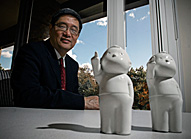
Confucius once said: "Knowledge is recognizing what you know and what you don't." With nearly 300 centers around the world, the Confucius Institute brings Chinese art and culture to global audiences, while acting as a platform for diplomacy. U-M is home to one of Michigan's four institutes, providing Ann Arborites with a dynamic range of programming.

EMU, U-M partner on $1M climate change grant

Eastern Michigan University is leading a group of the state's top universities, including Michigan State University and the University of Michigan, that are sharing in a $1 million federal grant to add educational programs about climate change."We have all kinds of different people who are associated with it," says Sandra Rutherford, a geo-science education professor at EMU and the lead investigator for the grant.The project plans to set up a national network of educational partnerships devoted to incorporating climate change and its effects into school curriculums. It will focus on pairing those who are working on climate change research with research and educational programs in the Great Lakes region. Everyone from science teachers to business stakeholders to the general public is targeted for the program. Within the next two years, these educators should be able to access a network of researchers and scientists focusing on climate change. The three universities are working with the College of Exploration of the National Oceanic and Atmospheric Administration, the Ann Arbor Hands-On Museum, and a consulting faculty member from Ashland College.Source: Sandra Rutherford, geo-science education professor at Eastern Michigan UniversityWriter: Jon Zemke

TorranceLearning triples office space, moves into Chelsea’s Clocktower

TorranceLearning has a new face or two in its office, and a new office in downtown Chelsea.The consulting-and-education firm has recently hired a new person and moved into bigger digs, in Chelsea's iconic Clock Tower complex. The 4-year-old firm now employs eight people and expects to add a couple more within the next year as it continues to attract clients. TorranceLearning recently landed the likes of Be The Match bone marrow program and has a host of others nearly ready to sign on."We're close to signing a couple of significant contracts," says Megan Torrance, president and CEO of TorranceLearning. "If we land them all we will be able to hire 2-4 people. We now have the space to do it."The new office for TorranceLearning, which specializes in training for companies and non-profits, is three times as big as the company's old offices. It now has elbow room for everyone and a few niche things, such as a brain-storming pit and voice-over booth in an open work space. Source: Megan Torrance, president and CEO of TorranceLearningWriter: Jon Zemke

Far From Standard expands in Ann Arbor, plans to open in new U.S. markets

Far From Standard is growing both inside and outside of Ann Arbor as the 3-year-old tutoring service adds staff in Tree Town, expands its offices near the University of Michigan, and looks to open new locations nationwide."We have been growing steady so everything looks good," says Neel Chheda, president of Far From Standard. The company provides highly trained and specialized academic tutors for university science and business students. These are focused on the University of Michigan and Michigan State University classes. Over the last year, Chheda, a U-M graduate, has added one new employee in Ann Arbor and a couple of tutors to round out his staff to three full-timers and 20 tutors.The downtown-based firm has also moved to bigger office space, upgrading from two tutoring rooms to eight. Chheda is also looking at opening in other markets across the U.S., such as Los Angeles, Chicago, or New York. Far From Standard has also revamped its website and is focusing on providing more video content. "We have basically been creating our own database of material," Chheda says. "It creates an identity and brand for ourselves."Source: Neel Chheda, president of Far From StandardWriter: Jon Zemke

Our Partners

30044
30045
30046
30047
30049
Washtenaw ISD logo
Eastern Michigan University
Ann Arbor Art Center
UMS
U of M Arts Initiative
Engage EMU

Common Ground Is Brewing

Support local stories and receive our signature roast straight to your door when you join at the Standard level (or above).

Drink Better, Read Local

Close the CTA

Don't miss out!

Everything Ann Arbor and Ypsilanti, in your inbox every week.

Close the CTA

Already a subscriber? Enter your email to hide this popup in the future.