
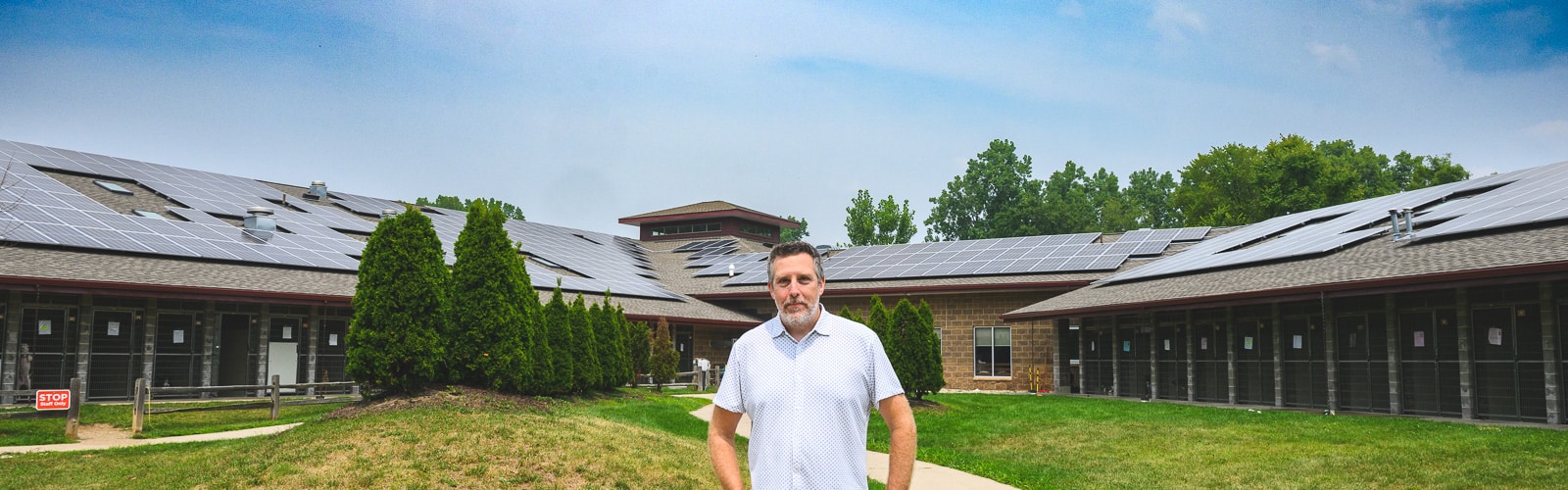
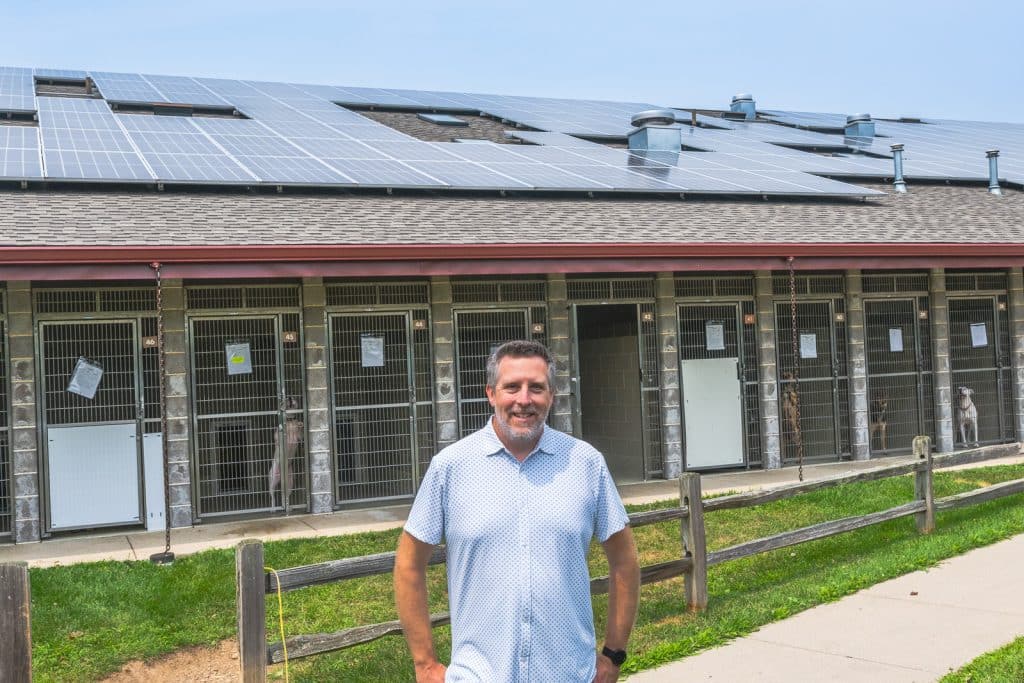
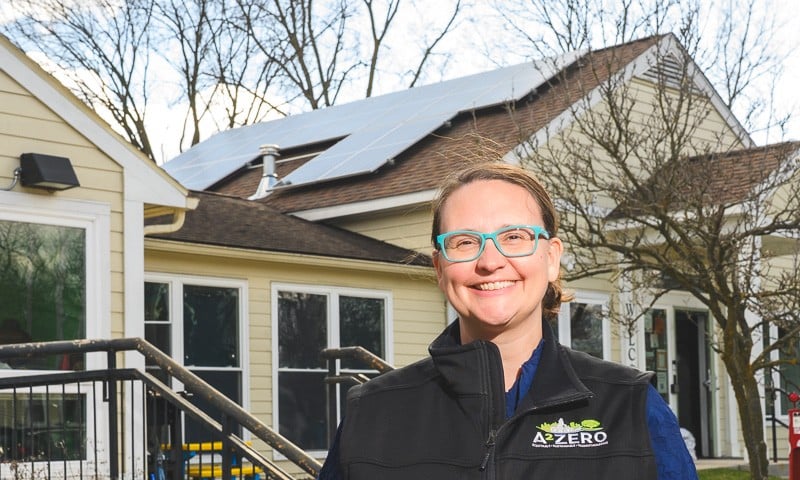
Thanks to the Inflation Reduction Act of 2022 (IRA) and a federal program called Elective Pay, the Humane Society of Huron Valley (HSHV) has taken a major step toward financial sustainability and environmental responsibility. The Superior Township-based nonprofit recently completed the installation of 474 rooftop solar panels — an initiative that is already reducing operational costs and enabling the organization to reinvest more deeply in animal welfare and community programs.
HSHV Chief Financial Officer Jonathon Trevathan first learned about Elective Pay in 2022. Elective Pay, established through IRA, was designed to make federal clean energy incentives accessible to nonprofits, tribal governments, municipalities, schools, and other tax-exempt organizations. Previously, these groups were excluded from claiming clean energy tax credits because they didn’t owe federal income tax. Now, under Elective Pay, they can receive up to 30% of their eligible clean energy project costs as a cash refund from the Internal Revenue Service (IRS). These incentives are activated by the installation of qualifying clean energy technologies, including solar panels, wind turbines, electric vehicle charging stations, and geothermal systems.
Trevathan and his colleagues at HSHV seized the opportunity they saw in the program. HSHV’s solar panels, installed by Ann Arbor-based Homeland Solar, were up and running in under two weeks — a process Trevathan describes as “seamless.” More importantly, the financial impact was immediate. While Elective Pay provides a one-time federal tax refund after installation, the long-term energy savings are where the true value lies.
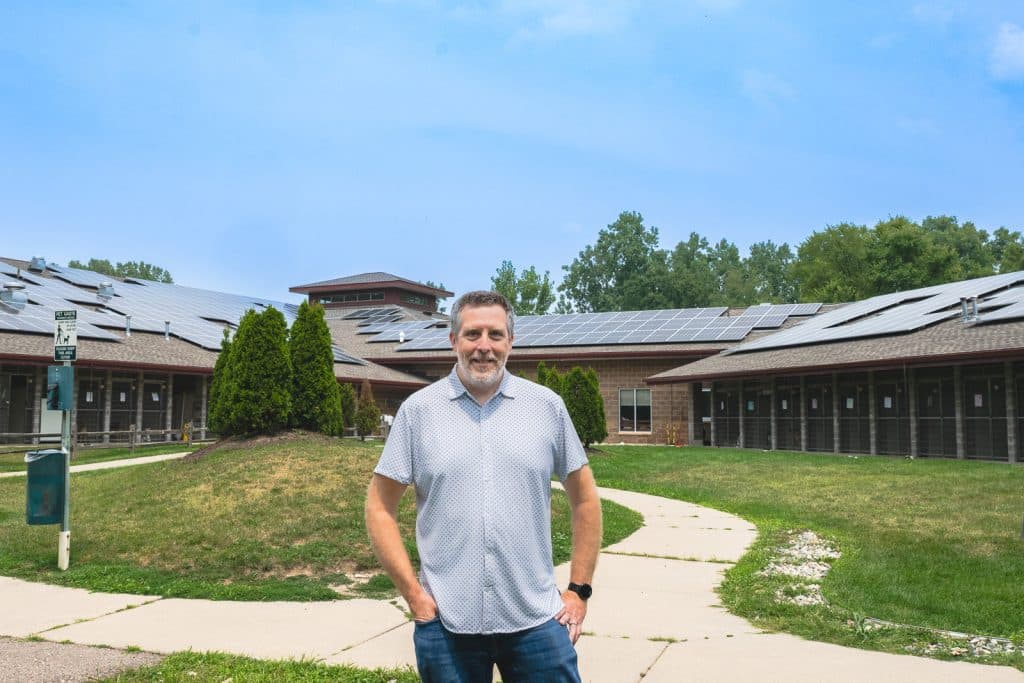
Over the next 25 years, HSHV is projected to save approximately $850,000 on energy costs. That money can now be directed toward critical services such as grief counseling, pet ownership education, emergency sheltering, foster care, and veterinary treatment. For HSHV, the transition to solar is more than a sustainability win — it’s a strategic investment in HSHV’s mission.
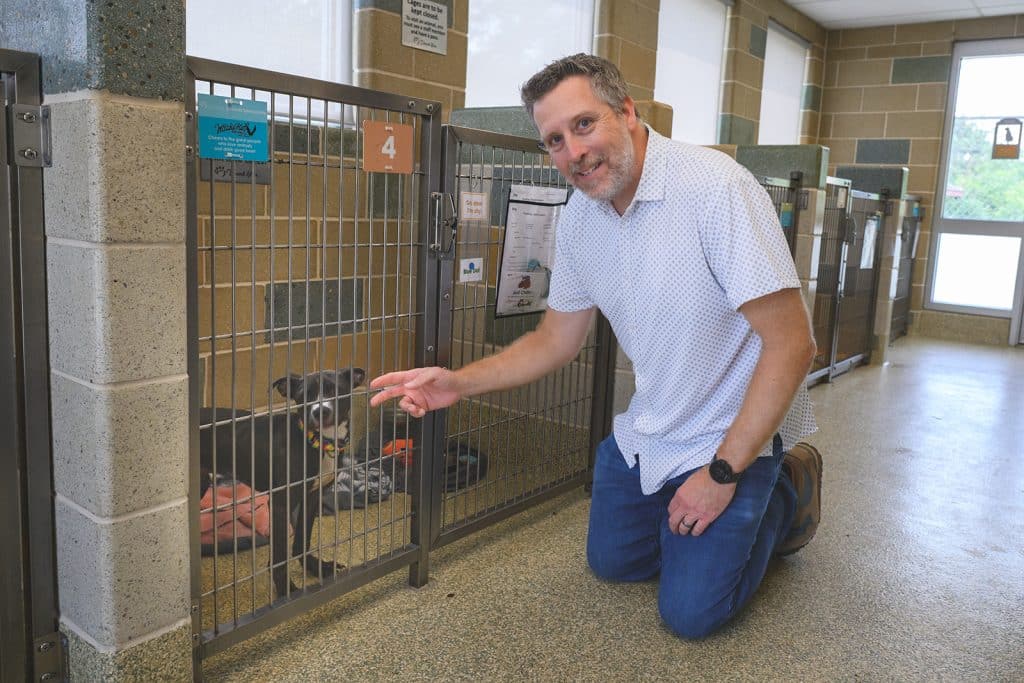
But for Trevathan, one initiative holds particular importance: keeping pets in loving homes during times of financial hardship.
“We’ve got a Bountiful Bowls program where you can come and collect food a couple times a month to help feed your animals,” he says. “If you love this animal, and this animal loves you, let’s keep it in your family. Having $850,000 more can really allow us to be generous in that way.”
Trevathan says the benefits of the Elective Pay program extend far beyond this one project. He says he would “absolutely” encourage other nonprofits to look into the program.
“Even without the [tax] credits, I think it largely makes sense,” he says.
To assist organizations in navigating the Elective Pay process, the Michigan Infrastructure Office’s Technical Assistance Center (TAC) offers no-cost support. Through a combination of informational webinars, one-on-one consulting, and accounting guidance, the TAC helps applicants — many of whom are working through the refund process for the first time — to successfully access Elective Pay benefits.
Kris Brady, director of TAC, has been leading TAC’s effort to help Michigan nonprofits navigate Elective Pay since October 2023. Her mission goes beyond paperwork; it’s about making sure organizations know this resource exists and understand how to use it.
“We’ve been out and about, explaining that this program is available through the tax refund process with the IRS,” Brady says. “A lot of the time eligible folks for Elective Pay are nonprofits and they’ve never filed taxes and think a tax refund is not something they would be eligible for. There is a lot of public outreach to get folks to understand that if they’ve done one of these projects, they could get a refund of a portion of what they invested.”
Still, changes are on the horizon. According to Brady, the recently passed federal budget reconciliation bill has affected the Elective Pay program by tightening implementation timelines and removing some incentives altogether. However, she emphasizes that nonprofits still have another 10 months to take advantage of Elective Pay incentives.
“My best advice for folks that are planning projects is to reach out to the Technical Assistance Center,” she says. “We encourage these clean energy transition projects to continue. It’s important to realize that Michigan did not abandon its Healthy Climate goals and we are striving to meet those even though some of these tools might be changing.”
Among TAC’s newest initiatives is the Elective Pay Ambassador Program, a community-based effort that places trained ambassadors with organizations across Michigan to support clean energy project planning. TAC also offers the Unlocking Elective Pay Challenge, a competitive grant opportunity.
“We are all still dedicated to the mission and we will make it work one way or another,” Brady says.
Related Articles
Ann Arbor to generate its own renewable power through new Sustainable Energy Utility
This spring the city of Ann Arbor will take sustainability goals into its own hands by launching a Sustainable Energy Utility that will generate its own renewable power for residents.

Ann Arbor Comprehensive Land Use Plan approved by planning commission, advances to city council
Ann Arbor City Council will consider allowing massive land use changes intended to improve affordability in the city, following the Ann Arbor Planning Commission’s unanimous Wednesday night vote to pass the draft Comprehensive Land Use Plan 2050.

Ypsi venue opens solar-powered electric vehicle chargers for free use
Prompted in part by neighborhood power outages, the Ypsilanti Performance Space recently began operating four solar-powered electric vehicle chargers.


