Ann Arbor

Arbor Brewing to extend microbrewery reach… into India

Who would have thought that a locally focused microbrewery would go international? Matt and Rene Greff, owners of Arbor Brewing Company and Corner Brewery, that's who. The duo are franchising the philosophy and beer behind their breweries in India thanks to a long-time patron who wants to start a craft beer boom in India.Excerpt:The Greffs, in Ann Arbor, Mich., were skeptical when Gaurav Sikka, a former University of Michigan student, approached them last year about opening a brewpub in Bangalore. Mr. Sikka, a native of India, was a regular at the couple's 200-seat Arbor Brewing Co. The couple had recently opened a small brewery in nearby Ypsilanti, and worried about stretching themselves too thin. "We said no, we don't have any time or money," recalls Mr. Greff. "He said: 'Don't rule it out of hand.' "The Greffs traveled to India, where they came to believe Mr. Sikka's idea was feasible. They found that southern India had a beer-drinking culture, as well as lots of U.S.-educated professionals, including plenty of University of Michigan grads. Moreover, it was an untapped market for traditionally crafted microbrews like the ones the Greffs serve in Michigan.Read the rest of the story here.

EngXT spins out of U-M and into Venture Accelerator

Electrostatic discharge. It's the bane of electronic companies and what EngXT is hoping to capitalize on.Electrostatic discharge is essentially sudden and momentary static electricity. These unwanted currents often cause damage to electronic equipment, such as integrated circuits. "It's estimated those zaps are a $10 billion problem in the industry," says David Hartman, a mentor-in-residence at the University of Michigan Office of Tech Transfer who is working with EngXT.The University of Michigan spin-out is developing technology that can detect when charges are building, utilizing technology that was originally used by NASA. The trio of guys behind EngXT has already come up with the first two generations of prototypes of the sensors. They look like a boom mike on a tripod. The start-up plans to become one of the first companies to take up residence at U-M's Venture Accelerator in the North Campus Research Complex. From there it plans to utilize the university's Tech Transfer resources to continue product development and explore potential partnerships or acquisition by larger corporations.Source: David Hartman, a mentor-in-residence at the University of Michigan Office of Tech Transfer and Nilton Renno, co-founder of EngXTWriter: Jon ZemkeRead more about Metro Detroit's growing entrepreneurial ecosystem at SEMichiganStartup.com.

A medley of food carts is coming to Ann Arbor
Edwards Brothers expands staff with new partnerships

The folks at Edward Brothers don't flinch when a recession blows through the local economy. The Ann Arbor-based company has survived more downturns that most in its 118 years.However, the company is a little more cautious after surviving the Great Recession. The downturn took a toll on its book stores, schools (text books) and professional publications. "Just being here is a victory after 2009," says John Edwards, president & CEO of Edwards Brothers. "It's been a rough couple of years. We used to say we don't participate in recessions. This last one nearly got us."That doesn't mean Edwards Brothers is licking its wounds today. The company is starting to grow its traditional customer bases again (textbooks only last so long) and is exploiting new growing areas, such as custom publication and digital printing. "What we're seeing is shorter runs more often," Edwards says.Edwards Brothers is also picking up competitors its has bested through acquisitions and partnerships. It added 40 people to its staff last year through acquisitions. It also just inked a partnership with Rockpoint Logistics to provide digital printing services out of its Illinois facility. Those moves have allowed Edwards Brothers to expand its printing facilities portfolio to nine buildings, including two factories that specialize in both traditional and digital printi. Edwards Brothers' staff has also grown to 700 people, including 420 in Ann Arbor. It hopes to add a few more in 2011 and it continues to gain ground after a close economic call.Source: John Edwards, president & CEO of Edwards BrothersWriter: Jon ZemkeRead more about Metro Detroit's growing entrepreneurial ecosystem at SEMichiganStartup.com.

Strange Brew: A Q&A with Rene and Matt Greff

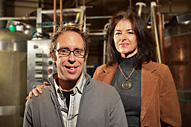
If gung-ho could be bottled, Matt and Rene Greff would probably put it in a microbrew. Owners of ever-popular Ann Arbor Brewing and Corner Brewery in Ypsilanti, the couple are practically poster children for the region's unique personality. Quirky, entrepreneurial, civic-minded, and opinionated, Concentrate talks business, politics, downtown development and, oh yeah, beer with this dynamic duo.

Video The Business Of Making Music

If you missed last week's speaker event with Sam Valenti IV fear not. We've got you covered. Check out this video copy of Sam's talk, which included the who, how and why of Ghostly International, what they're doing now, where they're headed next and why Ann Arbor is the perfect home base for this cutting edge music label.

World takes notice of opening of U-M’s Venture Accelerator

The University of Michigan's North Campus Research Complex was in the news last week, specifically its Venture Accelerator, and the world took heed. Check out what everyone from near and far is saying about the new start-up incubator.Excerpt:When drugmaker Pfizer Inc. announced four years ago it would close its massive research and development center in Ann Arbor -- the home of University of Michigan -- academic and government leaders were stunned at the punch in the economic gut.Four years later, after an unlikely series of events during Michigan's long, painful recession, officials call the redevelopment of the 174-acre, 30-building North Campus Research Complex as a starting point for the state's economic recovery.University leaders on Tuesday officially unveiled the Venture Accelerator, a business incubator for startup companies possessing promising technology bubbling up from the university's classrooms and laboratories. The incubator, which takes up a small part of the sprawling complex, has signed one company and hopes to have four more join within weeks to grow their business and commercialize their technology."We didn't quite know what to expect when this first happened," said university President Mary Sue Coleman. "Initially, we thought, 'Well, maybe another company will come in and snap up the property.'"Read the rest of the story here, and more here, here, here, here and here.

Roll out the green carpet for U-M’s show of sustainability

While the University of Michigan's physical footprint may be growing, its environmental toll is shrinking. According to the 2010 Sustainability Annual Report, for the year ended June 30, 2010, total building square footage increased by 8% (mostly due to the acquisition of the North Campus Research Complex property) and campus headcount by 2%, but eco-efforts resulted in a 4% drop in normalized (per-person, per-square foot) energy use, a shrinking of the per-person trash heap by 5%, and 3% less water usage."What that [report] is showing us at this point in time is that all of the efforts that are going on in other parts of the university, such as our Planet Blue operations teams... are going through and basically recommissioning buildings and teaching building occupants how to use their facilities the most efficient way possible," explains Terry Alexander, executive director of U-M's Office of Campus Sustainability. "Things that are happening from our IT department in green IT technology, green purchasing from our purchasing department - all of these things are having a positive impact on the university so that we're offsetting that growth," The Planet Blue teams, considered a best practice by other universities nationwide (including the University of California system) have a 5% energy reduction goal for every building they sweep. After completion of the first 44 facilities the report noted a 12% reduction. The teams will be passing through 30 more buildings each this year and next. Projection of 2011 results would be premature, given that the North Campus Research Complex occupancy rate, and accordingly energy use, will only grow, Alexander points out.While stats and technical play-by-plays relay the message, without individuals' buy-in these efforts only go halfway, Alexander says. "That's where a lot of places don't really hit it. They'll do the building itself but they won't necessarily get the people involved in it. From our standpoint, if we have the ability to get the people that work [there] to be a part of it, they come up with a lot of great ideas on their own about how they can improve the building." As an example he cites the IT department's decision to move their server farms, which require cooling, from individual buildings to a central server system. "But if we hadn't been there to get the people involved we probably would not have known that was one of the issues we would have had to overcome."Source: Terry Alexander, executive director of U-M's Office of Campus SustainabilityWriter: Tanya Muzumdar


U-M is the place for Apple product savings

The University of Michigan and "inexpensive" are not usually mentioned in the same breath. That is, unless you're a student looking for the latest in tech that's below normal market prices. LifeHacker recently used U-M as an example of where to buy Apple products on the cheap.Excerpt:I can back this up at my alma matter as well, and it works for hardware, too. Take a 13" MacBook Pro, for example. At Apple.com, you can punch in your college and get a nice $168 discount, but buying that same model from the University of Michigan's Computer Showcase gets you an extra $50 off Apple's discounted price. Furthermore, the University offers a package of computing essentials to first-years, including Microsoft Office, a laptop sleeve, an 8 GB flash drive, a 4-port USB hub, Ethernet cable, and a security lock, adding even more value to the overall package. You have a bit less leeway as far as customization goes, but they still have a pretty wide range of models available.Read the rest of the story here.

U-M spin-off 3D Biomatrix to bring 3D cell matrices to market this year

Some of the companies looking to move into the Venture Accelerator at the University of Michigan's North Campus Research Complex are enabling research rather than actually conducting it.3D Biomatrix is a prime example. The University of Michigan spin-off develops and makes 3D cell matrices for cell growth in testing. These small scaffoldings provide small dips for the cells to develop. Most of the current products on the markets offer flat surfaces, such as slide or Petri dishes.  "We have had some sales of the scaffolding and we are about to sell the commercial drop plates," says Meghan Cuddihy, senior scientist with 3D Biomatrix. "We're ready to commercialize."The three-person company is hammering out the details for a lease at the Venture Accelerator. It expects to begin selling its products, with more in the offering, later this year.Source: Meghan Cuddihy, senior scientist with 3D BiomatrixWriter: Jon ZemkeRead more about Metro Detroit's growing entrepreneurial ecosystem at SEMichiganStartup.com.

Our Partners

30044
30045
30046
30047
30049
Washtenaw ISD logo
Eastern Michigan University
Ann Arbor Art Center
UMS
U of M Arts Initiative
Engage EMU

We want to know what's on your mind.

Close the CTA

Don't miss out!

Everything Ann Arbor and Ypsilanti, in your inbox every week.

Close the CTA

Already a subscriber? Enter your email to hide this popup in the future.