Ann Arbor

Rain washes clean in Burns Park porous alley project

When it rains, it pours in Washtenaw County. Rain falling onto impervious pavement courses into storm water systems which carry pollutants such as motor oil that wash off the county's roads into creeks and the Huron River. To better manage capacity in the storm water system and raise water quality, permeable pavement installations that allow rainwater to soak into the ground, where natural filtration occurs before rainwater makes its way into the groundwater, are becoming increasingly popular eco-conscious projects in municipalities. As such, a porous alley is planned for Ann Arbor's Burns Park neighborhood. Nick Hutchinson, project engineer for the city of Ann Arbor, says the rebuilding of the 12-foot wide residential alley spanning between Lincoln Avenue and Martin Place is expected to commence this August and should take no longer than one-and-a-half months to complete.The alley design isn't complete yet, but Hutchinson's cost estimate is around $165,000. The cost will be funded via a low-interest loan from Michigan's Dept of Natural Resources and Environment, which also has a 50% loan forgiveness offer through its State Revolving Fund. The remaining half will be covered by the city's storm water fund.Permeable pavement is costlier than typical resurfacing projects mostly because of the need to build underground stone beds to hold water before it can filter into the ground. These installations work particularly well in areas with well-drained, sandy soils, Hutchinson explains. "They can be built in other places too, but in places where you've got clay you're probably not going to get the water to go into the ground. It's more of a temporary storage of the water before filtering and releasing into the storm system. We have very good soil conditions in this project and we're expecting to get all of the water going into the ground instead of going into the storm system."Hutchinson cites the city of Chicago's Green Alleys as instances of successful porous alley projects. While the Burns Park neighborhood will be the site of the city's first porous alley, this is not the first time the city has experimented with permeable pavement. Porous pavers were installed on Easy Street, and Sylvan Avenue was reconstructed out of porous asphalt last summer. The city is monitoring the hardiness of these installations; it's still too early to tell how well they will hold up, although research has been encouraging, he adds."I think it's definitely the wave of the future. We're going to see more and more porous pavements, especially if the ones that we've put in so far perform well." A public meeting to explain the Burns Park Porous Alley project is scheduled for tonight, Wed. Jan. 19 at 7PM, at the Burns Park Elementary School cafeteria, 1414 Wells St. For more information, email nhutchinson@a2gov.org.Source: Nick Hutchinson, project engineer for the city of Ann ArborWriter: Tanya Muzumdar


NY Times on Ann Arbor Caldecott winners

Ann Arbor, the college town known for trees and books, now has the hardware to back up its literary claim to fame. Erin and Philip Stead, Ann Arbor residents, recently won the Caldecott medal for their illustrations in the children's book, A Sick Day for Amos McGee.Excerpt:The winner of the Caldecott medal, A Sick Day for Amos McGee, was also a debut by its authors, a husband-and-wife team in Ann Arbor, Mich. It is the story of a zookeeper and his tender friendship with the animals, and was published by Roaring Brook Press, an imprint of the Macmillan Children's Publishing Group.Mr. Stead said he and Ms. Stead conceived the project in 2006, when they were living in Carroll Gardens, Brooklyn. (They first met in a high school art class in Dearborn, Mich.) Now they work together in the same studio in Ann Arbor, when Mr. Stead is not teaching graphic design at Washtenaw Community College, a side job. Read the rest of the story here.

U-M biz engagement, tech transfer offices move to NCRC; Venture Accelerator opens
Wind-powered church practices what it preaches

n her musings, writer and poet Janet Frame presciently noted: "Electricity, the peril the wind sings to in the wires on a gray day."With mounting concern over sourcing energy, groups are pooling their resources to fund alternative energy projects. And religious organizations, many with large and diverse memberships, are no exception. Case in point: Last November the First Unitarian Universalist Congregation of Ann Arbor installed a 2.5KW wind turbine system in its parking lot, together with 48 solar panels on the church roof that generate an additional 10.8 kilowatts of energy. Together, the installations are expected to save the church up to 20% on its annual energy costs, according to Dave Friedrichs, chair of the congregation's renewable energy committee and managing member of Homeland Builders of Michigan, LLC.Friedrichs says after the church moved to a 45-acre site on the south side of Ann Arbor, members were focused on how best to use the land. The impetus behind the renewable energy projects was a result of "..the raising of the concerns of the congregation in general about energy issues and… our desire to increase sustainability and lessen the dependence on fossil fuels."The $30,000 wind turbine portion of the project was funded almost entirely through the sale of personalized paving stones to be used in a renewable energy plaza on the premises - scheduled for completion by Earth Day, April 22. Next in the energy pipeline, although no start date has been set yet, will be an amping up of the solar panel installation to accommodate up to 100KW of energy generation, Friedrichs says. The church is a member of Michigan Interfaith Power & Light, a non-profit coalition supporting energy efficiency and renewable energy projects in the faith community statewide. While it's not at all unusual for faith-based organizations to install solar panels on their properties, wind turbines are a rarity due to the need for open space and good elevation. This wind turbine sits atop an 85-foot monopole in the parking lot, an open area at an elevation of just over 900 feet. The wind activity is good, Friedrichs notes. Energy production and cost savings statistics are available on the congregation's website."[People] are able to have a real test case right here in Ann Arbor where they can watch and listen to a wind turbine. It's doing its educational job," he explains. "It's an item of curiosity and it's almost taken for granted now... People don't even notice it. They park their cars and go about their business. It's part of the anatomy of the church...parking lot now."Source: Dave Friedrichs, chair of First Unitarian Universalist of Ann Arbor's renewable energy committee and managing member of Homeland Builders of Michigan, LLCWriter: Tanya Muzumdar

U-M start-ups look to repeat successes at Clean Energy Prize
Ann Arbor VCs stand to gain from $120M Venture Michigan Fund II

Thanks to the launch of the Venture Michigan Fund II, venture capital firms in Michigan have $120 million in new funding available to them and Ann Arbor-based firms are well positioned for a shot at that money.The new fund will be run by Credit Suisse and serves as the sequel to the $96 million Venture Michigan Fund launched in 2006. The Venture Michigan Fund II will act as a fund of funds, investing its capital in local VC firms. Those firms will use the money to invest in seed and early stage Michigan-based start-ups in the advanced manufacturing, health-care, life sciences, IT, alternative energy, homeland security and defense sectors.Ann Arbor-based VC firms and start-ups received the lion's share of the first Venture Michigan Fund. Nine of the 11 VC firms to receive commitments from the first fund were either based in Ann Arbor or have offices there. Twelve of the 15 start-ups that have received VC investments are also based in Ann Arbor."Most of the firms based in Michigan are based in Ann Arbor," says Bob Payne, who runs Credit Suisse's Michigan-based investment funds. "A lot of that comes from the University of Michigan Office of Tech Transfer."State tax vouchers are providing the capital for the Venture Michigan Funds, the first of which is fully committed to 11 venture fund vehicles, with about one-third of that money invested in 15 Michigan-based companies. That money supported the creation of 200 new jobs and has leveraged $186 million from other investors.The idea behind the Venture Michigan Fund is to grow the state's fledgling VC industry. Many of those firms (both new and established) are in based in Ann Arbor. A Thomson Reuters study shows that there were 26 VC investments in Michigan in 2006, representing $117.3 million. Those numbers went up to 44 deals worth $231.1 million last year, the year the U.S. officially emerged from a recession.Source: Bob Payne, manager of the Michigan Venture Fund II Writer: Jon ZemkeRead more about Metro Detroit's growing entrepreneurial ecosystem at SEMichiganStartup.com.

More Than Just Good Timing: A Q&A with Ben Kazez

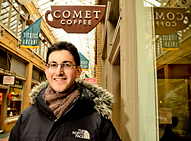
Ben Kazez defines the new economy lifestyle. He's the founder of a successful mobile app start-up, lives near Kerrytown, and walks to his downtown office. With promises that success won't lure him away (Mobiata was acquired by Expedia last fall), Concentrate chatted with Kazez about good food, apps, and launching a start-up.

HealPay turns debt collection into mobile app start-up

Erick Bzovi and Lance Carlson knew they wanted to get a piece of the emerging mobile app game, and saw their best shot in a sector most people wouldn't expect – debt collection.The pair of young entrepreneurs started HealPay in Ann Arbor nine months ago. They now have a team of six people who have helped get the idea from concept to Beta testing last fall to market debut earlier this month. "A lot of these payment collection programs are ripe for innovation," Bzovi says.He points out that debt collection is a fragmented industry that hasn't been a leader when it comes to keeping up with technology trends, such as mobile apps. HealPay's app automates the collection process by integrating it with other software programs, such as accounting software. The duo is now focusing its effort on municipal debts, such as parking ticket fines."This presents an opportunity to streamline a fragmented industry," Bzovi says.Bzovi and Carlson plan to focus on getting HealPay to be adopted in Michigan municipalities during the first quarter. They hope to start spreading it across the Midwest by this spring/summer, and even the nation by the end of the year. If successful, they expect to have a staff of 15-20 people by 2012.Source: Erick Bzovi, co-founder of HealPayWriter: Jon ZemkeRead more about Metro Detroit's growing entrepreneurial ecosystem at SEMichiganStartup.com.

Greenfield Partners move to A2 because of start-up scene

Ann Arbor's entrepreneurial reputation not only preceded the move of Greenfield Partners, but it inspired the investment firm's move to Tree Town.The Bloomfield Hills-based firm run by Benjamin Rye and his father, Jon Rye, both University of Michigan graduates, is in the midst of moving to Ann Arbor's start-up rich pastures. The reason? The multitude of investment opportunities coming from U-M."It's really a question of brain power," says Benjamin Rye, managing partner of Greenfield Partners. "We see a number of opportunities in Ann Arbor because of the entrepreneurial culture."Jon Rye started Greenfield Partners in the 1980s, focusing his efforts on private equity and business turnarounds. He put the company on hold in 1995 until resurrecting it in 2008 with his son. Now the younger Rye plans to focus on seed investments coming from places like U-M's School of Engineering. Jon Rye plans to be active in the firm from a private equity standpoint.Both Ryes and one more principal plan to raise an investment fund this year. The team plans to have a fully funded investment vehicle and 1-2 portfolio investments primarily made up of university spin-outs and Ann Arbor-based firms by the end of the year. To start, Greenfield Partners is offering a $10,000 grant to a student-run start-up participating in an entrepreneurial experience contest at TechArb. "We think Ann Arbor is going to be the hub for the state moving forward," Rye says.Source: Benjamin Rye, managing partner of Greenfield PartnersWriter: Jon Zemke

Defense contracts fuel ePack’s growth; hires planned

The Accelerate Michigan Innovation Competition served a higher purpose for ePack than the normal networking and fundraising efforts. It helped the Ann Arbor-based company take a serious look at itself."It was a good excuse to re-evaluate our business plan and get some feedback," says Jay Mitchell, president of ePack.Part of that re-evaluation is a tweaking of its focus. The start-up that is developing technology to protect micro devices is shifting its focus from consumer electronics to defense. Revenue at the 3-year-old company reached $400,000 in 2010, with about two-thirds of that coming from government defense grants."We're going to focus on the lower-volume and higher-margin markets," Mitchell says.ePack's two co-founders are now full-time with the company after serving as part-time researchers at the University of Michigan. Mitchell expects to go after more grants and contracts in 2011, which should allow the company to go from two full-time employees and an independent contractor to a staff of 4-5 people full-time.ePack expects to finish product development and bring it to market within two years. The long-term plan is to reach the point where it can open a manufacturing facility.Source: Jay Mitchell, president of ePackWriter: Jon Zemke

Our Partners

30044
30045
30046
30047
30049
Washtenaw ISD logo
Eastern Michigan University
Ann Arbor Art Center
UMS
U of M Arts Initiative
Engage EMU

We want to know what's on your mind.

Close the CTA

Don't miss out!

Everything Ann Arbor and Ypsilanti, in your inbox every week.

Close the CTA

Already a subscriber? Enter your email to hide this popup in the future.