
Sustainability

More density coming to U-M’s campus in big and small projects

Space is becoming more and more of a luxury on the University of Michigan's campus. Urban-style housing is popping up like dandelions, creating greater density.Big projects like the 26-story 601 Forest and 10-story Zaragon Place Lofts grab most of the headlines, erasing decades old buildings for super-dense student housing. But such big-foot tactics are occurring on a smaller scale, too.The latest example is the 133 Hill project, which was recently given the green light by the Ann Arbor City Council. That project basically calls for razing an existing single-family home for a tri-plex on the edge of the "student ghetto" on Hill Street about a half block east of Main Street. The 1.5-story house has been there since 1901, but lies in an area where zoning calls for multi-unit dwellings. Replacing it will be a 2.5-story structure that will, from the curb, look much like a normal Midwestern-style home.Inside, however, the building will have 8,150 square feet of space, divided into aprtment units. Five parking spaces are being installed behind the building. Of those parking spaces, three will be covered. There will also be 11 spaces for bicycles and a rain garden.The surrounding area is a mix of small apartment buildings and single-family homes turned into student housing. Some homes for townies are also sprinkled into the neighborhood that has become more oriented to student-housing in recent decades because of its close proximity to Elbel Field and U-M's athletic campus.Source: City of Ann ArborWriter: Jon Zemke

Latest in Sustainability
Ride Boutique creates Ann Arbor-brand bicycles

Ann Arborites are proud of their against-the-grain reputation, not the least of which is an ability to embrace eco-friendly trends long before they're fashionable. One local business plans to make a mint combining those two instincts â€“ Ride Boutique. The custom-bicycle builder is teaming up with two major bicycle manufacturers to design a pair of Ann Arbor-centric bicycles that will be sold exclusively in Tree Town."We're trying to brand a bike with a community that really embraces the fact that it loves bicycling," says Chad Johnston, owner of Ride Boutique.Ann Arbor has long been known as one of those places. The city is a leader in creating bike lanes and trails (it has built 43 miles so far) along with installing dozens of bike racks and lockers downtown. It even has its own plan for non-motorized transportation.It's why Johnston set up shop just north of downtown two years ago. Ann Arbor just seemed like a great place for bike nerds like him. Yeah he lives in Fenton, but Johnston parks his car 10 miles outside of Tree Town and bikes in the rest of the way to work... year round. To him The Deuce is ripe to sell bikes at a few thousand dollars a pop.Today the store has four people and 20 bikes on the floor. The Ann Arbor-brand bikes will take center stage within the next few weeks.Ride Boutique's cycles will be custom designed by Massachusetts-based Seven Cycles, whose popular Axiom bike --called Axiom Ann Arbor-- will sell for $6,000. The second will be from Wisconsin-based Waterford, selling at the more price conscious $1,500. Both bikes will have a graphic montage of trees and water around the word "Ann Arbor," along with a number of racks and lights Johnston and his staff have noticed that Ann Arborites prefer."Just looking at the bike you know where it's from," Johnston says. "It's a bike you see people riding in Ann Arbor all of the time."Source: Chad Johnston, owner of Ride BoutiqueWriter: Jon Zemke

U-M’s Planet Blue energy audit expected to yield $11 million in savings

Ten percent of $111 million is a lot of money, even in a world where the Canadian dollar outpaces the American green back. And that $11 million is what the University of Michigan hopes to save in energy costs in the next three years as part of its Planet Blue program.Those savings will come by creating efficiencies in 90 of the university's buildings, and training staff to "think about what they're doing and how that can save energy," says Jim Erickson, a spokesman for U-M. How? By moving computer servers to climate-controlled rooms and turning off energy-hogging machines when not in use. The Planet Blue program is the latest in the evolution of university efforts to cut energy costs and establish sustainable practices. The program's annual $5 million price tag is expected to be recovered through energy savings within two years of full implementation. As of now, five buildings have been targeted in the program's pilot phase, which wrapped up this summer. Thirty more structures are in line for an energy audit within the next year, 30 the following year and 30 more the year after that.The first five buildings included the Institute for Social Research, Chemistry, Space Research, Rackham and Fleming. Among the efficiencies that have been discovered are installing occupancy sensors for fume hoods in the Chemistry Building ($200,000 saved annually) and moving a computer server room from Fleming's basement to a climate-controlled data center in an adjacent building ($97,000). Others include reducing operating hours for HVAC fans in the Institute for Social Research's Thompson Building ($80,000) and installing daylight/occupancy sensors in six Rackham rooms ($13,000). University officials consider the changes as inexpensive, low-hanging fruit for saving energy."A lot of it is installation of relatively small pieces of technology," Erickson says.Source: Jim Erickson, spokesman for the University of MichiganWriter: Jon Zemke

AATA to put more hybrid buses on road, builds new shelters

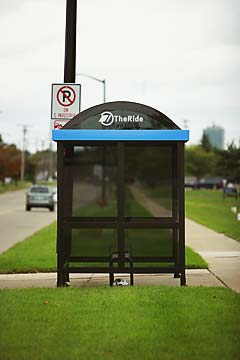
Now that more people are riding the bus in Washtenaw County, more hybrid buses are being brought on line by the Ann Arbor Transportation Authority. Better yet, much-needed shelters are popping up around town.New shelters have been installed at seven Ann Arbor area bus stops. Each has surpassed a 50 passenger per day average. That makes for 22 new shelters installed so far this year bringing the total to 90 on AATA routes. More are planned for next year.And since seven seems to be the lucky number, seven new hybrid buses are set to go into service next April. AATA began adding the fuel efficient vehicles to their fleet last year. Currently 20 out of the 69 buses in service are hybrid. "We are eventually going to replace the entire fleet, but only as they reach the end of their nine-year lifespan," says Lois Crawford, spokeswoman for AATA.The hybrid buses are built by Hayward, California-based Gillig Corp and are significantly more fuel efficient. AATA expects to buy 80,000 fewer gallons (10 percent) of B10 bio-diesel this year because of them. The hybrid buses also produce lower levels of pollution, making them a key component of Mayor Hieftje's initiative to make Ann Arbor more environmentally friendly. Recently, the city started a campaign to transition all its facilities to 30% renewable energy by 2010.Source: Lois Crawford, spokeswoman for AATAWriter: Jon Zemke

Ann Arbor’s Archiopolis Architects aims for energy efficient designs

Archiopolis Architects isn't just about creating great architecture in Ann Arbor, it's a leader in sustainable architecture.

Local dining spots buying more from local farmers

More and more Ann Arbor restaurants are making their greens greener by using more locally grown foods in their servings.

Ypsilanti fair showcases alternate transportation

Ypsilanti's leaders are looking to find more ways to get downtown and Depot Town patrons from Point A to Point Y and back again without automobiles.

Ann Arbor’s Kaydon expects big financial gains with wind energy

Ball-bearing manufacturer Kaydon expects to make big gains in its business plan this year as it starts to shift production to making parts for turbines.

Bridgewater Township homeowners go geothermal

The word geothermal is becoming more commonly used locally as both an earth and a money saving term, as another Ann Arbor-area homeowner is demonstrating.

Thompson Block project receives $185,000 brownfield tax credit

Work behind the scenes of the Thompson Block project is moving forward as the state approves a $185,000 tax credit for the project in Ypsilanti's Depot Town.

Our Partners

30044
30045
30046
30047
30049
Washtenaw ISD logo
Eastern Michigan University
Ann Arbor Art Center
UMS
U of M Arts Initiative
Engage EMU

We want to know what's on your mind.

Close the CTA

Don't miss out!

Everything Ann Arbor and Ypsilanti, in your inbox every week.

Close the CTA

Already a subscriber? Enter your email to hide this popup in the future.