Technology

Evigia Systems’ sensor products score award from Frost & Sullivan

Evigia Systems has garnered the prestigious independent industry recognition for its wireless sensor and RFID products, winning the Product Line Strategy Award for Wireless Sensing Systems from Frost & Sullivan. Accolades like this and continuous growth have allowed the Ann Arbor-based company to expand their business in Michigan. "We have been continuously growing," says Navid Yazdi, CEO of Evigia Systems. "The business we are in is a rapidly growing market. This is an incredibly resilient market." Evigia Systems develops and creates wireless sensing products. Its EV3 platform delivers smaller size, higher energy efficiency and lower cost products which allow significant improvement in the performance and cost of wireless sensing networks. Yazdi declined to say how many people in total work at Evigia Systems, but did say the seven-year-old company has added four people in the last nine months. That has been on the strength of its sales to government and commercial entities, such as the U.S. military, aerospace and transportation markets. This year Yazdi plans to have Evigia Systems release a few new products and expand in the new markets, such as industrial asset tracking and condition monitoring. Source: Navid Yazdi, CEO of Evigia Systems Writer: Jon Zemke Read more about Metro Detroit's growing entrepreneurial ecosystem at SEMichiganStartup.com.

Latest in Technology
Got Talent? A Conversation with Kurt Riegger

When it comes to building a vibrant entrepreneurial ecosystem, Kurt Riegger, COO of OcuSciences, argues that there's no lack of ideas or innovations in Ann Arbor. Talent with enough experience to execute on those ideas may be another question. Riegger has launched, funded, and advised 26 companies, and chats with Concentrate about what our community needs to succeed.

U-M prof weighs in on tech bubble predictions

A U-M engineering professor takes a look at the latest bubble-like eruptions in the tech market and figures whether the valuations are justified. Excerpt: "The ‘right’ answer, albeit wholly unsatisfactory, is that it depends on how one looks at these companies’ business models and value capture potential, Groupon’s recent unconventional revenue reporting notwithstanding. So let’s dissect business model and value capture potential differences between the dot-com boom and what is going on with the social network companies right now." Read the rest of Peter Adriaen's column here.

Richard Florida says density = innovation

Though we have to wonder whether it's density or really the presence of world-class research universities that have the bigger impact (or is that a chicken-egg question?), Richard Florida presents some interesting ideas about urban density and the creation of patents. And Ann Arbor makes the list! Excerpt: "It's not surprising that San Jose (Silicon Valley) tops the list with .831 patents per square kilometer or that nearby San Francisco is second with .446 patents per square kilometer. Los Angeles is third with .41 patents per square kilometer, followed by Trenton, Bridgeport-Stamford, Connecticut, Greater Boston, Boulder, Greater New York, Ann Arbor, and New Haven. The density of patents is closely associated with key regional economic outcomes such as regional wages (.668), regional incomes (.588), and regional economic output (.459). (As usual, I point out that these correlations only suggestion associations between variables. They do not specify any causation or make any claims about the direction of causality. Other intervening variables may come into play)." Read the rest here.

Maker Works: The Revolution Will Be Robotized

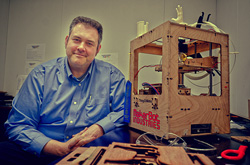
Maker Works is the future of manufacturing. Tom Root, managinmg partner of Zingerman's Mail Order, has help found the ultimate D.I.Y. workshop, a place where members can access high-tech machines and learn to bring their designs to fruition.

Video Start-up 101: Mentoring new U-M businesses

Sometimes a little guidance goes a long way. U-M's Tech Transfer office along with its new Michigan Venture Center have started a mentorship program that turns technologists into entrepreneurs. As a result they expect to see a 20% bump in start-up launches.

MichBio, KnowledgeWatch grow through new media partnership

A local start-up and economic development non-profit are forming a new partnership they believe will not only spur more business growth in Ann Arbor's bio-tech sector, but also the economy for the state overall and eventually the country. MichBio and KnoweldgeWatch, both based in downtown Ann Arbor, are collaborating to create miBio NewsWatch, a news and information gathering channel for Michigan-based biosciences companies. The news service, created and managed by KnowledgeWatch, will aggregate concentrations of bioscience news with content that focuses on their market segment. "We're accessing some 20,000 bioscience articles everyday," says Don Hogan, CEO of KnowledgeWatch. "That's from about 875 bioscience sources out there." The new miBio NewsWatch will allow users to search for relevant stories and pieces of information with key words, instead of wading through numerous headlines each day. The news service will be available to MichBio's members. Non members are eligible for a free 14-day trial. Hogan and MichBio president and CEO Stephen Rapundalo believe this new service will first gain traction in Ann Arbor and Michigan before spreading to the dozens of other states that are working to develop bio-tech industries. Source: Don Hogan, CEO of KnowledgeWatch Writer: Jon Zemke Read more about Metro Detroit's growing entrepreneurial ecosystem at SEMichiganStartup.com.

U-M Tech Transfer breaks records in tech commercialization

Officials at the University of Michigan Office of Tech Transfer like to say that they are striving for more quality start-ups rather than more stats. That doesn't mean they can't do both. The university recorded 101 license and options for its technology in the fiscal year ending on June 30. That's more than any other previous year. U-M researchers also recorded 322 inventions and filed for 122 patents. U-M also helped launch 11 start-ups that utilize technology originating in university labs. "Doing more is good," says Ken Nisbet, executive director of University of Michigan Office of Tech Transfer. "But doing more high-quality agreements is better. We strive for that." U-M Tech Transfer is also focusing on helping guide these start-ups from initiation to acquisition. A key part of that transition is its new Venture Accelerator at the North Campus Research Complex. The Venture Accelerator provides lab and office space, along with other business development resources for U-M start-ups. So far 10 start-ups are occupying the space, including some venture-backed firms. "We're doing things to complete the opportunity, to package it and make it attractive for people to invest their time and money," Nisbet says. U-M recorded $16 million in tech transfer revenues, which include royalties and equity returns. These revenues are reinvested in research and education. U-M's total research spending hit $1.24 billion last year. "Our pipeline is very strong," Nisbet says. "We have great people and great research." Source: Ken Nisbet, executive director, University of Michigan Office of Tech Transfer Writer: Jon Zemke Read more about Metro Detroit's growing entrepreneurial ecosystem at SEMichiganStartup.com.

Smart Parking In Ann Arbor

Though traditional coin-operated parking meters may evoke feelings of nostalgia (followed by memories of ticket-fueled anger), Ann Arbor has been adopting innovative approaches to downtown parking management. And while we may be ahead of the curve for a city our size, there are even more cutting edge technologies out there. Concentrate's Natalie Burg takes a look.

U-M and city of Ann Arbor team up to pursue gigabit broadband networks

Blink and it's gone. Or maybe it's still coming. In a push to reach eye-opening speeds for broadband internet service, the University of Michigan and the city of Ann Arbor have joined Gig.U, a nationwide consortium of 29 universities pressing for the deployment of ultra high-speed networks to research universities and their home communities. We're talking networks with speeds in gigabits per second – 1,000 times faster than the megabits per second services commercially available.Gig.U, launched in late July, was fueled by the unprecedented public response to the Google Community Fiber competition, says Dan Atkins, the associate vice president for residential cyber infrastructure and W.K. Kellogg Professor of Community Information at the University of Michigan. Over 1,100 communities nationwide, including Ann Arbor, vied last year to be the recipients of an experimental one-gigabit broadband network. Just two – Kansas City, Kan. and Kansas City, Mo. – were chosen.This enthusiasm prompted Blair Levin, former staff director of the Federal Communications Commission's National Broadband Plan, to visit universities around the country to see whether this interest could be funneled into finding other sources to build these high-performance networks. The thinking went, as Atkins relates it, "Is there any way we can form a coalition to get additional resources to invest in more gigabit community experiments than the two that Google has?"Such powerful networks could be used in high definition video conferencing, for possible applications in the biomedical and telemedicine fields, and for information sharing between universities, Atkins says. And Gig.U sees them as a driver of economic growth and entrepreneurship in their neighboring communities, enabling advances made on campus to be applied offsite.Yet the fact that there's no crisp answer to the demand question is part of the problem of why gigabit speeds aren't yet a reality, according to Atkins. "This does have the flavor of a build it and they will come figure out what to do with it kind of thing." He coins the effort a "long shot". It's a 'Which comes first?' issue of entities like AT&T and Comcast wanting to know the demand before investing in such costly infrastructure. Gig.U is calling for private funding for this initiative."So the question is, is there any way that this coalition of universities could help break the chicken or the egg cycle... could they play a kind of a neutral convening ground that might even get an AT&T and Comcast and a Verizon or some others to come together and try some pilot projects, co-invest in some pilot projects to establish some additional gigabit communities beyond what Google is doing. And maybe a little bit of their incentive might be the fear of Google, of Google actually entering the gigabit network market and figuring out a business model for supporting gigabit networks before they do," he poses."The whole history of technology illustrates that when a fundamental capability is there, that people figure out how to use it and it quickly doesn't become enough," Atkins points out. He cites Thomas Watson, an early president of IBM, who speculated that at most six computers would be all the country would need. And, he adds, "The original backbone for the ARPANET, the thing that started the internet – the speed of that, the superhighway for that – was an order of magnitude slower than the network connection you have coming into your home."Google has made its awards, but that doesn't mean this gig is up. "There are some [entities] who've stepped forward to try to capitalize on the work and energy and the statements of interest and to find a way of getting resources for more communities to explore gigabit connectivity. Ann Arbor and the U-M are one of those," Atkins says. "And stand by for future developments."Sources: Dan Atkins, associate vice president for residential cyber infrastructure and W.K. Kellogg Professor of Community Information at the University of Michigan; Gig.UWriter: Tanya Muzumdar


Our Partners

30044
30045
30046
30047
30049
Washtenaw ISD logo
Eastern Michigan University
Ann Arbor Art Center
UMS
U of M Arts Initiative
Engage EMU

Common Ground Is Brewing

Support local stories and receive our signature roast straight to your door when you join at the Standard level (or above).

Drink Better, Read Local

Close the CTA

Don't miss out!

Everything Ann Arbor and Ypsilanti, in your inbox every week.

Close the CTA

Already a subscriber? Enter your email to hide this popup in the future.