
Technology

Technology, problem solving focus of Ypsilanti New Tech High School

In the real world, people don't work in one spot on one subject for an hour and then turn in a homework assignment. They work together to solve real-life problems. So how do you better prepare students for the real world? You design a school to emulate it.That's the idea behind the New Tech family of schools, one of which will be opening in the Ypsilanti Public school district this September. Ypsilanti New Tech High School at Ardis, in a former elementary school, will help students learn by working on projects that solve problems that integrate subject matter, explains Cory McElmeel, Interim Dean of Instructional Services.The basis of New Tech is engaging students in context. When presented with a program, they create a know and a need-to-know list, including what they yet need to learn to complete the project. Everything is based on the required Michigan curriculum.However, it's not done in typical one-class-per-hour fashion. Longer classes integrate subject matter: Biolit will be a combination of biology and English language arts, perhaps studying literature about ecology or genetics. Other combinations are Geoart (geometry and three-dimensional art), and Historytech, combining American history and geography with technology and communications. Double-sized classrooms will accommodate two teachers apiece, one for each of the integrated subjects.New Tech will also help students prepare for college; graduates are required to earn college credit and complete an internship. College freshmen often see a drop in grades as they get used to their new freedoms, and "part of New Tech is to get students to understand those freedoms," McElmeel says.Among the updates that had to be done was remodeling bathrooms to high-school size and installing lockers and windows to ready the school for its fall opening. A science lab will be built next year. Wireless Internet and additional electrical outlets were installed for MacBook computers, refurbished from previous teacher use, that each student will use. Interactive whiteboards were also brought over from now-closed schools, saving money."Having a laptop is key for students," McElmeel explains, enabling students to congregate and move around to solve a problem. "That desktop becomes a barrier between the students. Laptops can be moved aside."Enrollment is capped at 125 and includes a range of students, not just those who happen to be technologically minded. "It works for all the gamut of students," McElmeel says. "This program, because it's built on a need-to-know curriculum and working in groups, it works for any type of student."Ypsilanti New Tech was supported by grant funds, including a $450,000 grant from the Ann Arbor Community Foundation for new software and professional development. The facility update came from leftover bond funds."We do feel very lucky in Ypsilanti," he says of receiving the funding. "It's key to us. We would not have been able to bring this awesome program to our district."Ardis, at Ellsworth Road near Hewitt Road in Ypsilanti Township, was closed by the district in 2005 as part of a budget-cutting move.Source: Cory McElmeel, interim dean of instructional services for Ypsilanti New Tech High School at ArdisWriter: Kristin Lukowski

Latest in Technology
U-M plans to launch start-ups with new Mich Venture Center

The University of Michigan has created a number of avenues to allow entrepreneurs to spin off university technology or enable students to chase after their start-up dreams. The newly formed Michigan Venture Center will serve as the hub for all of that activity."It's meant as a one-stop hub for people interested in working with us on University of Michigan start-up opportunities," says Ken Nisbet, executive director of the Office of Technology Transfer at the University of Michigan.The Michigan Venture Center will allow entrepreneurs, investors and faculty inventors do everything from evolve their start-up to leveraging the university's bevy of inventions, innovations and patents. The main focus is to facilitate the creation of start-ups by helping them form business plans, assess potential for commercialization, attract investors and acquire gap financing.The university has programs and staff to facilitate all of these angles. But bringing them all under one roof at the U-M Tech Transfer's Business Engagement Center --1214 S. University Ave.-- is meant to help streamline the process. So far, the Engagement Center has been involved in the creation of 83 start-ups over the last nine years. "We've had a lot of success at creating new companies," We're easily in the Top 10 of U.S. universities, maybe the Top 5," Nisbet says.For more information on the Michigan Venture Center, send an email to techtransfer@umich.edu or call (734) 763-0614.Source: Ken Nisbet, executive director of the Office of Technology Transfer at the University of MichiganWriter: Jon Zemke

The String’s the Thing

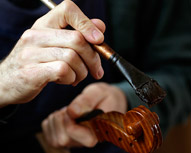
Ann Arbor has an international and rarefied reputation for violin making. Concentrate visits the studios of two local masters --David Burgess and Joseph Curtin-- for a look at the skills, technology and artistry that produces some of the most beautiful sounds in the world.

U-M hits a new record with an invention a day

The University of Michigan always likes to compare itself to the academic elite, like MIT, Stanford and Johns Hopkins. Now it has more than a few inventions to stand on when it makes that assertion.The university pushed the number of inventions it creates to 350 for the 2009 fiscal year, an average of almost one per day. That's in comparison to 487 for MIT, 401 for Standford and 282 for Johns Hopkins in 2007, the marquee names for research, development, tech transfer and commercialization."We're in the big leagues now," says Ken Nisbet, executive director of the University of Michigan Office of Technology Transfer.U-M has sharpened its focus on developing its research and transforming it into new spin-off businesses in recent years. For instance, the university had 158 inventions in 1999 and was only in the mid 200s per year as recently as five years ago. Those numbers started to really race upward in 2007 when U-M hit 327 inventions.Although these numbers are impressive, the university is beginning to focus more and more on the quality of these inventions, patents and other assorted bits of research."It's not even a question of quantity," Nisbet says. "It's whether there is a business that can spin off from it."Source: Ken Nisbet, executive director of the U-M Office of Technology Transfer.Writer: Jon Zemke

Ann Arbor’s tech community banks on millions in federal stimulus funds

If money follows talent, Ann Arbor should be feeling pretty good right now.Excerpt:The federal economic stimulus package is becoming an ATM for Ann Arbor's technology community.The $787 billion program, officially called the American Recovery and Reinvestment Act, is becoming a financial beacon of hope for university researchers and local entrepreneurs.A sudden flood of stimulus funding to the Ann Arbor region reflects the research talent and engineering strength of the local economy.Read the rest of the story here.

Video U-M Students Get A Tech Start

Think of it as a Head Start program for budding entrepreneurs. U-M's Office of Tech Transfer teams students from a variety of backgrounds with university researchers and innovators to start new companies from scratch.

Our Partners

30044
30045
30046
30047
30049
Washtenaw ISD logo
Eastern Michigan University
Ann Arbor Art Center
UMS
U of M Arts Initiative
Engage EMU

Common Ground Is Brewing

Support local stories and receive our signature roast straight to your door when you join at the Standard level (or above).

Drink Better, Read Local

Close the CTA

Don't miss out!

Everything Ann Arbor and Ypsilanti, in your inbox every week.

Close the CTA

Already a subscriber? Enter your email to hide this popup in the future.