
Tinker, EMU’s facilities dog, helps students reduce stress in “open paw-fice hours”
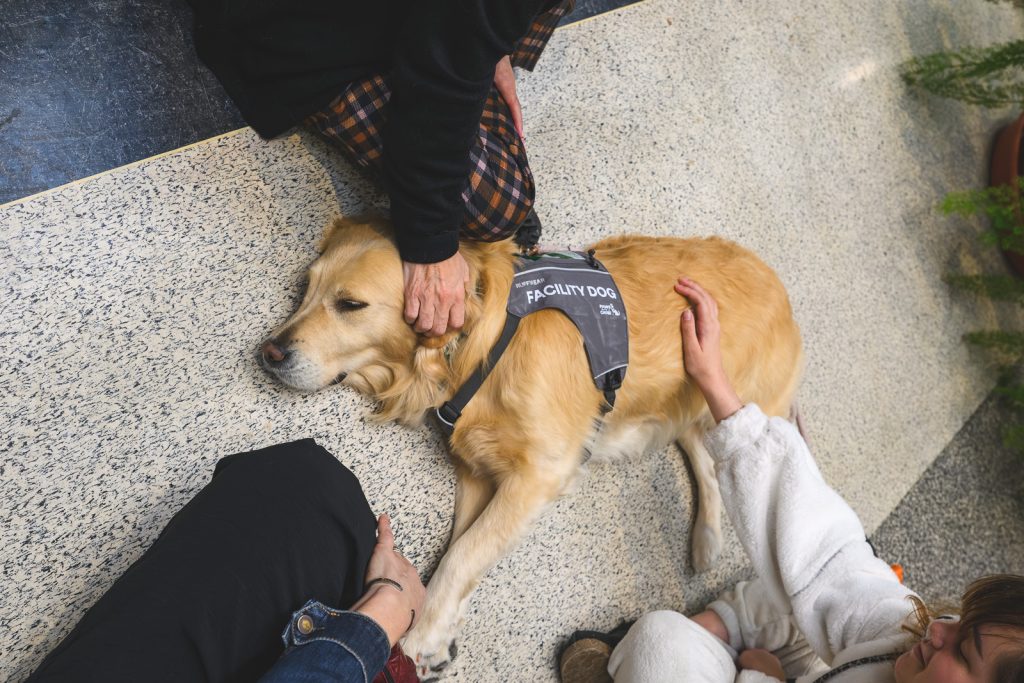
Since fall 2024, Tinker the facilities dog has been available to students four days a week on campus.
On the Ground Ypsilanti is an “embedded journalism” program covering the city and township of Ypsilanti. It is supported by Ann Arbor SPARK, the Center for Health and Research Transformation, Destination Ann Arbor, Eastern Michigan University, Engage @ EMU, Washtenaw Community College, Washtenaw County Parks and Recreation Commission, and Washtenaw ISD.
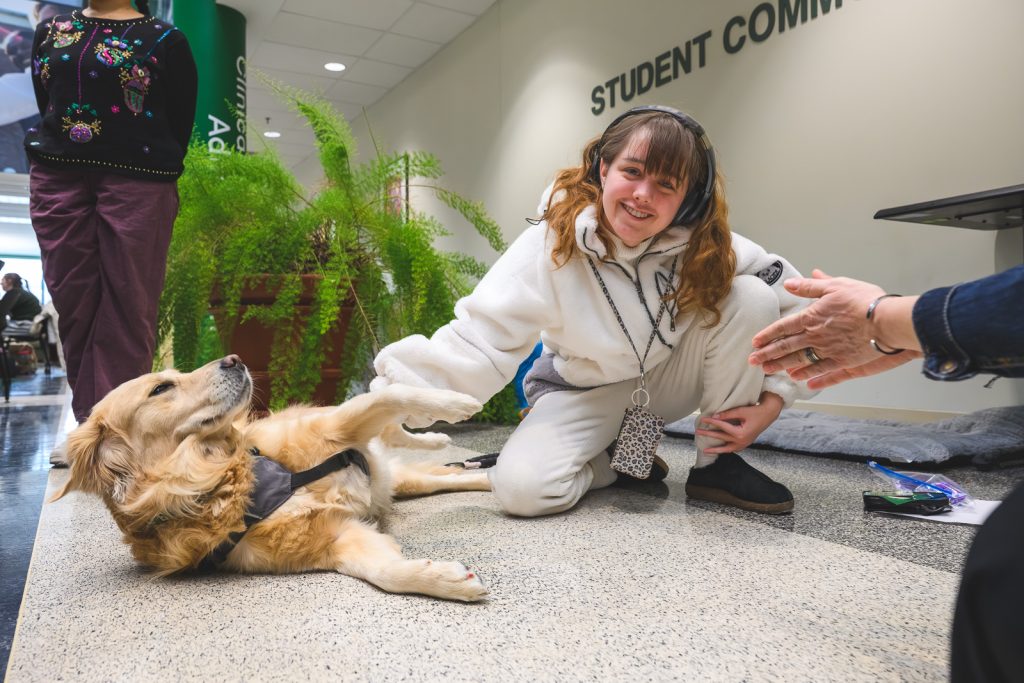
Eastern Michigan University (EMU) freshman Elena Quinonez has been missing her dog and two cats at home, so she recently stopped by “open paw-fice hours” for Tinker, the EMU facilities dog, for the first time. Quinonez says she responded to how “incredibly calm” the not-quite-4-year-old golden retriever is, even when surrounded by multiple humans in a busy student commons area.
“I have ADHD and autism, and when I’m around animals, especially if they’re calm, then naturally I feel calm,” she says.
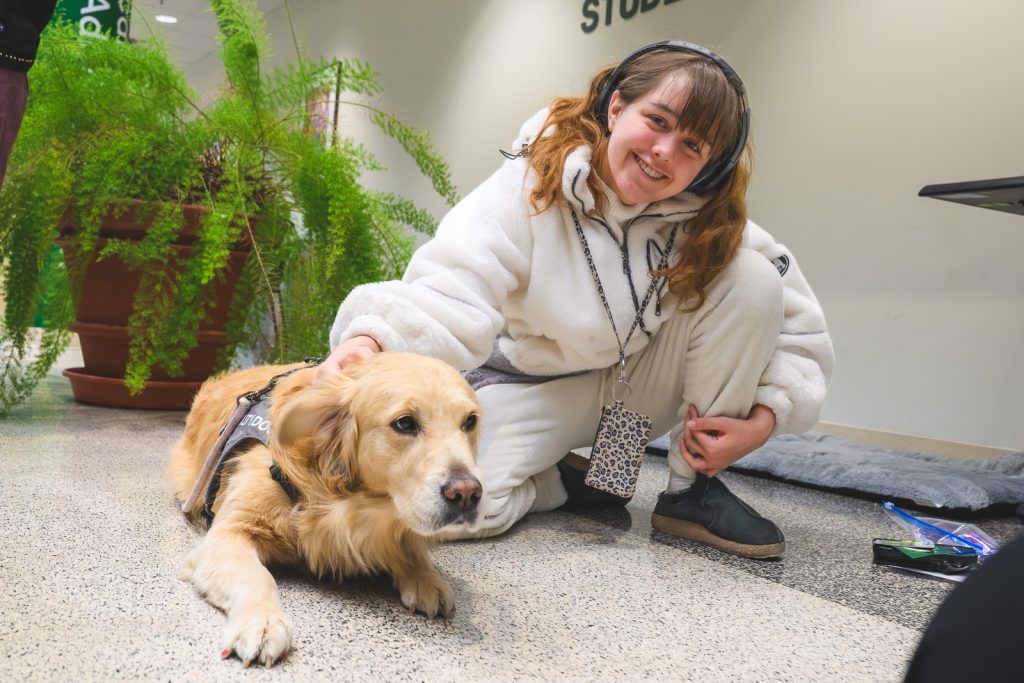
That’s exactly the aim of bringing Tinker on campus, says Jennifer Kellman-Fritz, Tinker’s co-handler and dean of EMU’s College of Health and Human Services. Kellman-Fritz says she’s had dogs her whole life and knows that they often have a calming effect.
“They make people feel good,” she says.
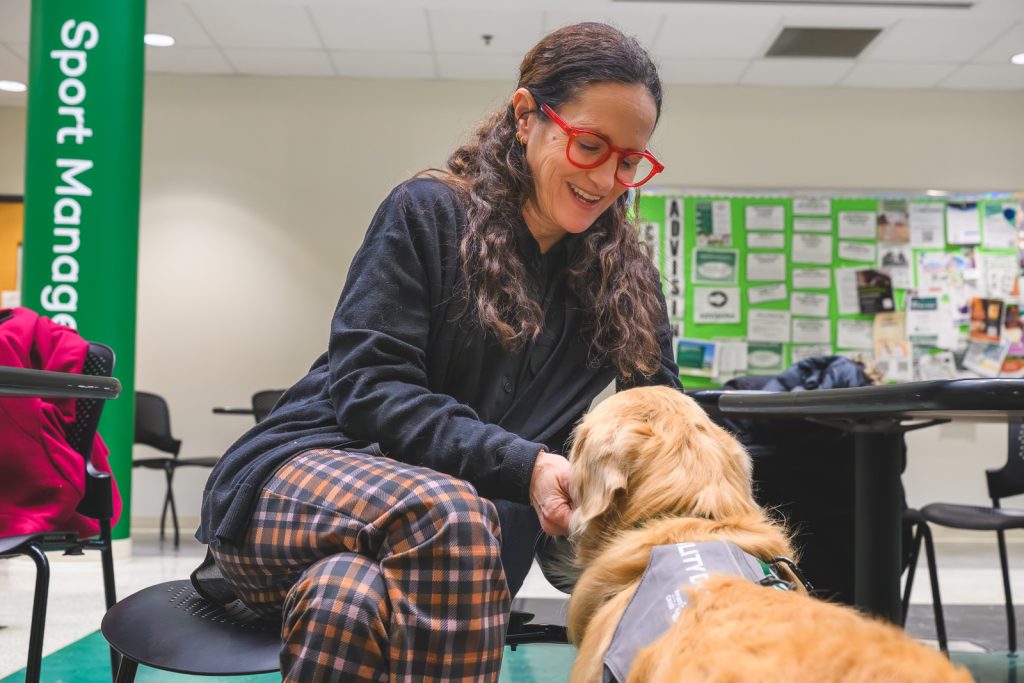
Tinker held her first “paw-fice hours” in fall of 2024. She’s now available to students two days a week in the Marshall Building student commons and two days a week at Halle Library. As head of a department focused on mental health, Kellman-Fritz says having a dog on campus felt like a great opportunity for students. She wrote a proposal to acquire, train, and deploy a facilities dog, and says the university’s provost office was supportive of her aims. At the same time, University Archivist Alexis Braun Marks was also thinking about the therapeutic effects of dogs.
She says she’s friends with other faculty members who handle a facility dog at C.S. Mott Children’s Hospital in Ann Arbor. Those faculty members and others who had certified therapy pets would bring the dogs on campus during final exam weeks.
“Our students don’t just need help at finals, but all semester long,” Braun Marks says. She wondered if EMU’s Halle Library could be a good place for a facilities dog program.

“We get students from all over campus, and they’re typically coming to us with a lot of stress and anxiety,” she says, adding that the “stars aligned” so that she and Kellman-Fritz had similar ideas at the same time.
This has led to Kellman-Fritz and Braun Marks co-handling Tinker, who stays with each handler about half the week. One mainly takes on vet visits while the other handles grooming. They say the transition between handlers doesn’t seem to affect Tinker as much as it does their own kids, who miss Tinker when she’s gone for part of each week.
Kellman-Fritz acquired Tinker from nonprofit therapy dog training organization Paws with a Cause when the dog was about 2. Under EMU’s facilities dog agreement, Tinker belongs to the university. That means that the two handlers had to make agreements outlining what would happen if there were an emergency and one of them became unable to be a handler anymore or if one of them quit working at EMU. Both handlers want to ensure Tinker’s long-term wellbeing and to avoid any questions about who owns her, a problem that cropped up with a school therapy dog in Ann Arbor not long ago.
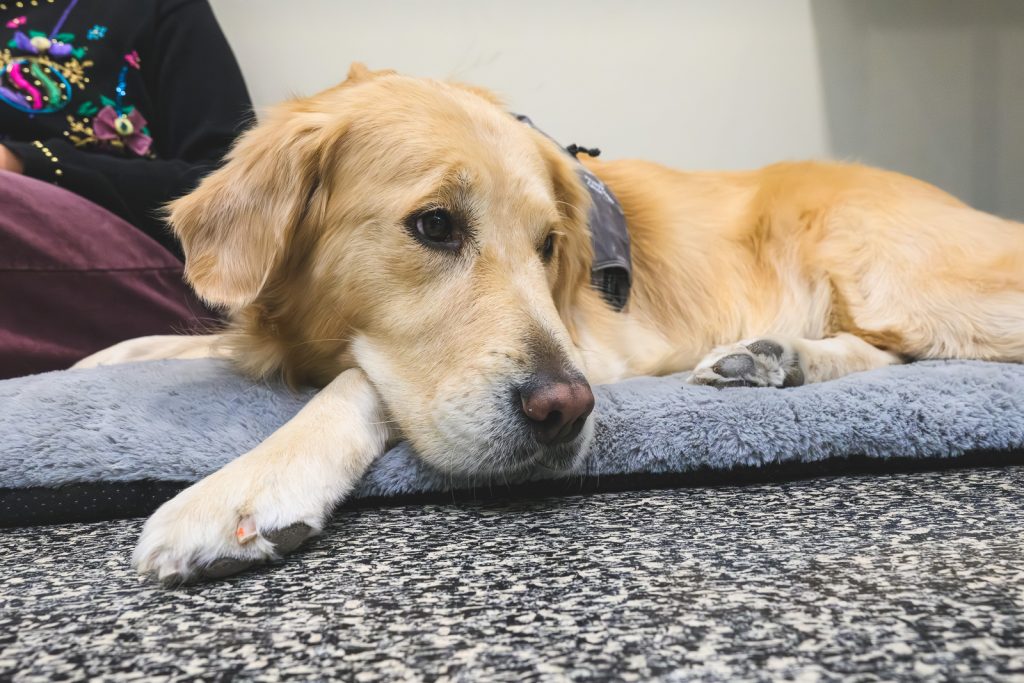
A facilities dog goes through rigorous training and has many of the same skills as a therapy dog or seeing-eye dog. Kellman says the big difference is that a seeing-eye dog or other kinds of therapeutic dogs are trained to be focused on one person and their specific needs, while a facilities dog like Tinker must be able to handle interacting with many different humans every day, all day. Her handlers give her every Friday through Sunday “off work” so she can just be a dog and do a little playing and barking, which her handlers say she never does on campus.
Still, there’s more demand for Tinker than she and her handlers have time for. Each of the handlers try to bring Tinker to events when they can, but they have other on-campus duties and off-campus lives.
“That’s probably the hardest part,” Kellman-Fritz says. “We want everybody to have access to her, but we don’t want to over-stimulate her. And we really want to make her available for the people who really count on her for her office hours.”
“Health and human services is a huge caretaking profession, and mental health support for students is critical,” she adds. “Students all around campus, not just in our college, take advantage of spending time with her.”
Another unexpected challenge of having a facilities dog is that Tinker wants to do her job all the time. That means her handlers sometimes find it challenging to make it to a meeting on time if they have to cross campus with Tinker in tow, because everyone they pass wants to meet and chat about her. And Tinker can’t pass either Halle Library or the Marshall Building without wanting to go in and do her job, even if it’s not during her official paw-fice hours.

Jada Roberts, a graduate student in EMU’s School of Education, helps handle Tinker during office hours when the other two handlers need coverage. She got the job after being a “frequent flyer” who came to visit Tinker often as an undergrad. When she came back to EMU as a graduate student, the handlers asked Roberts to come on board to assist with paw-fice hours.
General stress reduction is the aim of the EMU facilities dog program. But Kellman-Fritz says visitors may also miss a pet they had to leave behind with parents or they might be grieving the recent loss of a pet.
Both were true for Roberts.
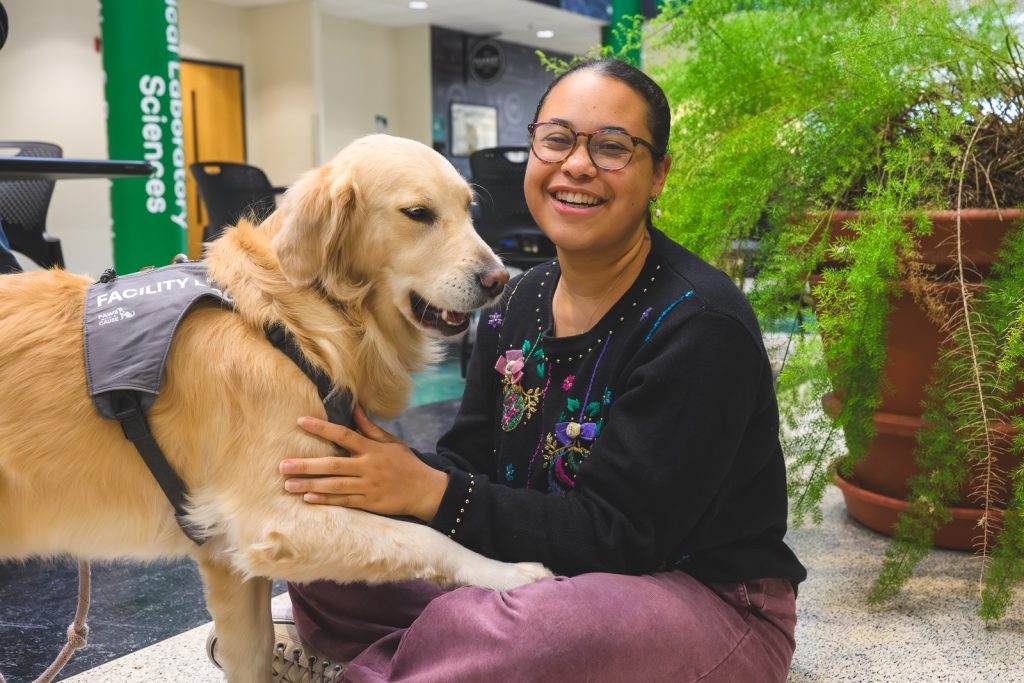
“Mostly, I made time in my schedule to see Tinker because she was the sweetest, but also I missed my dog at home,” Roberts says. “And then he passed away soon after.”
“I think Tinker knows when folks need a little bit of extra TLC,” Kellman-Fritz says.
Tinker’s fans can follow her on Instagram.
Author

Related Articles

ECIC guides Michigan’s early childhood strategy
ECIC works with public agencies, community partners, philanthropy, and providers to ensure every child has a foundation for lifelong success.

Ypsi’s Student Advocacy Center marks 50 years of supporting student success and educational equity
The Student Advocacy Center of Michigan is celebrating its 50th anniversary of working to ensure that every student is heard, supported, and treated equitably.

Ypsi schools’ new agriscience/botany program has students developing green thumbs
From planting an orchard to using photographs of plants for a postcard charity project, students in Ypsilanti Community Schools’ new career and technical education program are getting their hands dirty.


