Transportation

Double decker rail cars tested for Ann Arbor commuter line

Inch by inch the development of a commuter rail system between Ann Arbor and Detroit... well, actually Jackson and Detroit, becomes a reality. Excerpt: "Officials say they hope to hear next week whether the cars passed the test to enter into service. If so, the public could have a chance to take demonstration trips next year. Tuesday's test used an Amtrak engine to take the cars on a run that began in Pontiac and included stops at Birmingham, Royal Oak, Detroit's New Center area, Dearborn, Detroit Metropolitan Airport, Ypsilanti, Ann Arbor, Dexter, Chelsea and Jackson." Read the rest here.

Latest in Transportation
AATA to break ground on Ann Arbor’s $8M Blake Transit Center

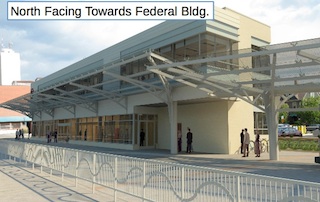
Come winter, the skeleton of the long-awaited new Blake Transit Center will be erected in downtown Ann Arbor. A groundbreaking ceremony is scheduled onsite on Monday, Nov. 19 at 11 a.m. Construction will begin within 2-3 weeks after the groundbreaking and should be completed by August or September of 2013, according to Nancy Shore, a spokesperson for the Ann Arbor Transportation Authority (AATA). The $8 million center will be built directly opposite the current center on William St., between Fourth and Fifth Avenue, which will be demolished once the new terminal is completed. It will accommodate the same number of buses as today's facility, which serves six buses in the transit mall area and nine on Fourth Avenue, including AirRide. The 12,000-square-foot building will be LEED-Gold certified. Other enhancements over the old facility are: ADA accessibility, more bathrooms and waiting space, heated sidewalks, public art, extensive window banks, and an overarching transparent canopy penetrable by sunlight. The center will have three levels, including a basement. "It does have the capacity to add three or four floors on top of it. This building was really designed to think about future expansion," Shore says. Since the old terminal was built in 1987, usage has increased by 60%, she adds. "The AATA just had a record amount of transit ridership this year, reaching six million riders, so we know that the demand is going to increase. And we've got Air Ride now coming into the Blake Transit Center, so this building is really made to grow with the growing need of transit in our community." Source: Nancy Shore, spokesperson,Ann Arbor Transportation Authority Writer: Tanya Muzumdar

How public art makes economic sense

With research from the Urban Land Institute backing it up, Dan Rosenfeld, a senior deputy for economic development for Los Angeles County's MTA makes the case that public art can have a positive bottom-line economic impact, particularly when it comes to transportation. Excerpt: "The intangible benefits of public art—aesthetic beauty, cultural interpretation, education, inspiration, and general improvement of the urban environment—are well-known. But because these are considered "soft" benefits, they are sometimes dismissed as a low priority, especially during challenging economic times. However, experiences in Los Angeles show that public art can be a source of publicity and cash income, as well as beauty." Read the rest here.

Going blue by train instead of car

Reporter and blogger Jeff Wattrick decides to travel from Royal Oak to Ann Arbor (a mere 52 miles) to take in the U-M vs MSU football game on Saturday. This is his story. Excerpt: "It’s certainly the less stressful choice. I might have gone full-on Michael Douglas in Falling Down trying to endure Michigan Stadium traffic. Seriously, traffic jams before and after the game were like a goddamned REM video. Instead of living out traffic hell scenarios from early 1990s entertainment, I sat on the train and watched an episode of The Wire on my iPad. What’s more, if the planned Detroit-Ann Arbor commuter rail line ever comes to fruition, the train to a Michigan game could be even more cost-effective. Compared to fares for the long-haul Amtrak, commuter rail is generally less expensive. The most expensive ride on the Massachusetts Bay Transit Authority commuter rail, for example, costs $11 and MBTA lines run with greater frequency." Read the rest here.

Density may actually reduce traffic

Here's some counterintuitive food for thought... communities with higher mixed use denisty demonstrated reduced congestion. Excerpt: "[The study] found that roadways in more compact, mixed, multi-modal communities tend to be less congested. This results from the lower vehicle trip generation, particularly for local errands, more walking and public transit travel, and because the more connected street networks offer more route options so traffic is less concentrated on a few urban arterials. This contradicts our earlier assumptions." Read the rest here.

Better downtown parking coming for Ann Arbor cyclists

The Ann Arbor DDA is making room for bike riders in the popular Maynard St parking garage - 50 bikes. Given that it means giving up just two auto spaces that seems like pretty good math to us. Excerpt: "The authorization of $30,000 from the DDA’s parking fund – for design, fabrication and installation of the bicycle storage facility – was given at the board’s Oct. 3, 2012 meeting. Similar “cages” in other cities use a chain-link fencing material. However, the DDA hopes that a more aesthetically pleasing option can be identified." Read the rest here.

A daily commuter train from A2 to Detroit in our near future?

Most American metroploitan areas have several daily commuter trains between the region's largest city and the surrounding suburbs. Wouldn't it be nice if we could join them? Finally? Excerpt: "The paper reported that the Michigan Department of Transportation "is in the process of spending more than $500 million to purchase the tracks between Dearborn and Kalamazoo from Norfolk Southern and improve them, according to officials at the meeting."  " Read the rest here.

Reimagine Washtenaw implements more walk, bike, bus options

The remaking of Washtenaw Avenue, the busiest throughway in Washtenaw County in terms of traffic volume, has begun. Reimagine Washtenaw, a coalition of representatives from the cities of Ann Arbor and Ypsilanti and Pittsfield and Ypsilanti townships, and other organizations, is using a portion of the county's $3 million HUD Community Challenge Planning grant to hire consultants to study and recommend options to make the corridor friendlier to all transportation forms and improve the efficiency of public transit. "Part of the challenge right now is there are so many bus stops along the route," says Nathan Voght, project manager for Reimagine Washtenaw. "Because of the corridor lacking sidewalks, you have to have more bus stops to let people get to those stops. And if we can consolidate those by working with the Ann Arbor Transportation Authority, it actually makes the service more efficient." Smith Group JJR and Parsons Brinkerhoff will be doing a right of way study, designing AATA bus stops, and recommending locations for additional bike lanes, sidewalks, and other non-motorized facilities, including possibly mid-block crossings, according to Nathan Voght, project manager for Reimagine Washtenaw. The study will wrap up in September of 2013. Meanwhile, MDOT's addition of sidewalks on both sides of Washtenaw underneath the U.S. 23 overpass is expected to be complete by November, Voght says. And the construction of Arbor Hills Crossing, a 90,000-square-foot office and retail center across from Whole Foods is under way. "What's great about that is that [the city of] Ann Arbor modified some of their zoning regulations to help push the vision for the corridor," making it better-suited for alternative transportation methods, says Voght. "They for example required parking to be not in the front yard – so it would be in the side yard, or the rear yard – and required the buildings to have a maximum setback from the street instead of  the traditional minimum setback." The city has an easement for a wide sidewalk and an AATA transit stop in front of the center. "That's the irony of these corridors, is we built them thinking they're so great, you can get in your car and get to any of these businesses, but it's gotten to the point where you tolerate the corridor instead of experience it in a positive way. We can change that," Voght says. Source:  Nathan Voght, project manager for Reimagine Washtenaw Writer: Tanya Muzumdar

What’s next for passenger rail between Pontiac and Chicago

The Michigan Department of Transportation is evaluating passenger rail improvements on the Pontiac/Detroit to Chicago line that runs through Ann Arbor by holding a series of meetings to discuss the environmental impact of an improvement project. The changes are being discussed as federal and state departments of transportation work to determine how the line could open up economic opportunities for the region. The focus of the improvements is a 304-mile line that connects Michigan, Illinois and Indiana. A series of meetings are being held in each state to help determine potential effects on the natural environment, air quality, jobs, the economy, traffic and neighborhoods. According to GreatLakesRail, an advocacy group for passenger rail improvements, "the purpose of the program is to improve intercity mobility by providing an improved passenger rail service that would be a competitive transportation alternative to automobile, bus and air service between Chicago and Detroit/Pontiac…The program will provide sufficient information for the Federal Railroad Administration to potentially support future decisions to fund and implement a major investment in the passenger rail corridor." The discussions come as cities, including Ann Arbor, are building or have received federal funding to build more modern transportation stations. The Michigan Department of Transportation's environmental impact meeting will be held Wednesday, Sept. 26 at 7 pm. at the Double Tree Hilton Hotel, 5801 Southfield Expressway, Detroit. Comments about the changes can also be shared online at GreatLakesRail.org or by telephone, 877-351-0853. Source: Janet Foran, communications, Michigan Department of Transportation Writer: Kim North Shine

Video What’s Next For Regional Transportation?

At the end of last month, Concentrate held a speaker event about regional transportation. Megan Owens of Transportation Riders United and County Commissioner Conan Smith discussed what's going on, why Washtenaw County should care, and how it all comes together. Missed it? No worries. We have it on video here.

Our Partners

30044
30045
30046
30047
30049
Washtenaw ISD logo
Eastern Michigan University
Ann Arbor Art Center
UMS
U of M Arts Initiative
Engage EMU

Common Ground Is Brewing

Support local stories and receive our signature roast straight to your door when you join at the Standard level (or above).

Drink Better, Read Local

Close the CTA

Don't miss out!

Everything Ann Arbor and Ypsilanti, in your inbox every week.

Close the CTA

Already a subscriber? Enter your email to hide this popup in the future.