
Washtenaw County officials say local elections are secure despite Trump calls to “nationalize” them
Washtenaw County elections officials say they’re well-prepared to protect against fraud in this year’s midterms and any other election. We interviewed them about their system and President Trump’s statement that elections should be “nationalize[d].”
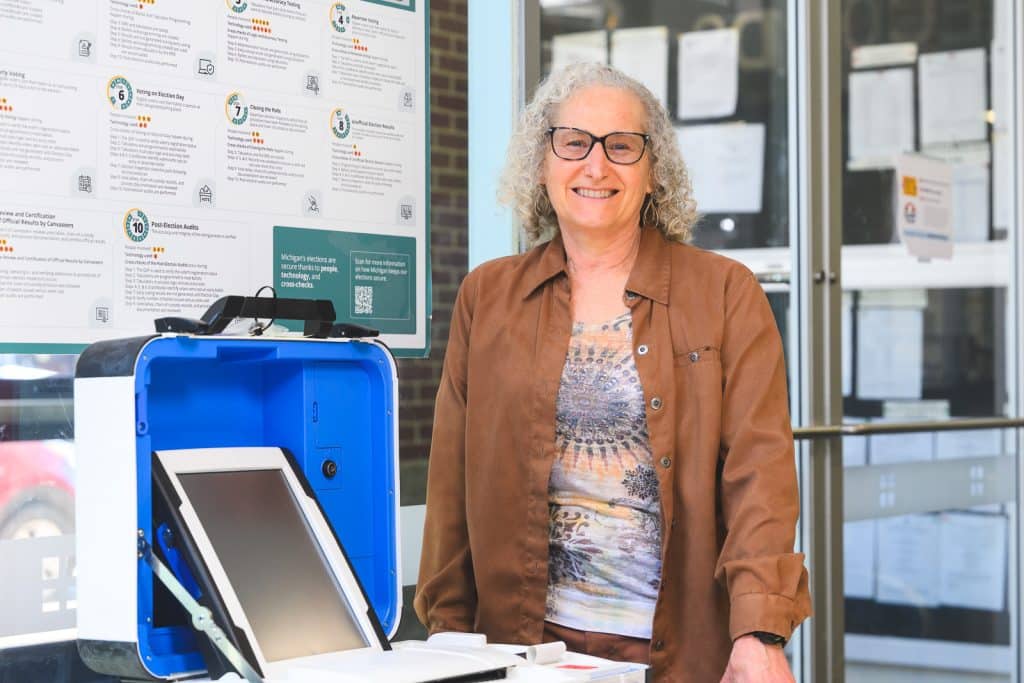
President Donald Trump has recently called for the Republican Party to “take over” or “nationalize” elections to quash voter fraud. But those who oversee elections in Washtenaw County say their system is already well-prepared to protect against fraud in this year’s midterms and any other election.
“Michigan has four things that really make our elections secure. It’s people, tech and tools, cross-checks, and paper,” says Rena Basch, director of elections for Washtenaw County. During the “journey of a vote” from registration to voting to counting to post-election audits, she says, “there are multiple people involved, multiple technologies and tools involved, and there are built-in cross-checks. The different groups of people check each other’s work. … The people check the technology. And then the different technology tools also check each other.”
Trump’s election takeover musings are directly contradicted by the U.S. Constitution. Article One, Section Four, states that “The Times, Places and Manner of holding Elections for Senators and Representatives, shall be prescribed in each State by the Legislature thereof.”
Ekow Yankah, assistant dean at the University of Michigan Law School, says “you’d have to do an ‘Ocean’s 11’-style” caper to actually succeed in stealing an election through ballot stuffing or data manipulation. Over the last few generations, a system of interlocking checks and balances has produced a system that emphasizes ability to thoroughly safeguard and verify votes.
“I don’t want to catastrophize. But I do think it is worth taking a moment to really think about where we are, that these seem like even plausible questions to be asking,” Yankah says. “… The more plausible these questions seem, the more we should recognize how dangerous our territory is.”
One of the biggest claims to roil politics recently is the insistence of widespread voter fraud in the 2020 election. President Trump still claims that Joe Biden cheated, in spite of numerous voter audits and court rulings verifying that the Democrat beat him legitimately.
However, in her 21 years on the job, Basch says she has had “two five-minute conversations” in which she had to take care of legitimate cases of voter fraud. Similarly, Ann Arbor City Clerk Jacqueline Beaudry says she can remember “only one documented case of non-citizens voting” and “a handful” of legal voters trying to vote twice.
The voting machines in each county precinct are manufactured by one of a handful of companies that have proprietary data and only accept input from external links that are highly encrypted. They don’t accept normal USB devices or other port-based media.
“There’s checks and balances in place. The absentee ballots sent out are numbered and voters have to sign the ballot envelope to return the absentee ballot that’s turned into the system. So we have their signature on file. We already know what number goes out and what number comes back,” Beaudry says. “It’s a similar process if you vote early or vote on Election Day.”
When each voter walks in, election workers consult a list of voters assigned to each precinct. Their voter profiles are already checked against their residency records, voter identification numbers, and signatures on file.
Voter rolls are updated on a regular basis, and there is a steady stream of citizens and organizations who use the Freedom of Information Act to check over voter records for partisan, academic, or transparency-related reasons. The net result is that thousands of eyes are on the voter rolls in every election.
Michigan’s elections are also decentralized, meaning that county and local officials, rather than state officials, run them. This also means there are simply too many individual elections to target without a systematic attempt at cheating becoming obvious. Even if someone succeeds in compromising a small batch of votes from one precinct, that would not be enough votes to tip the scales in even a very close election. And even if you could do that, it would be easy to toss out those compromised ballots, or to find who compromised what where.
This is possible because every single vote cast results in a paper record. That way, even if polling machines are hacked or an algorithm of some sort is used to distort the counting, the paper records can still be checked by hand, and any discrepancy can be found that way.
Once the votes are all cast, they are taken to a centralized, secure counting center. There, Basch explains, every vote is counted by teams in which one Democratic Party member and one Republican Party member jointly open, count, and record votes in groups of 10. That means bipartisan cooperation would be needed to intentionally miscount. And if someone did try something like stuffing three ballots into a single envelope, it’d be immediately obvious to both representatives and the ballots would get rejected.
Both representatives have to use a machine to tabulate votes electronically. Even if someone tried to put ballots through multiple times, or used a similar tactic, that would result in the number of ballots not matching the voter rolls.
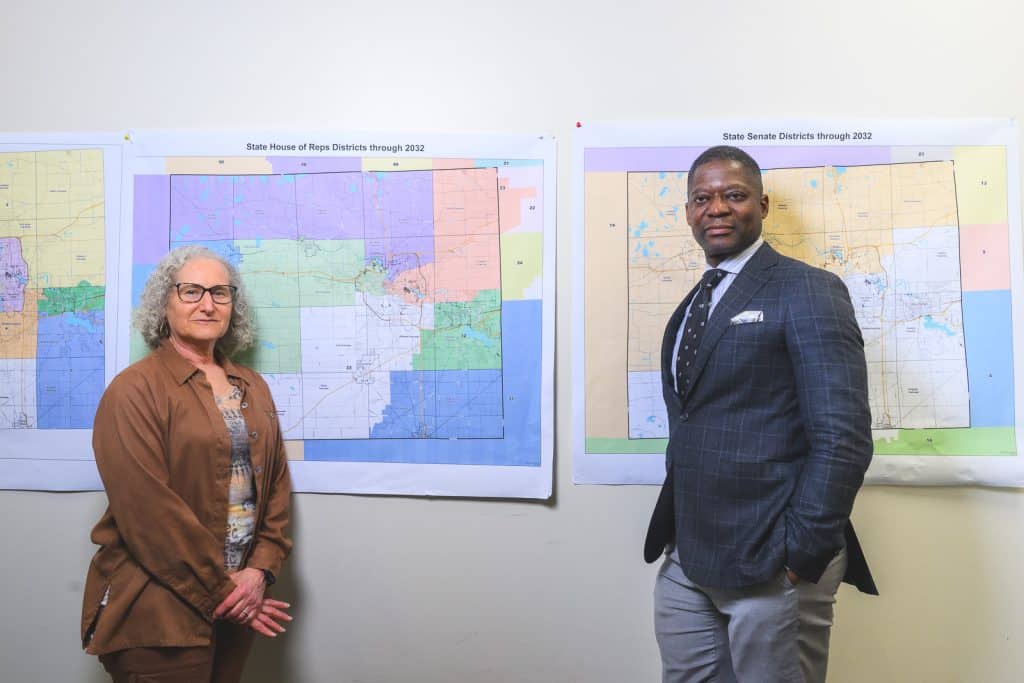
“At the end of the night, the number of votes has to match the number of names on the voter list. And you can’t close down an election night precinct with a discrepancies, or if you have a discrepancy, you have to document it,” Basch says. “If it’s 3:00 in the morning, we’re going to tell you ‘wrap it up and bring it in and it’ll have to be retabulated during the [Board of Canvassers meeting].’ And there you have another group of people that’s checking the previous group of people that’s tabulating these ballots.”
The vote results are sent through a secure network on election night. But even those results are verified by securely transported paper ballots. The city of Ann Arbor invested $2.5 million into a new election facility last year.
Despite these layers of safeguards, Trump has called for a Republican election takeover and also spoken (seemingly humorously) about canceling elections. He’s also advocating for the SAVE America Act, which would mandate “individuals to provide documentary proof of U.S. citizenship when registering to vote, and requires photo identification to vote, in federal elections.” While the House of Representatives passed it in February, it is not likely to pass the Senate before the midterms.
With low rates of voter fraud and a well-developed system to prevent it, Yankah says there are bigger fish to fry. He says the real challenge at hand is reinforcing people’s confidence in election security and integrity while ensuring that anti-voter-fraud efforts don’t result in suppression of legitimate votes.
“Let’s be clear: nations crumble,” he says. “… If the American citizens say ‘This is intolerable. We will not permit this. We will not believe this. You must step down,’ then any potential dictator would. Unless they have massive parts of the military on their side, there’s not much they can do. And even then, you can’t suppress an entire nation. On the other hand, if enough people create enough conspiracy blogs, and create enough doubt, such that they say, ‘Actually, I’m fine with this,’ then the American experiment will end.”
Author

Related Articles
Washtenaw County Opportunity Index improvements make it easier to track areas of inequity
Washtenaw County recently announced a major improvement to its Opportunity Index, a map designed to track the county’s areas of economic inequity and connect those in need to help.
As ICE comes to Ypsi, residents organize to protect neighbors and prevent misconduct
Community advocates are urging residents to organize, prepare, and support one another as enforcement actions become more visible and more aggressive.

Will new MiLEAP policies better support small and home-based child care spaces?
Licensing updates and funding strategies aim to strengthen quality, stabilize providers, and expand access to child care.


