
Ypsi venue opens solar-powered electric vehicle chargers for free use
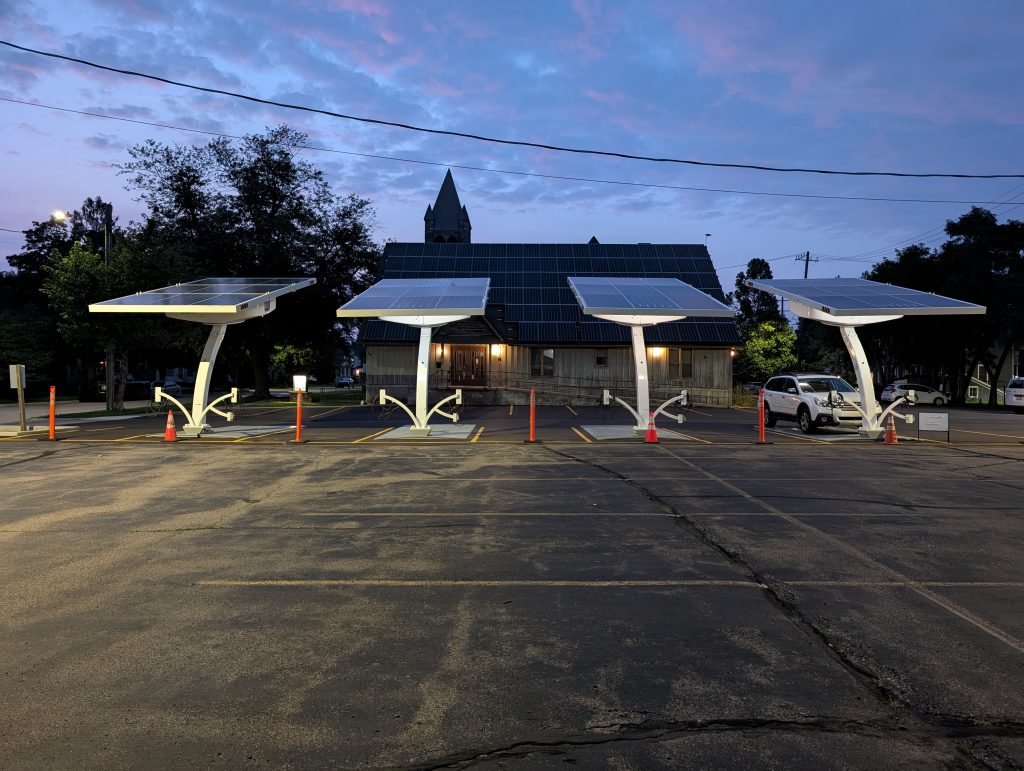
Prompted in part by neighborhood power outages, the Ypsilanti Performance Space recently began operating four solar-powered electric vehicle chargers.
On the Ground Ypsilanti is an “embedded journalism” program covering the city and township of Ypsilanti. It is supported by Ann Arbor SPARK, the Center for Health and Research Transformation, Destination Ann Arbor, Eastern Michigan University, Engage @ EMU, Washtenaw Community College, Washtenaw County Parks and Recreation Commission, and Washtenaw ISD.
When a multi-day power outage hit the blocks surrounding the intersection of Michigan Avenue and Cross Street in Ypsilanti in 2023, the effects rippled quickly through the neighborhood. Steve Pierce, operator of the Ypsilanti Performance Space (The YPSI), had a clarifying moment when his venue’s neighbors came by to ask if they could use The YPSI’s many solar panels to charge their electronics.
“What was heartbreaking was realizing we couldn’t help, because when the grid goes down, traditional solar shuts down too,” Pierce says.
That experience helped push Pierce’s long-standing commitment to sustainability in a new direction. The YPSI, located at 218 N. Adams St. in Ypsi, recently began operating four solar-powered electric vehicle (EV) chargers in its parking lot. They’re free to use and available 24 hours a day to neighbors, commuters, and visitors.
The chargers are freestanding, portable units manufactured by San Diego-based Beam Global, each powered by onboard batteries and solar panels. Unlike grid-tied chargers, they can continue operating during power outages, PIerce explains.
“We’re a music place trying to restore an old building,” Pierce says. “But we’re also in the neighborhood, and we want to help.”
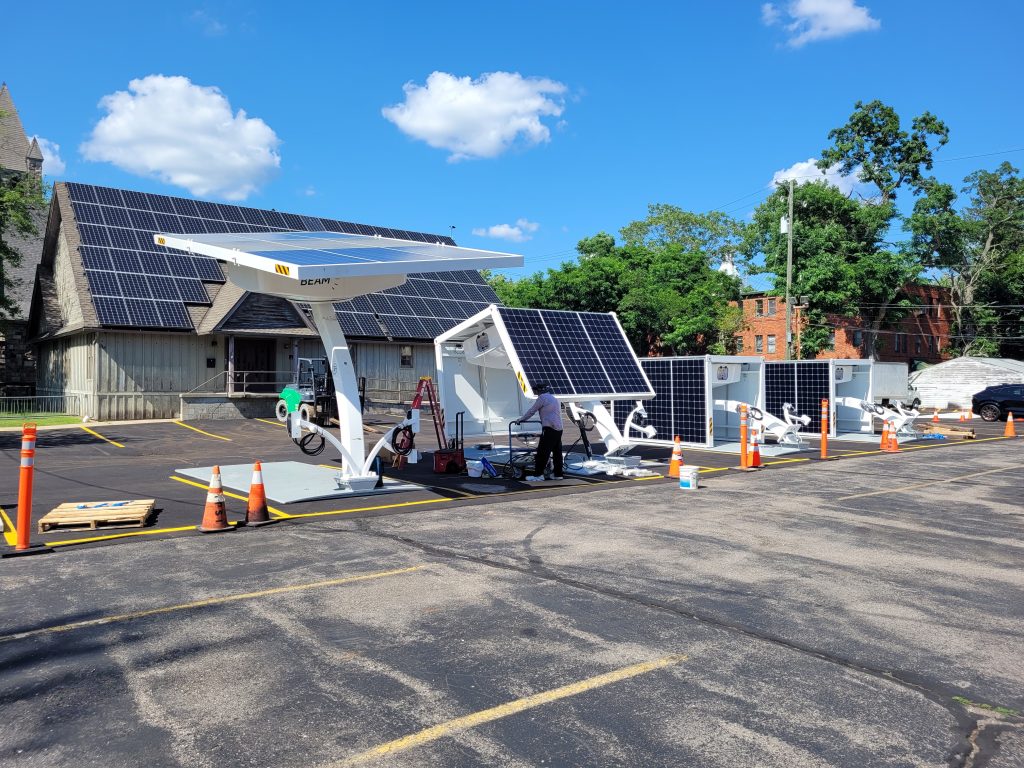
The project builds on nearly a decade of sustainability work at the venue. Pierce says one of the first sustainability-related investments he made after launching The YPSI eight years ago was a large solar array. Those panels were installed in 2018 with help from local grassroots organization SolarYpsi, which has also helped install solar panels at Ypsilanti City Hall and the Ypsilanti Farmers Market. The YPSI’s solar installation cut the building’s monthly electric bill from roughly $600 to about $60.
“That’s always been our focus: reducing operational costs so we can keep the space affordable and alive,” Pierce says.
Funding for the EV chargers came from a Renewable Energy and Electrification Infrastructure Enhancement and Development grant from the Michigan Public Service Commission. The $500,000 award covered the chargers, electrical upgrades, and partial repaving of The YPSI’s parking lot. Pierce says navigating the reimbursement-based grant structure was challenging, requiring bridge financing and support from multiple nonprofit partners.
“This only happened because people took a risk on us,” he says. “Nonprofits connecting us to other nonprofits, local leaders stepping up, that just doesn’t happen everywhere.”
Since becoming fully operational in January, the chargers have seen steady use. Pierce estimates three to four people use the chargers daily, some during events, others overnight. Importantly, many users are neighborhood residents who don’t have access to home charging.
“50 to 60% of the housing around here is rental,” Pierce says. “People park on the street. They don’t have garages or electrical capacity. This fills a real gap.”
The chargers are also designed to support smaller electric vehicles like bikes, scooters, and wheelchairs, and include emergency power capabilities that could support buses, ambulances, or emergency response vehicles during outages.
The benefits extend beyond transportation. The battery systems can power outdoor concerts, food trucks, and community events without gas generators, reducing noise and emissions. Pierce recalls a recent neighborhood event where a DJ unknowingly plugged into the charger and ran an entire sound system on solar power.
Pierce sees the chargers as a natural extension of what makes Ypsilanti work: neighbors helping neighbors, and institutions evolving alongside the community.
“This city has always adapted,” he says. “From horses to cars, and now to electric, the historic district understood that. The city understood that. Everyone showed up and said, ‘This matters.’”
For more information about The YPSI, visit its website. More information about SolarYpsi’s work can be found here.
“I don’t know who all the angels were that made this happen,” Pierce says. “But whoever you are, thank you.”
Related Articles

Ann Arbor Comprehensive Land Use Plan approved by planning commission, advances to city council
Ann Arbor City Council will consider allowing massive land use changes intended to improve affordability in the city, following the Ann Arbor Planning Commission’s unanimous Wednesday night vote to pass the draft Comprehensive Land Use Plan 2050.

Ann Arbor Bluebelt program seeks to permanently preserve drinking water supply
The Bluebelt program is designed to permanently protect properties that are vital for safeguarding Ann Arbor’s drinking water supply.

Ann Arbor launches “Solar Mobile Nanogrid” for education, sustainable energy
Ann Arbor’s Office of Sustainability and Innovation is rolling out a new solar-powered trailer that will serve as a community engagement tool and mobile power source.


