
3 new public art installations in Ann Arbor and the stories behind them
We chatted with the artists behind three new Ann Arbor public art installations to learn about the background and creative process behind them.
Hannah Kirkpatrick, director of the Ann Arbor Art Center’s (A2AC) Art in Public program, says the program’s mission is simple: it’s about “creating an environment that people enjoy being in [and] being part of,” she says.
This fall, the A2AC partnered on three new public art projects in Ann Arbor with Washtenaw County Parks and Recreation, Ann Arbor Parks and Recreation, and the Ann Arbor Downtown Development Authority (DDA). Kirkpatrick says the main goal of the projects in Liberty Plaza, Gallup Park, and the Barton-Bandemer Tunnel is “building community.”
“It [goes] beyond adding visual interest and value to a place,” she says. “Art has the ability to inspire people.”
Before installing artwork, the A2AC issued public calls for art online, which received numerous responses from across the country. Ultimately, Kirkpatrick collaborated with city and county partners to settle on the artists they felt were the best fit for the area.
“All these artists were great to work with,” Kirkpatrick says.
We chatted with the artists behind each of the new installations to learn about the background and creative process behind them.
The Liberty Plaza mural
When Kirkpatrick teamed up with Ann Arbor Parks and Recreation and the DDA to install murals in and around Liberty Plaza, she found that the DDA — which recently launched its own program, Elevate, to fund public art projects — “wanted something that really livened up the space.”
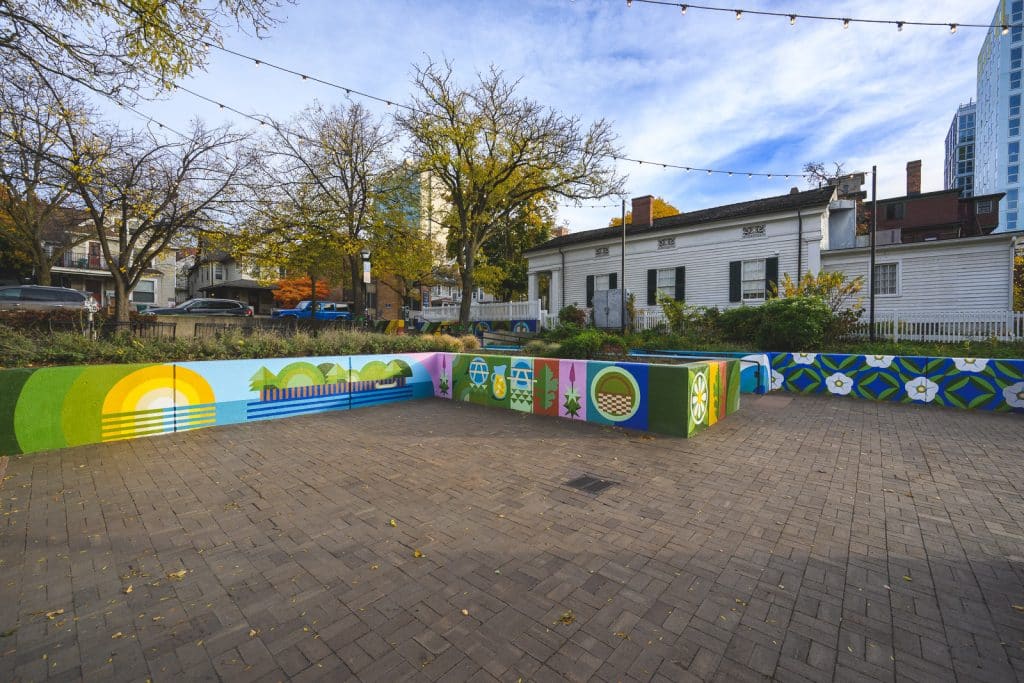
Kirkpatrick’s team wound up selecting a Florida-based muralist, Christian Stanley, whose design she describes as “graphic and fun.”
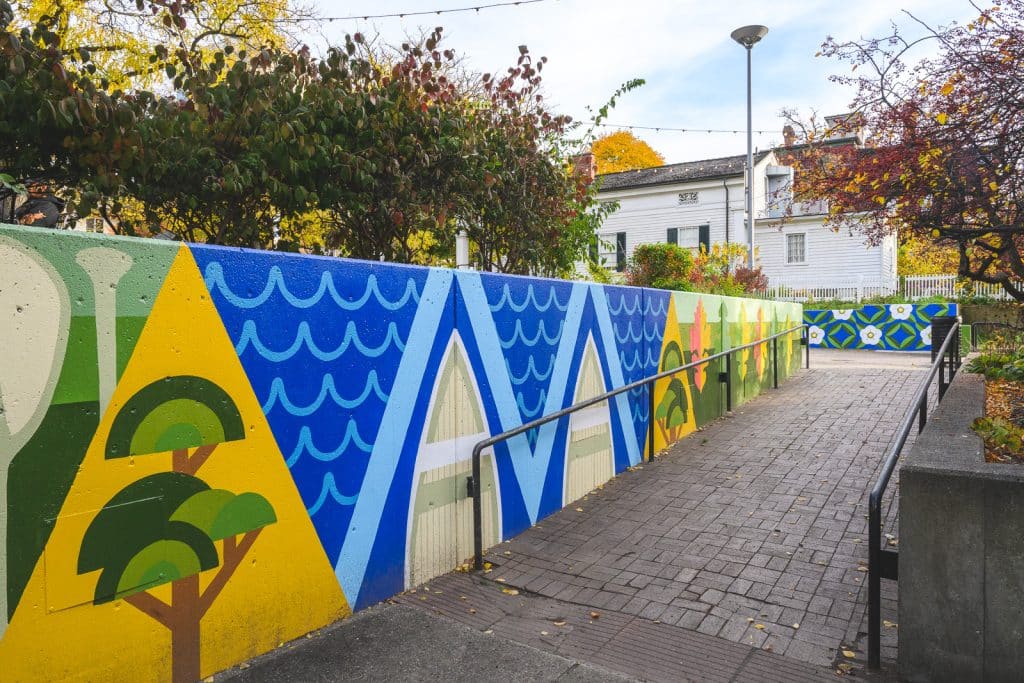
“Christian did a really good job capturing different parts of Ann Arbor in his [imagery] and color palette, from park activities at the river and at Liberty Plaza [to] creative nods to the [University of Michigan] through subtle integration of maize and blue colors,” Kirkpatrick says.
Stanley, who earned a degree in graphic design from the University of Central Florida in 2011, says he was particularly influenced by Bauhaus design principles, especially in its use of simplified shapes: “It’s a lot of clean lines, geometric shapes, [and] patterns,” he says.
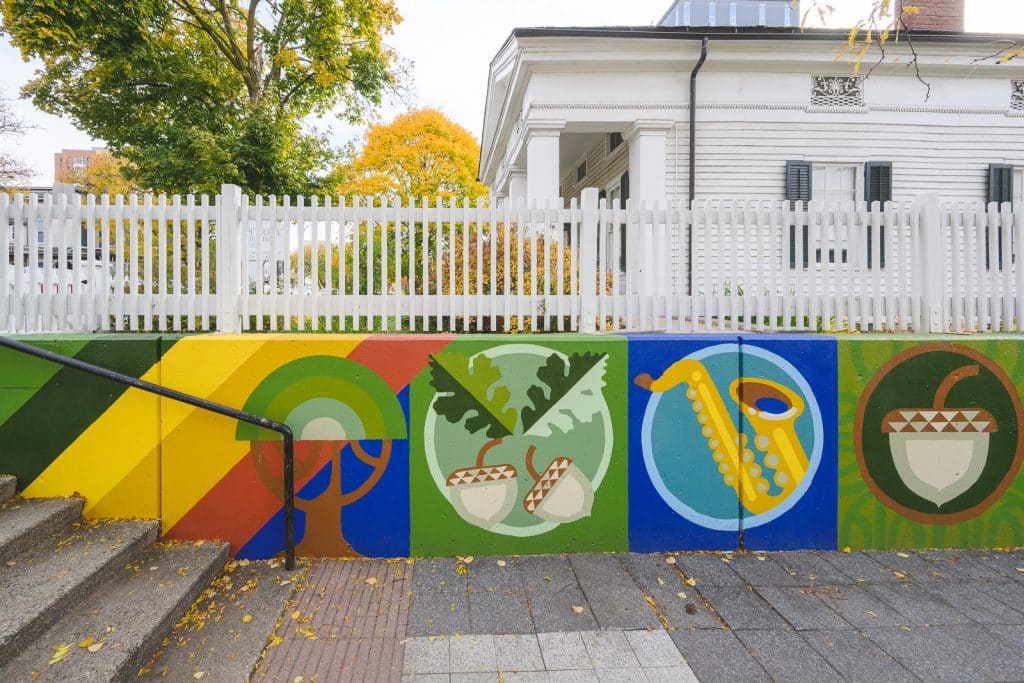
That influence is on display at Liberty Plaza, where Stanley’s mural incorporates simplified but playful designs that can be thematically linked to events like Sonic Lunch (like pitchers or picnic tables), or the Huron River (like canoes), or Ann Arbor itself (acorns and oak leaves, say, in a reference to the town’s name).
Because the plaza has three different levels, Stanley specifically set out to “unify the space” — and, at the same time, “make each wall or area unique and interesting on its own.”
Stanley has worked as a full-time muralist since 2021. His wife, Jessica Stanley, works alongside him, installing artwork, applying for projects, and managing their business, C. Stanley Creative.
They’re based in Orlando, and “to book anything out of state — [especially] up north, during the summer — is always a win for us,” Stanley says.
“We’ve done some outdoor projects down here during the summer and they’re pretty brutal,” he adds.
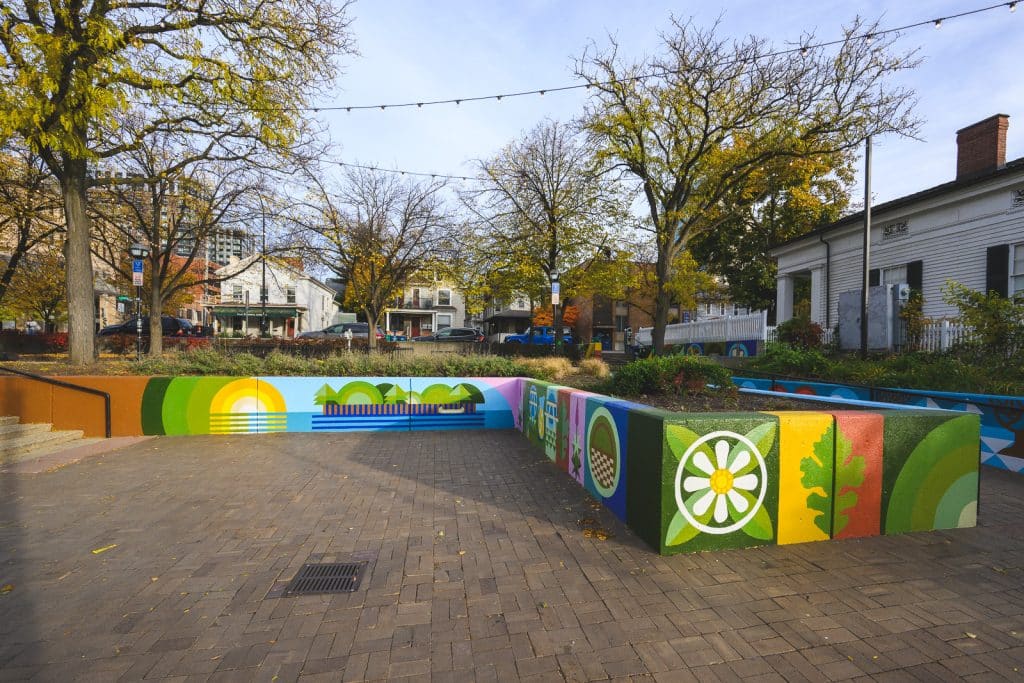
But working in a different climate also introduced its own challenges: Stanley knew that within a season or two, drifts of snow would come to rest against the Liberty Plaza walls. In decades past, snow had already roughened up the walls, creating textures that would have been difficult to paint over. To fill holes and cracks and smooth out surfaces, Stanley used both a specialty paint and an acrylic concrete filler.
Now that the mural is finished, Stanley says he hopes that “people of all different backgrounds and people of all ages can enjoy and appreciate the art.”
The Gallup Park sculpture
When a new bridge opened in Gallup Park in 2024, a portion of its budget had been set aside for public art on or near the bridge. Ann Arbor Parks and Recreation conducted a public survey and, according to general consensus, “people didn’t want the art to detract from the natural landscape,” Kirkpatrick says.
“I don’t think you want something giant, loud, bold, and red, saying, ‘Look at me,’” she continues. “You want something that balance[s] visually within the landscape.”
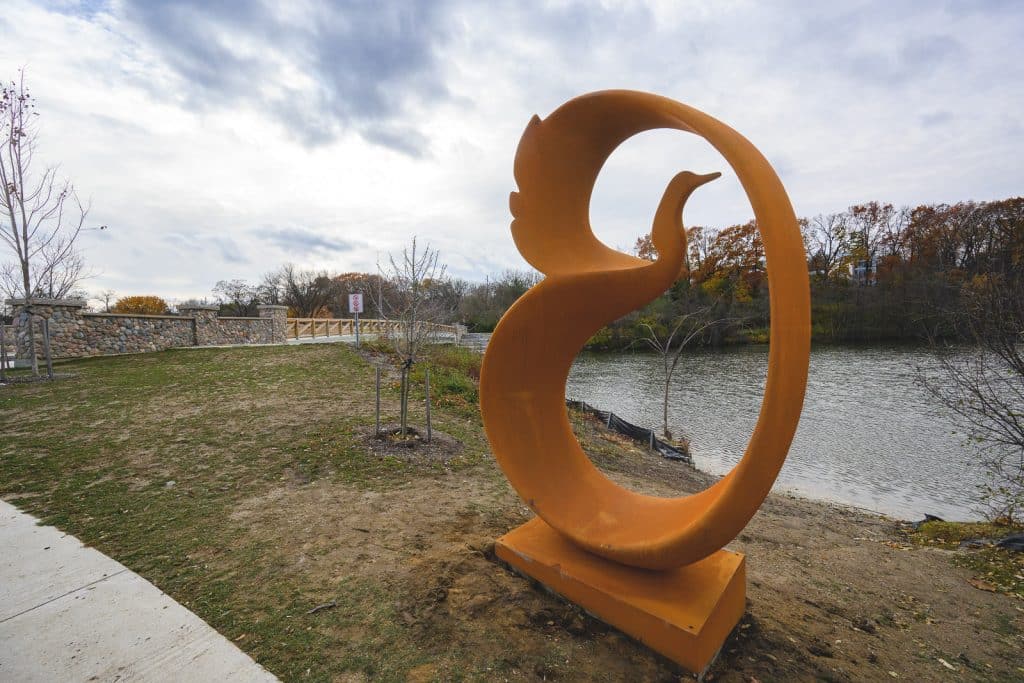
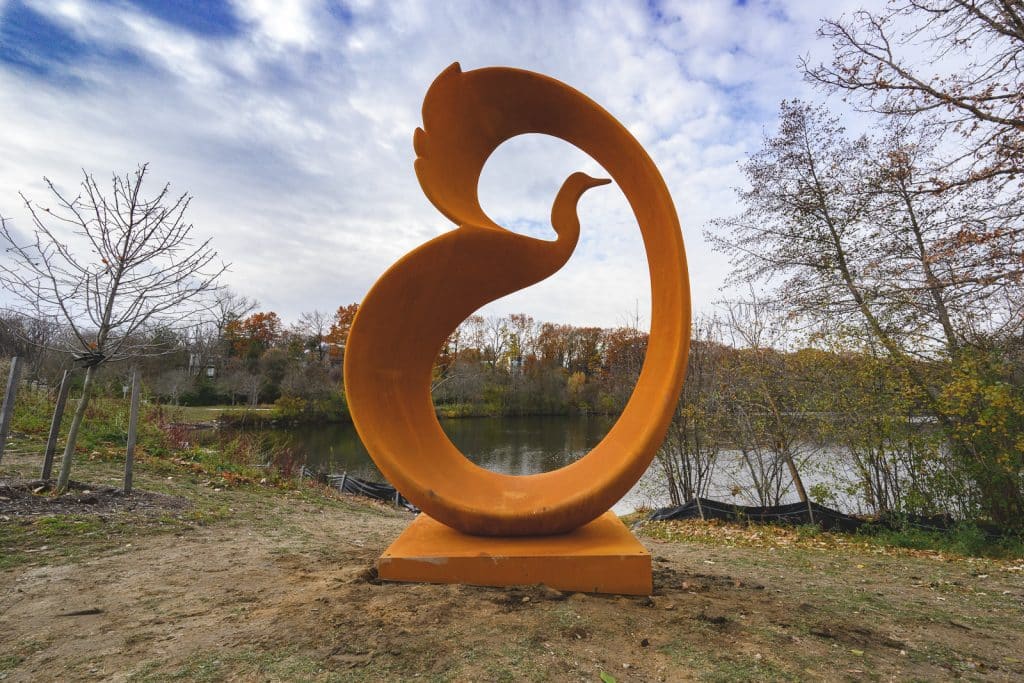
The resulting 10-foot, corten-steel sculpture of a heron, designed by married couple Kelley and Gavin Brodin, was recently installed along the northwest corner of the bridge over the Huron River. The Brodins are the creative force behind the Los Angeles-based sculpture studio Formed For.
“We hope [the sculpture is] going to be an inspiration for people to celebrate the land, to connect to nature, … [and] to be responsible stewards of the land,” Kelley Brodin says.
The Brodins have collaborated for about five years on public, commercial, and residential sculptures, primarily working in bronze, stainless steel, painted stone, and corten steel.
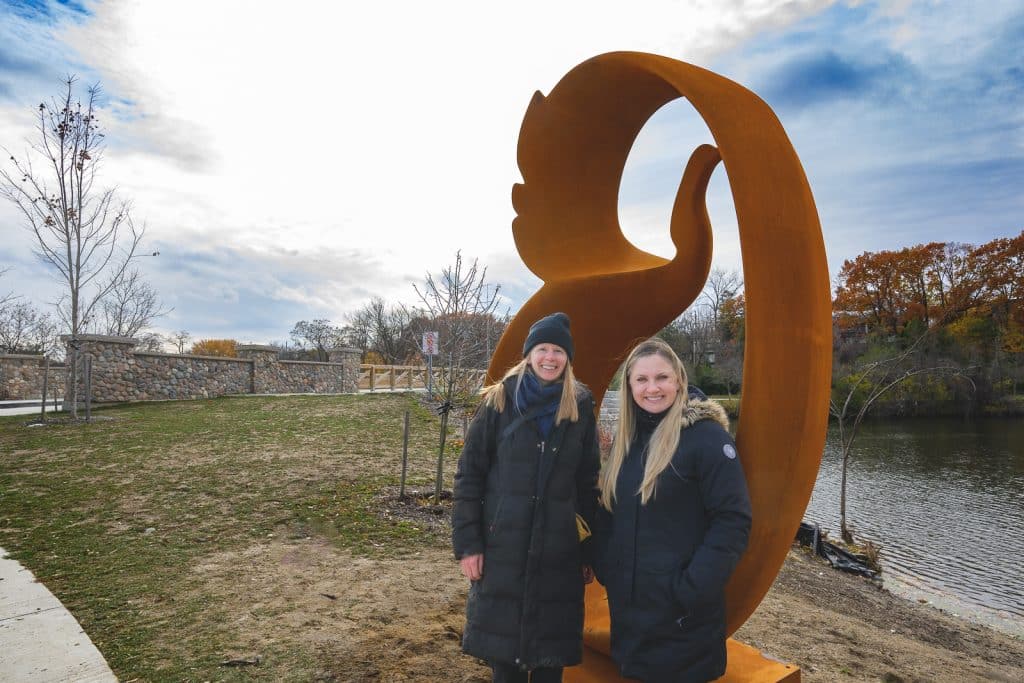
In terms of style, Kelley Brodin says she and her husband tend toward an “abstract and modern kind of look,” rather than something “hyper-traditional.”
The sculpture’s abstract, swooping gesture provides “a framed view of the river,” Kirkpatrick says. But she says that same “framing element” also makes it a perfect backdrop for selfies, so she anticipates “a lot of people interacting with the sculpture for pictures.”

The Brodins’ biggest challenge, Kelley Brodin says, was working from a distance: it was difficult to visualize where in the park the sculpture would be situated.
Kelley Brodin says Kirkpatrick would FaceTime her from the site, “holding the phone, trying to angle it different ways, like, ‘What about here? What about here?’”
But they also used an augmented reality tool to help visualize the sculpture’s placement. The tool essentially allowed Kelley Brodin to share an image of the sculpture by copying and pasting it into her camera viewer.
“If you’re holding [your] iPad, looking through your camera, you’re seeing the sculpture as if it were in that spot,” Kelley Brodin says.
And while the tool helped determine the best location and scale for the sculpture, Kelley Brodin says the Brodins’ goal isn’t ultimately focused on technology. She says their aim is to “speak to communities around the country and around the world through our art — [and] for people to really celebrate, connect, and take care of the natural world we live in.”
The Barton-Bandemer tunnel
Clinton Township-based artist Tatum Lorway designed the metal panels now lining the insides of the Barton-Bandemer pedestrian tunnel, which connects Barton Nature Area with Bandemer Park.
The panels, which are five feet tall and 60 feet long, offer a sectioned view of the Huron River. Eventually, they’ll be backlit so that light shines through the holes or cutouts in the panels. (Because the actual lighting element was on back order, the tunnel opened without it. “There’s always delays,” Kirkpatrick says.)
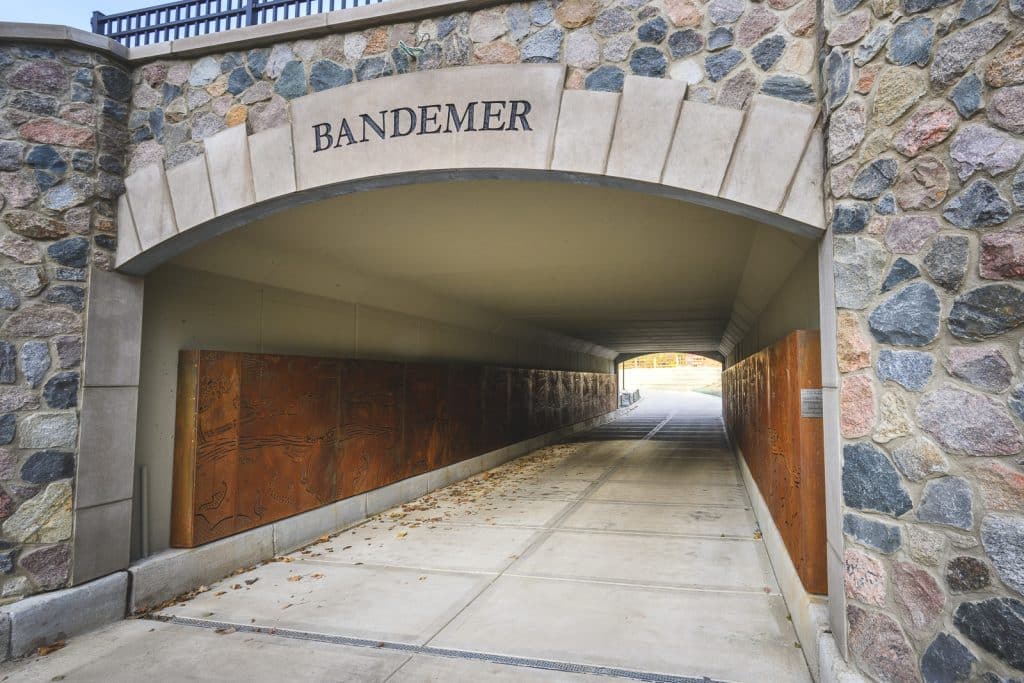
The lighting will also have a practical aspect: to illuminate the tunnel itself so pedestrians and bikers can see where they’re going.
Kirkpatrick says the design “giv[es] us a perspective that we don’t normally see — every living thing, from creature to plant to rock, is given equal attention.”
Lorway says she took a holistic approach to her design process, trying to incorporate “the fish, the turtles, the herons, the beavers, the insects, but especially the people” that the area is known for.
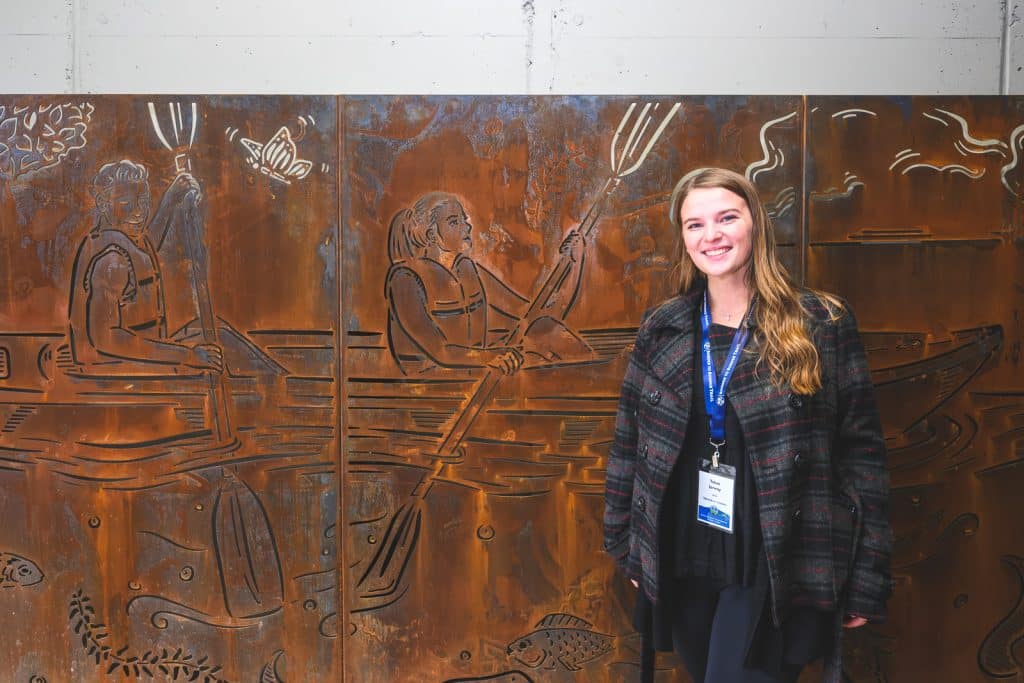
“I wanted to represent everyone [and] everything in this piece of work … so that nothing gets left behind,” she adds. “I want everything to be included.”
Kirkpatrick says she’s “really excited about this project for several reasons.”
For one thing, it’s one of the few examples of public art in Ann Arbor that isn’t a mural or a sculpture. For another, Kirkpatrick says the project is the result of a brainstorm by two different parks and recreation departments. In her telling, Washtenaw County Parks and Recreation and Ann Arbor Parks and Recreation “came together to discuss what type of art they wanted in the tunnel: Would it be a mural? Would it be a mosaic?”
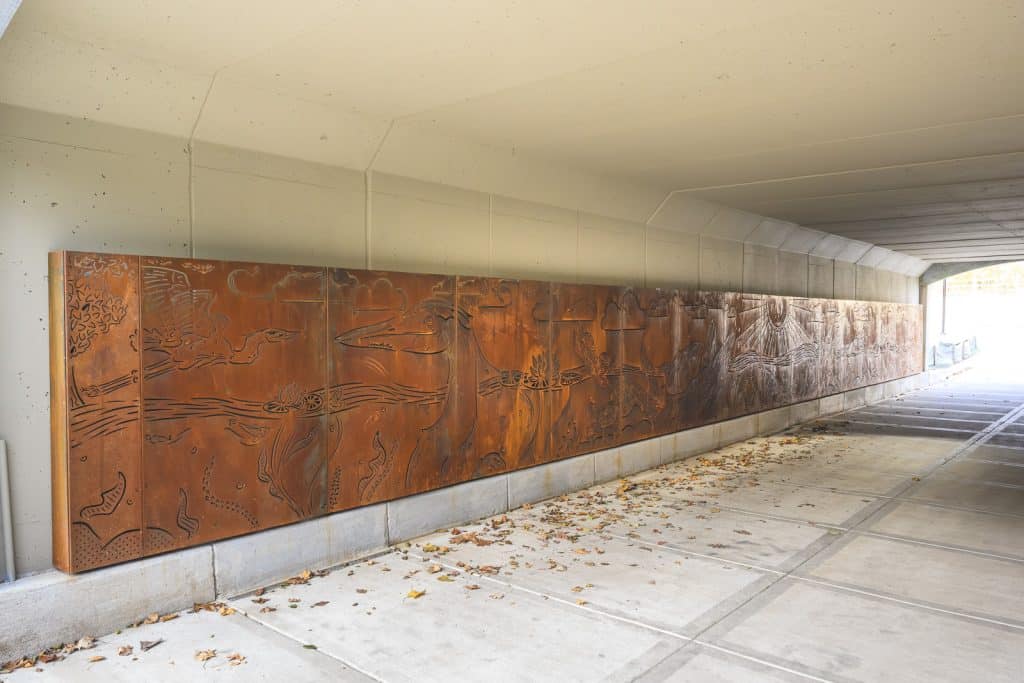
They came back to the A2AC with their decision, which was a little more unusual: they wanted a panel installation with laser-engraved metal and a lighting component. It would be the A2AC’s job to help find an artist and lead all the teams through the artistic process.
The A2AC settled on Lorway to design the panels, and fabricator Detroit Metal Elements to produce them.
Lorway wanted to make sure there wasn’t too much open space in the design – “or you wouldn’t have a design,” she says. “You would just have these open chunks – and you’d be able to see all the light bulbs or the sources of the light coming through.”
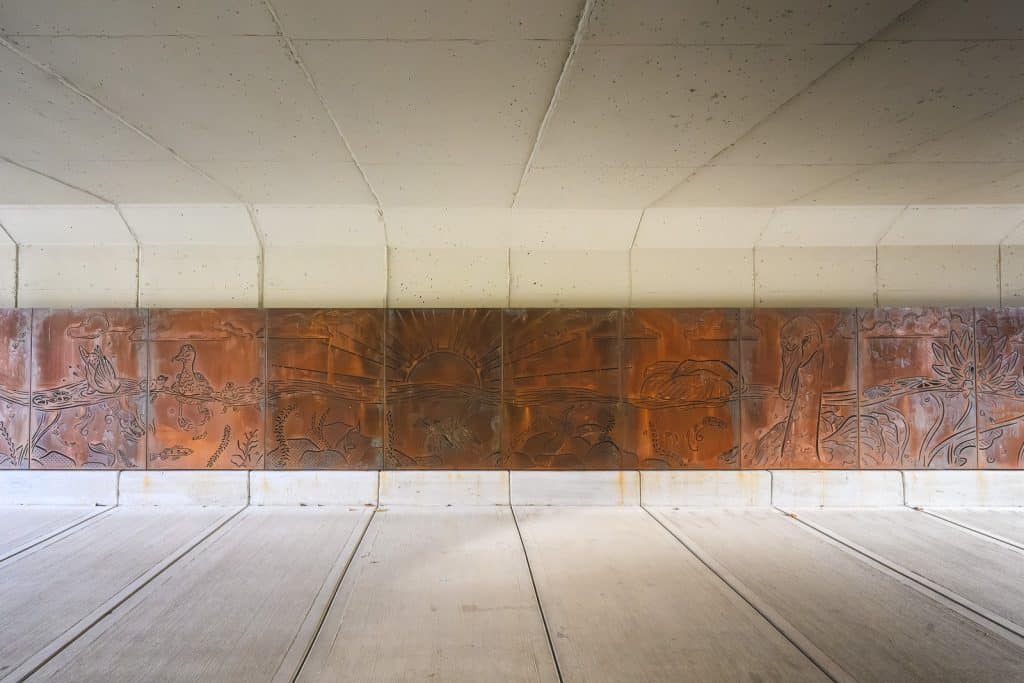
The trick was to cut enough metal away that “a lot of light would still emit in this tunnel,” which, windowless as it is, would otherwise remain dark.
“You’re walking through [the tunnel]. You’re biking through it. You want to be able to see where your feet are touching,” she says.
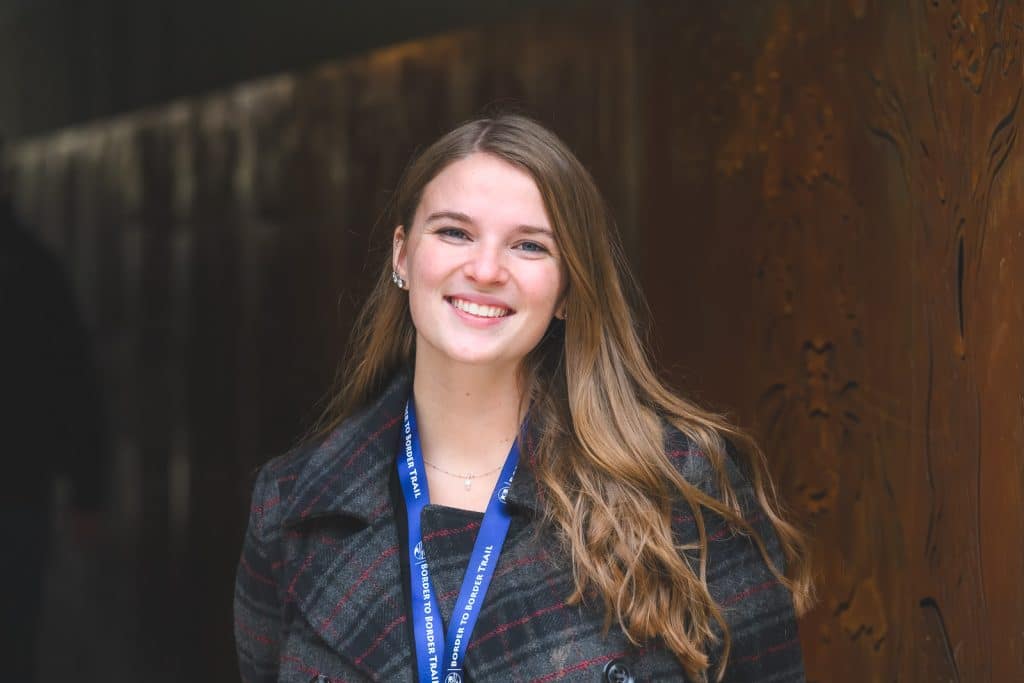
A freelance artist who’s primarily worked in the digital realm, Lorway also spends her days teaching ninth-grade art in the Romeo Community School district.
“I’m very thankful that I got this opportunity to … work more closely with the city and the Art Center,” she says. “I’m really hopeful that people have more of a chance to bring art as an appreciation into their lives.”
This story is part of a series about arts and culture in Washtenaw County. It is made possible by the Ann Arbor Art Center, Destination Ann Arbor, Larry and Lucie Nisson, the University of Michigan Arts Initiative, and the University Musical Society.
Author

Related Articles
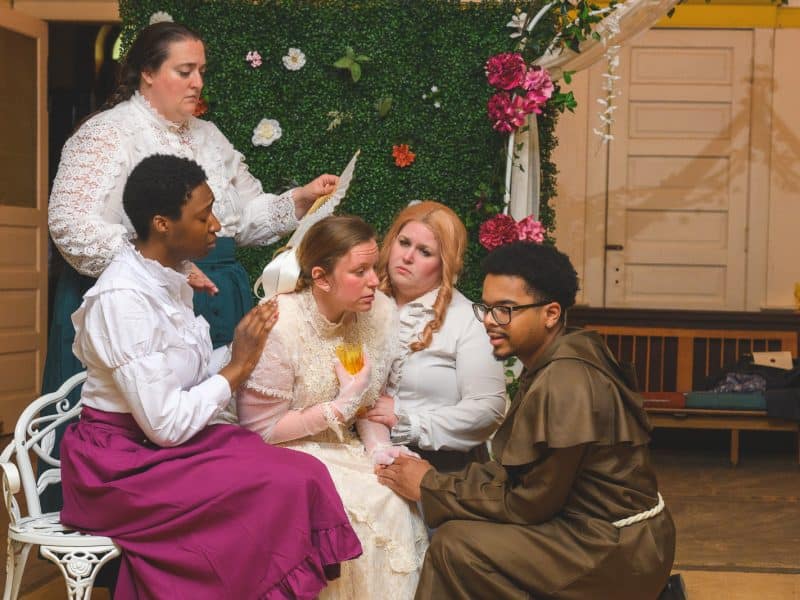
Ypsi-based Brevity Shakespeare “distills” the Bard for modern audiences
Brevity Shakespeare, an Ypsilanti-based theater company, adapts and stages abridged versions of Shakespeare plays.
Ypsi library’s “Noise Permit” summer youth program to expand with added funding
The Ypsilanti District Library has received additional grant funding from the Michigan Arts and Culture Council to expand its annual Noise Permit summer program for young people, bringing new technology, workshops, and mentorship opportunities to local youth.
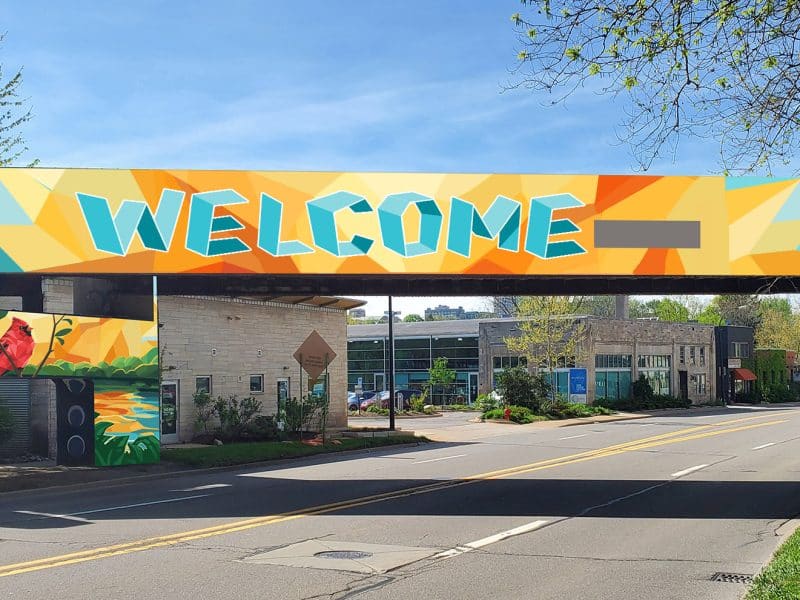
Underpasses as canvases: Organizers raise funds for mural on Ann Arbor railroad bridge
TreeTown Murals’ “Murals That Bridge” initiative is continuing a citywide effort to transform Ann Arbor infrastructure into visual landmarks.


