
Researchers seek “untold stories” of Ann Arbor’s Hill Auditorium for inclusive history project
University of Michigan researchers are seeking “untold stories” of Hill Auditorium as part of the university’s Inclusive History Project, a multi-year, multi-campus initiative seeking to document a fuller and more diverse history of the university.

University of Michigan (U-M) researchers are seeking “untold stories” of Ann Arbor’s Hill Auditorium as part of the university’s Inclusive History Project, a multi-year, multi-campus initiative seeking to document a fuller and more diverse history of the university.
U-M research fellow Emily Lyon says many other universities across the country, from Brown University to the University of Virginia, are doing projects that focus on alternatives to the mainstream, celebratory narratives usually found in an institution’s official archives.
“So this Hill Auditorium project is looking at how Hill Auditorium has been a gathering space and symbol for not just the campus but also for the wider local community,” Lyon says. “Who has it served? Who has been allowed to be on stage? Who has been allowed to determine who appears onstage? That’s the premise of the project.”

Cayenne Harris is vice president of learning and engagement for the University Musical Society (UMS) and one of two primary investigators on the Hill project. She says Matthew VanBesien, president of UMS, and David Gier, dean of U-M’s School of Music, Theatre, and Dance, approached the heads of the Inclusive History project to ask if they could add Hill to the initiative.
“We have a space in Hill Auditorium where there are portraits of the UMS presidents and the deans of the school of music. The portraits are very nice and hand-painted, but they’re all white men,” Harris says. “It is one of the few spaces in the building where there’s any kind of storytelling about history, and of course it doesn’t tell much about the history of the building, who has performed here, or who has been in the audience.”

She says VanBesien and Gier asked if the Inclusive History project could help them rethink how they tell the story of the auditorium, which has hosted musical acts, lectures, protests, and other arts and cultural events for more than 100 years.
A team of researchers has been digging through archives for relevant materials and seeking stories from community members who may remember the building in different ways. Those community members range from people who worked at Hill to student group members who brought programming there to people who experienced a graduation ceremony there.
UMS programming, and to a somewhat lesser extent the programming of the university’s choral society, are well-represented in the archives, Harris says. Hill is well known as a venue that has hosted prominent musical acts ranging from elite philharmonic orchestras to Bob Dylan and the Grateful Dead. But it’s lesser known that the auditorium was a hub for student activity, including political and protest work.
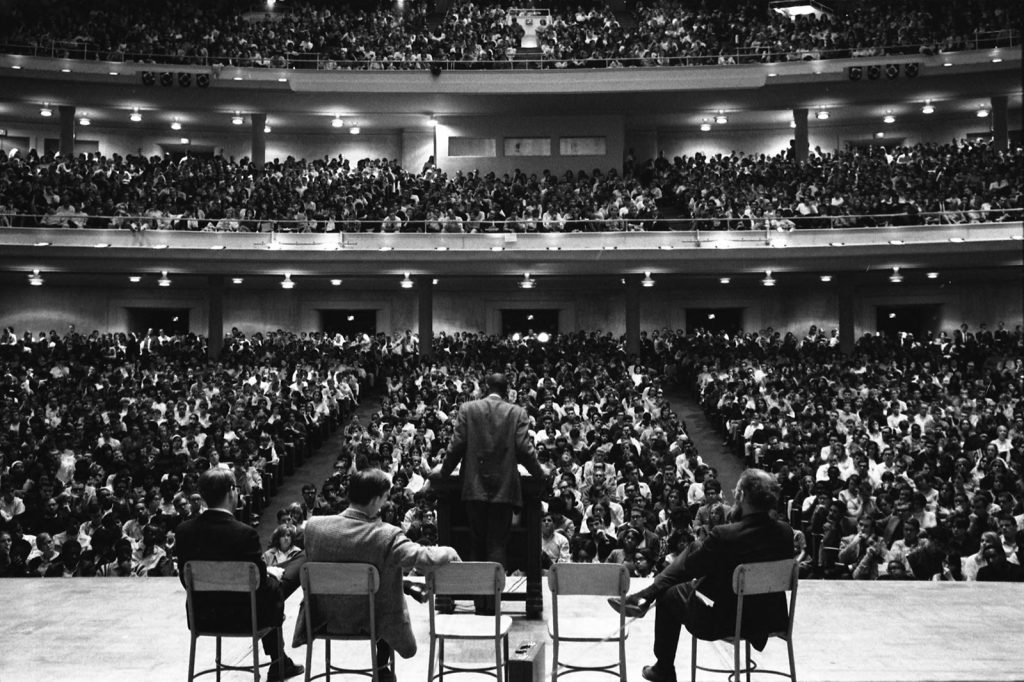
Lyon notes that student groups did a lot of programming at Hill in the first half of the 20th century, bringing in lecturers and presenting theatrical acts. Thanks to student groups, she says Hill has also been the site of “a lot of political speeches from national world leaders, especially those important in U.S. history, whether it was W.E.B. Dubois or Helen Keller, Teddy Roosevelt, Angela Davis, Huey Newton, or Martin Luther King Jr.”
Mark Clague, U-M professor of musicology and executive director of the U-M Arts Initiative, is the other primary investigator on the Hill project.
“Just this year, it delighted me that, during the Martin Luther King Jr. Day event at the auditorium, they were speaking at the same podium, the same piece of wood, that Martin Luther King spoke at on campus. That history is embedded in the very structure of Hill Auditorium,” Clague says.

Clague says he has a “very personal relationship” with Hill as a musician, having played concerts there as a member of a youth orchestra and as a music performance major at U-M. Hill’s parabola shape gives it special acoustic properties, Clague notes. It was built in the days before electric amplification and allowed a speaker on stage to project their voice to any seat in the house.
“But the thing about a parabola is that it’s an acoustic funnel, and it not only amplifies sound going out, but it concentrates sound going in, toward the stage,” Clague says. “When everybody in the audience starts clapping, that roar of affirmation just hits you on the stage. That mutual sense of connection between the stage and the audience is one of the reasons so many performers love playing in Hill.”
The researchers emphasize that Hill isn’t just a campus building, but a place Ann Arbor community members see as their own. Clague says part of what makes Hill special is “the way it creates community.”

“The magic of the building is what people do with it, not just what happens there,” he says. “Our project is a way of looking at arts and community as a process rather than as a thing or a moment in time.”
Graduate researcher Ellen Lee says that Hill, over the years, “not only brought the student body together but the general population as a whole.”
“Getting information about all those different perspectives is really important, and redefines what inclusive history means,” Lee says.

Currently, project heads are inviting small groups from Ann Arbor and surrounding communities to share memories of Hill.
Lyon says the listening sessions “will allow us to build a more nuanced and comprehensive understanding of how Hill is remembered and how it has shaped the history of its community, and to go beyond the stories that are available in existing archives.”
Community members who have a unique or interesting story about Hill, especially “untold stories” not mentioned in the official archives, are invited to reach out to the project researchers. The researchers have created a website where community members can share their stories.
Sometime later this year, project staffers expect to share the information they’ve gathered in some kind of formal presentation available to the public. It will include both a physical display inside Hill where visitors can learn more in person, as well as a website where the public can learn more about the history of the Ann Arbor landmark.
Author

Related Articles

Michigan League of Handweavers’ biennial show in Ann Arbor will feature myriad disciplines
From weaving to doll-making, a broad range of craftsmanship will be featured in both exhibitions and public demonstrations at the Michigan League of Handweavers’ 23rd Biennial Fiber Show.
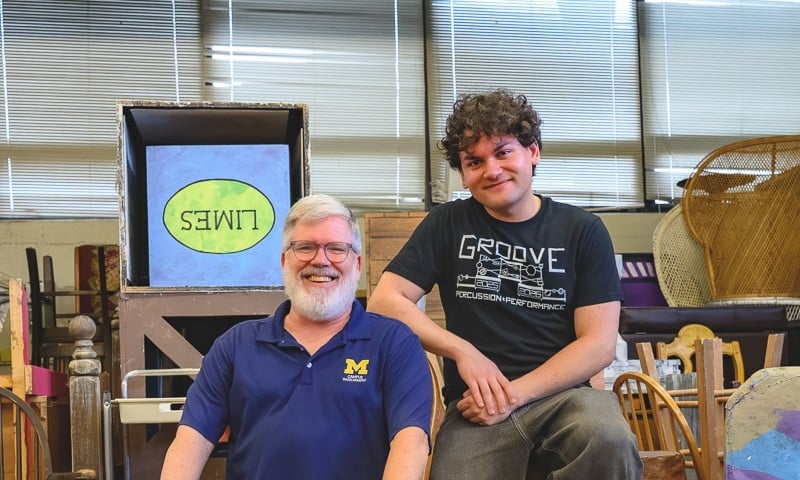
From building a train to hosting an alpaca, this U-M facility serves student performers’ needs
For about 50 years, the University of Michigan’s Student Theatre Arts Complex has been quietly providing crucial pre-production support to student-run theater and other performance groups.
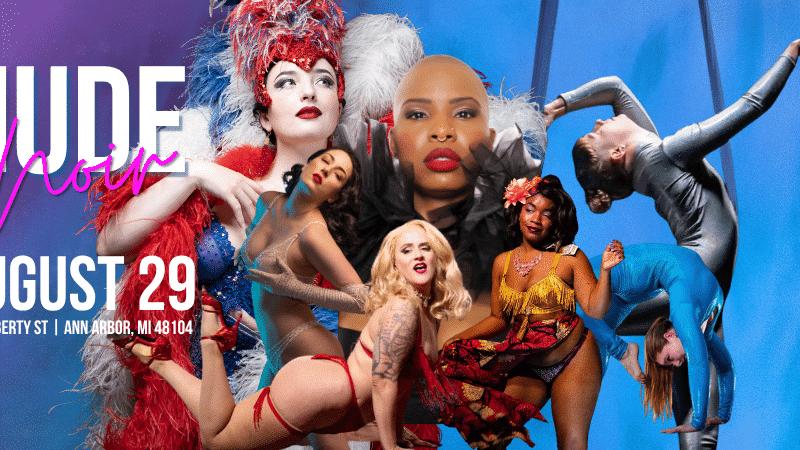
Nude Noir brings “celebration of the human form” to Ann Arbor’s Michigan Theater
Nude Noir attendees are invited to roam the Michigan Theater as performances — from burlesque and drag to aerialists and contortionists — unfold around them.


