
“Great Gatsby” will be read onstage verbatim in New York theater company’s Ann Arbor performance
The New York-based theater company Elevator Repair Service will bring “GATZ,” a six-and-a-half-hour production involving a verbatim reading of F. Scott Fitzgerald’s “The Great Gatsby,” to Ann Arbor March 27-29.
This story is part of a series about arts and culture in Washtenaw County. It is made possible by the Ann Arbor Art Center, Destination Ann Arbor, Larry and Lucie Nisson, the University of Michigan Arts Initiative, and the University Musical Society.
The New York-based theater company Elevator Repair Service will bring “GATZ,” a six-and-a-half-hour production involving a verbatim reading of F. Scott Fitzgerald’s “The Great Gatsby,” to Ann Arbor March 27-29. The University Musical Society (UMS) will present the performance at the Power Center, 121 Fletcher St. in Ann Arbor. The performance is divided into four sections, with two 15-minute intermissions and a 90-minute dinner break, for a total duration of approximately eight hours.
“This is an approach that we stumbled on that seems to work especially well for this novel because of its length, the way it’s written, the perspective of the narrator, and how that can translate into a real ally and guide for a live audience,” says director John Collins. “So many things about this novel happen to lend themselves to this way of doing it. I think it remains a kind of special experience that way.”
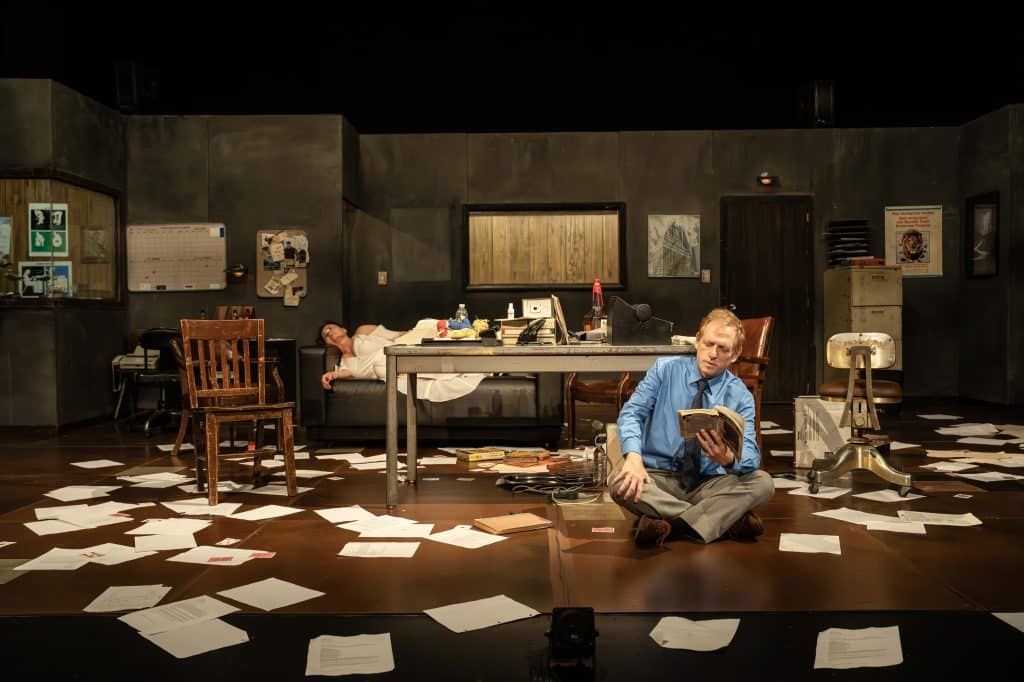
The method of adaptation alone sets “GATZ” apart, but it pairs fidelity to Fitzgerald’s text with a simple but innovative staging concept: the story unfolds inside a plain office, where the actors shift between reading, narrating, and embodying characters in real time.
“We’re not exactly staging the story of ‘The Great Gatsby.’ We’re staging the experience of reading ‘The Great Gatsby,’” Collins says. “It’s an act that literalizes an impulse that comes over you when you read a book you really love.”
Against a mundane backdrop, Gatsby’s world of wealth and excess has to be conveyed through language and performance alone.
“That counterintuitive setting starts out as creating a great ironic distance between us, the employees of the office, and the book,” Collins explains. “It allows the novel to have its own truth through its words, uncorrupted on some level by any attempts to do a perfect representation of it – and ultimately we get to some deeper truths about the novel and the story and the characters from an unexpected angle.”
That approach not only defines how the story is staged, but also helps explain why the production has continued to resonate with audiences for more than two decades. Collins attributes the production’s longevity largely to the novel itself, pointing to its lasting cultural hold as a driving force behind the decision to present it in full. The long runtime follows the same logic: it isn’t about filling time, but about committing to the story in full.
The commitment to the text also shapes the experience for both the performers and the audience. Actor Scott Shepherd, who portrays Nick Carraway, says acting in the production “takes a sort of commitment and energy” due to the long runtime. But after two decades of performing “GATZ,” that long haul has become almost second nature.
“The performance mainly rides on all the performers being alert and available to all the twists and turns Fitzgerald’s writing takes, and its humor as well,” Shepherd says.
Shepherd suggests that part of the production’s impact comes from how rare it is to spend such uninterrupted time with a single story, especially in an age shaped by shorter attention spans. Both Shepherd and Collins agree that part of what has kept the show so popular with audiences since it debuted in the mid-2000s is the shared immersive experience of a well-known novel that some audience members may not remember exactly as it was written.
“What continues to work is this opportunity for a room full of people to sit and spend the day having an experience with this novel,” Shepherd says.
Tickets for “GATZ” are available here.
Author

Related Articles

Ann Arbor artist hosts annual outdoor sale to benefit public art program
Glass artist Larry Nisson hosts an annual sale of his work from noon to 5 p.m. on Sept. 27 at his Ann Arbor home.
The Ann Arbor Symphony Orchestra brings its concert series to Ypsi for the first time
The 2026-27 season offers many firsts for the Ann Arbor Symphony Orchestra, from an Ypsilanti footprint to a live accompaniment of Disney’s ‘Frozen.’

Michigan League of Handweavers’ biennial show in Ann Arbor will feature myriad disciplines
From weaving to doll-making, a broad range of craftsmanship will be featured in both exhibitions and public demonstrations at the Michigan League of Handweavers’ 23rd Biennial Fiber Show.


