
Ypsi-based program disrupts school-to-prison pipeline through individualized support
The Student Advocacy Center of Michigan’s Check & Connect program pairs students with a dedicated adult mentor for two years.
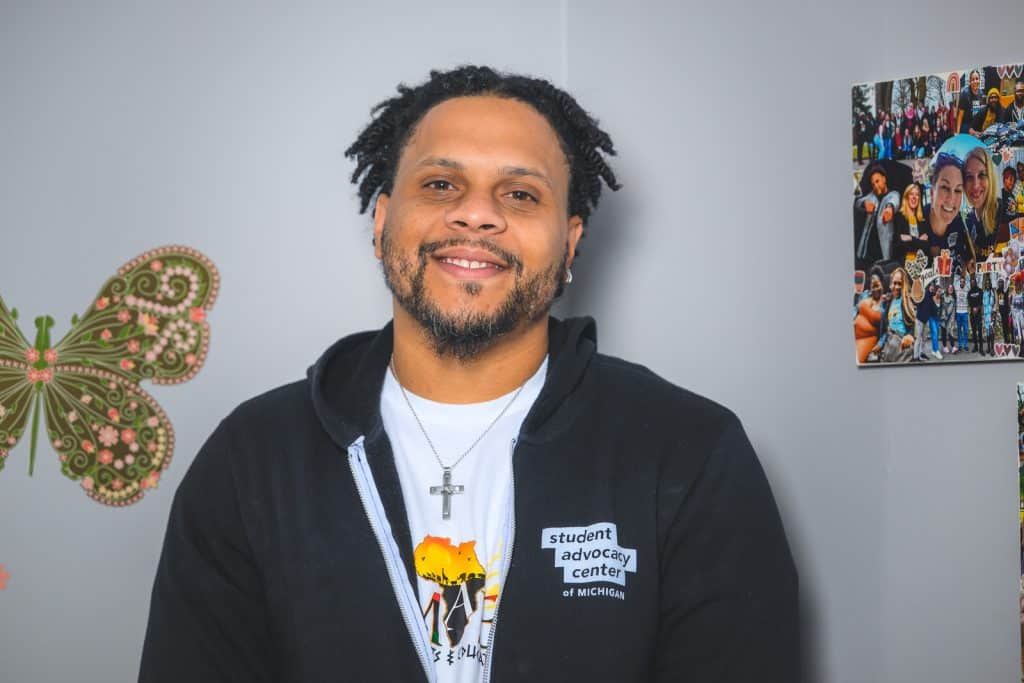
This article is part of Concentrate’s Voices of Youth series, which features stories written by Washtenaw County youth with guidance from Concentrate staff mentors, as well as adult-written stories spotlighting local youth perspective. In this installment, student writer Shruti Attili reports on the Student Advocacy Center of Michigan’s Check & Connect student mentorship program.
This article is part of a series about mental health in Washtenaw County. It is made possible with funding from Washtenaw County’s Public Safety and Mental Health Preservation Millage.
“A lot of it really comes back to opportunity.”
That’s how Anell Eccleston, the co-executive director of the Ypsilanti-based Student Advocacy Center of Michigan, explains the educational disparities that leave students vulnerable to the school-to-prison pipeline. Across Michigan, these disparities are reflected in school suspension rates, high school dropout statistics, and chronic absenteeism numbers. Specifically, in Michigan, Black youth are disproportionately affected by exclusionary discipline practices. While they make up only 15% of the state’s public school enrollment, they account for over a third of school expulsions, and are five times more likely to be detained when compared to white youth.
Student Advocacy Center staff believe that combating racial, socioeconomic, and systematic disparities that fuel the student-prison pipeline requires long-term support systems that encourage students to be connected to school in the first place. Eccleston explains that exclusionary school discipline methods have serious consequences, particularly in under-resourced communities. When students are removed from school, he says, they are often sent back to environments where there is less access to positive resources, directly increasing antisocial behavior and the likelihood for involvement with the juvenile justice system.
To address that opportunity gap, the Student Advocacy Center launched its Check & Connect Program.
The program, which recently received support from Washtenaw County’s Public Safety and Mental Health Preservation Millage, pairs students with a dedicated adult mentor for two years. Each adult mentor provides free, individualized support both inside and outside the classroom: everything from helping students stay on top of classwork to providing transportation.
“We see Check & Connect as vital to our organization because it’s an opportunity for us to really have a deep, long-term relationship with students over the course of two years,” Eccleston says.
Holistic approach
Because of its personalized approach, the program emphasizes supporting students’ broader needs in a holistic way, including the social and emotional factors that impact school performance. While the program tracks qualitative indicators such as attendance, academic performance, and behavioral write-up rates, success takes many forms.
“Students could also find themselves having a greater sense of belonging within the school and having trusted people within the school that they can identify with, which is also a sign of success,” says Jacorey Brown, one of Check & Connect’s most experienced mentors.
Through surveys conducted during the school year, Student Advocacy Center staff regularly hear stories about mentees becoming better siblings, stronger friends, and more engaged members of their communities. The program’s student-centered approach has also attracted the support of community organizations. This year, Check & Connect received grant funding from the Ann Arbor Youth Council, a council composed of Washtenaw County high-school students that awards more than $100,000 annually to local youth programs and initiatives. According to Greenhills School sophomore and Youth Council member Enan Shihadeh, Check & Connect stood out during the selection process because of its unique and clear student-centered approach.
“Check & Connect was a program that caught every Youth Council member’s eye, as it was an initiative that collaborated directly with students to ensure a supportive environment and academic success,” Enan says. “The program exemplified the Youth Council’s morals of teamwork, mentorship, and educational equality, a funding priority this year.”
Building trust
Because Check & Connect mentors enter students’ lives as strangers, relationship building is central to this work. Brown says the program’s two-year structure allows mentors to spend ample time learning about student needs and interests before focusing on longer-term educational goals.
“During the first year, we’re kind of just getting a feel for one another: seeing what their interests are, seeing the things they like and dislike, things that may be triggering for them, and figuring out ways that I can support them both inside and outside school,” Brown says.
For Eccleston, this approach starts with seeing students for who they truly are, even if in unconventional ways. He recalls one student who was deeply interested in cars, but struggled academically, reading at what he estimated was a third-grade level despite being in eighth grade. While providing a routine ride to school, Eccleston noticed the student’s automotive expertise firsthand when Eccleston’s car started to malfunction.
“A 13-year old eighth-grader was showing me how to change my oil in my car,” Eccleston says. “He had me pull over when my check engine light was on.”
This moment became a turning point in their relationship. Eccleston says he leaned into the student’s interest in cars, using it as a foundation to read automotive books and magazines, and attending auto shows to learn more.
“It was kind of the thing that connected us, because their interests are an extension of them,” he says. “We were able to dig into what he loved while still centering educational progression.”
This experience reflects the philosophy behind Check & Connect, which ties academic growth to how seen, understood, and supported students feel beyond the classroom.
Looking ahead, the Student Advocacy Center hopes to expand the Check & Connect program into more Ann Arbor Public Schools. The program currently serves students in two district schools, but Brown says the long term goal is to build a broader presence by obtaining additional funds to hire more mentors and reach more youth and families in the area.
Concentrate staffer Patrick Dunn served as Shruti’s mentor on this article.
Click here to read more from the Voices of Youth series.
Related Articles
New initiative guarantees EMU admission for Ypsi and Ann Arbor students
Eastern Michigan University, Ypsilanti Community Schools, and the Early College Alliance at EMU have partnered to guarantee EMU admission to local high school graduates.
Ypsi schools’ Mental Health Awareness Fair aims to offer resources, reduce stigma
Ypsilanti Community Schools are celebrating Mental Health Awareness Month with their fourth annual Mental Health Awareness Fair on May 16 from noon-3 p.m. at Prospect Park in Ypsilanti.


