Getting to the Airport: AirRide Provides First Step for Public Transit Option
DTW has been hailed far and wide as a world-class airport. Ground transportation to and from its terminals, however, have long been criticized as less than adequate. Last year Ann Arbor decided to address this shortcoming with AirRide, a daily public bus service that now averages nearly 1000 riders per day.
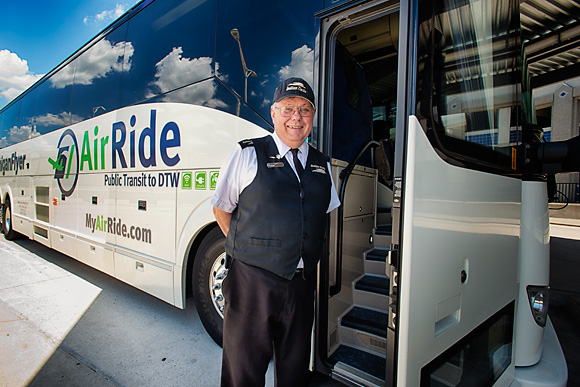
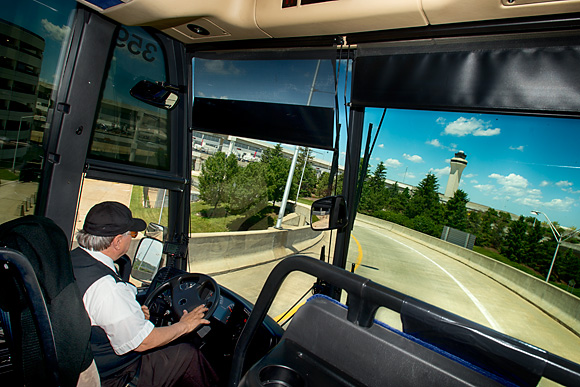
Doug Coombe – AirRide driver Harry Bentz at the North Terminal of Detroit Metro Airport
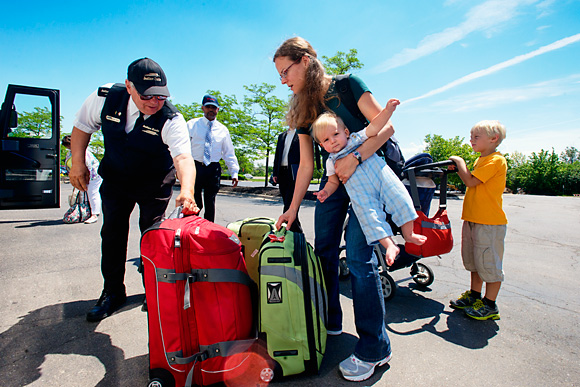
Doug Coombe – The Ott family gets on the AirRide at the Kensington Court Hotel
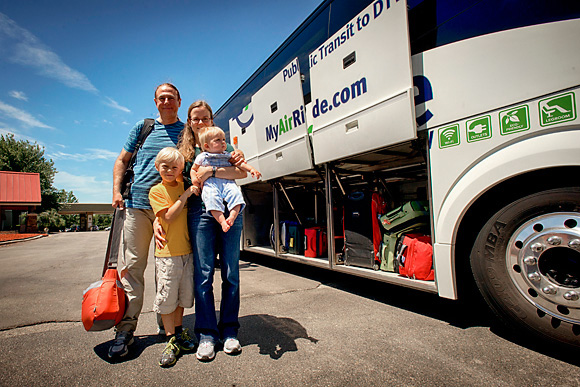
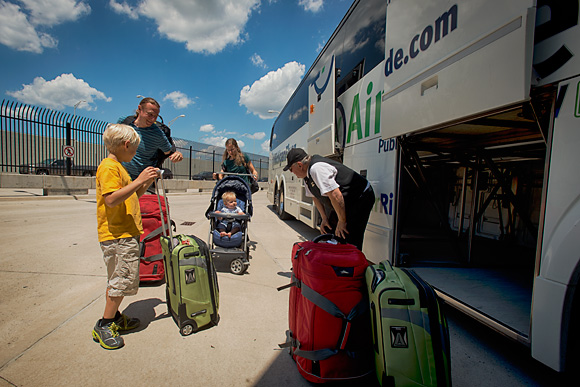
Doug Coombe – Paul and Annelie Ott with their sons Nicholas and Alexander board the AirRide
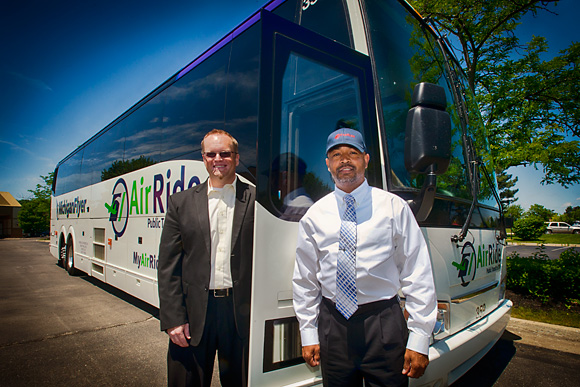
Doug Coombe – L to R Don Kline and Al Thomas of the AATA with the AirRide at Kensington Court Hotel
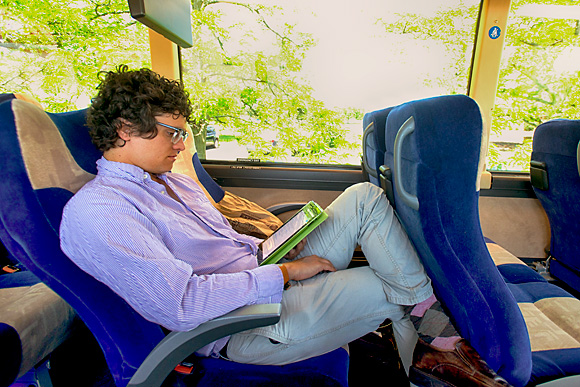
Doug Coombe – Daniel Reckan on the AirRide to Detroit Metro Airport
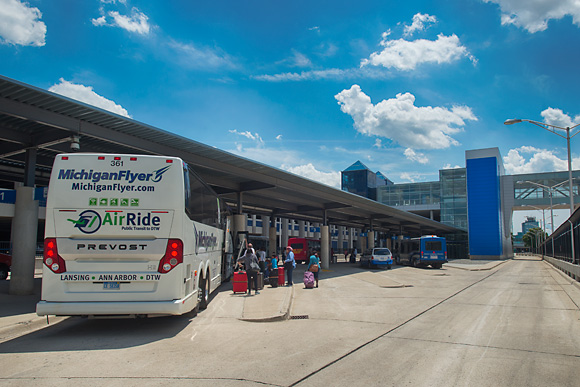
Doug Coombe – The AirRide pulls into the McNamara Terminal
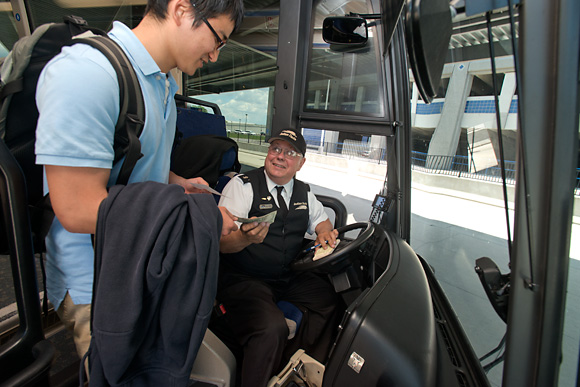
Doug Coombe – Heonsoo Lee buys a ticket to Ann Arbor on the AirRide
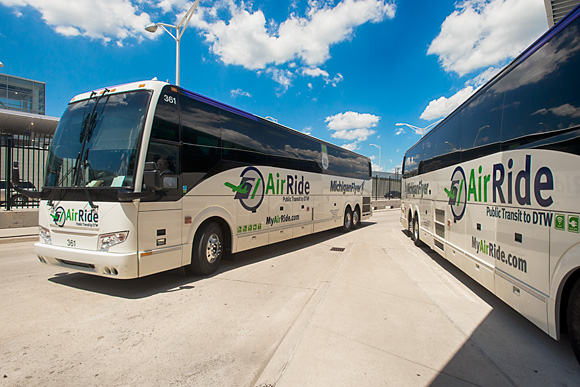
Doug Coombe – AirRide pulling into the North Terminal at Detroit Metro Airport
Doug Coombe – Passengers getting on the AirRide outside the North Terminal
Doug Coombe – The Ott family arrives at Metro Airport via AirRide
While the vast majority of large airport hubs in the United States have some type of public ground transportation option, until recently the only way to get to Detroit Metropolitan Wayne County Airport using public transit was a 90-minute, circuitous bus ride from Detroit, used mostly by airport employees. An automobile can make the trip in 30 minutes.
Now AirRide, a year-old public-private partnership between the Ann Arbor Transportation Authority and private bus company Indian Trails, has changed that with the first-ever passenger-oriented public transit option to DTW to and from Ann Arbor.
The service got its start as a private venture in 2008, when Indian Trail’s Michigan Flyer program began operating 8 trips per day between East Lansing and DTW with one stop in Ann Arbor. The service delivered about 400 passengers per day, with only about 40-50 originating in Ann Arbor, says Chad Cushman, Vice President for Indian Trails.
In 2011, the AATA adopted a 30-year Vision that called for better regional public transit connections, including better airport connections. That plan set the groundwork for AirRide.
In 2012, AATA, in collaboration with the Ann Arbor Downtown Development Authority, Ann Arbor Central Business District, the University of Michigan, and airBus, a student government-run bus transit service that shuttles students to and from DTW before and after school breaks, began to “think more creatively about regional connectivity and paving the way for a more vibrant and economically healthy future for both Ann Arbor and Detroit and all the areas around,” says Don Kline, public relations coordinator with AATA.
A public bid process led to a contract with Michigan Flyer to operate the new public airport shuttle service.
“Because we already had infrastructure in place, our bid proposal was competitive,” says Cushman. “We were able to expand the service and reduce the cost by putting private resources to a public use.”
An additional 4 trips and 2 additional stops were added to the original schedule, including a downtown stop at the Blake Transit Center, providing near-hourly service from early morning through evening. AATA marketed the service aggressively with billboards on I-94, print ads and radio spots, a cable video, and Facebook advertising targeting business travelers.
“We quickly hit our goal of 800 riders, doubling what Michigan Flyer had done privately, because of the additional stops and added awareness and marketing,” says Kline.”Now we are averaging 1000 riders per day. People have said to us ‘where have you been?'”
“It’s an example of the unmet demand for transit in this region and the opportunities that a creative and entrepreneurial agency can tap into,” says Richard Murphy, who represents Washtenaw County on the new Regional Transit Authority. “The fact that ridership took off so quickly shows how important this link is.”
AirRide does not attempt to compete with private carriers, notes Kline. “We don’t provide door-to-door service,” he says. “We give people the ability to get to the airport as frequently and conveniently as other services, but public transportation is always affordable and it caters to all customers,” he says.
The public-private partnership has been instrumental in keeping costs down for AATA, according to Kline. The fare is $12 each way, and $6 for seniors and those with a disability. Children ride free with a paying adult. Parking is available at the Blake Transit Center and the Kensington Court stops for $2 day, and AATA buses service all stops. By comparison, a private fare between Ann Arbor and DTW can runs as high as $68 dollars.
“When the service started, the cost was estimated at $1.2 million,” says Kline. “With state operating assistance, passenger fares, and private contractor contributions, AATA’s direct annual cost for the service was $303,400 at time of launch. As time has gone on, and ridership fees have exceeded our expectations, our cost share has gone down even further,” he says.
Having a public transit option to the airport is critical to keep the region economically competitive, according to Michael Conway, Director of Public Affairs for the Wayne County Airport Authority.
On-site parking revenues accounted for nearly 20% of DTW’s fiscal year 2012 operating budget. Despite this, Conway says the WCAA strongly supports development of more transit to connect the airport with the region, which will in turn help grow the regional economy and future airport traffic.
“This metropolitan region has a better chance to be prosperous if it has public transit to the airport, as do all other prosperous regions,” he says.
Conway notes that WCAA’s lease agreement with the airlines prohibits the authority from spending money on off-airport facilities. “The airport legally can’t financially support public transit, but we can be a cheerleader and accommodate the infrastructure,” he says.
WCAA provides bus stops at the terminals at no cost to AATA. The stops are shared with the Detroit-area Suburban Mobility Transit Authority bus, providing a point of regional transit connectivity between Detroit and Ann Arbor.
Despite the popularity of the service, AATA has no immediate plans to expand.
“To add to our 12 stops per day or to add a stop would be a little difficult with the infrastructure we have in place right now, to adhere to our schedules,” says Kline.
“People take it because it’s convenient, its frequent, and its affordable, and if we have to raise fares, or if we add a stop that slows down our schedule, I think people might look into other ways to get to the airport,” he says.
The creation of the new RTA may open doors for more transit development to DTW in the future.
“At some point the RTA could consider whether [AirRide’s] success can be replicated to other points in metro Detroit, both providing better access to the airport itself and also starting to knit together the pieces of the transit region to express links,” says Murphy.
“We are watching with great interest the potential of an Ann Arbor to Detroit transit system with a stop at metro airport,” says Conway. “It’s the exactly the kind of thing this region needs.”
Nina Ignaczak is project editor for Issue Media Group’s statewide transportatioon series, underwritten by the Michigan Environmental Council.
From weaving to doll-making, a broad range of craftsmanship will be featured in both exhibitions and public demonstrations at the Michigan League of Handweavers’ 23rd Biennial Fiber Show.
The University of Michigan’s Senior Implant Overdenture Restorative (SenIOR) program offers implant overdentures for free and is aiming to improve insurance coverage for the treatment.
University Bank’s lending division is providing up to $10,000 grants for low- to moderate-income borrowers in Washtenaw County to achieve their homeownership dreams.