
Ypsi-based Brevity Shakespeare “distills” the Bard for modern audiences
Brevity Shakespeare, an Ypsilanti-based theater company, adapts and stages abridged versions of Shakespeare plays.
This story is part of a series about arts and culture in Washtenaw County. It is made possible by the Ann Arbor Art Center, Destination Ann Arbor, Larry and Lucie Nisson, the University of Michigan Arts Initiative, and the University Musical Society.
“For most of us,” Karl Sikkenga says, “Shakespeare has similar connotations to, let’s say, algebra — things we studied in school that really didn’t resonate with us.”
Sikkenga is the founder and artistic director of Brevity Shakespeare, an Ypsilanti-based theater company that adapts and stages abridged versions of Shakespeare plays. Sikkenga says his goal is to make the plays accessible to contemporary audiences — and to highlight their relevance to modern life.
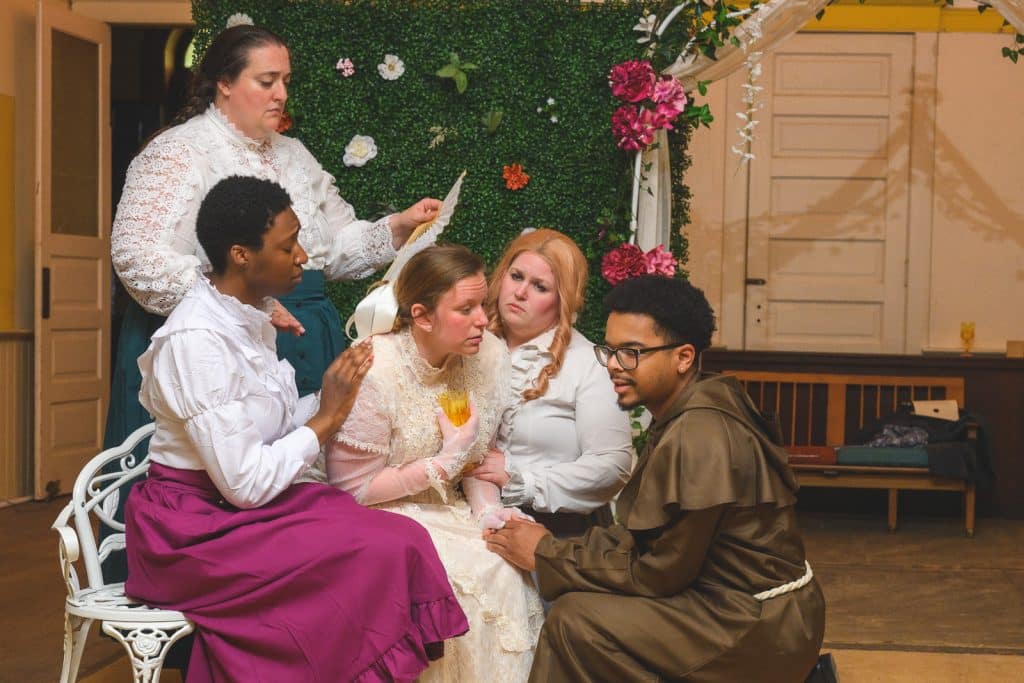
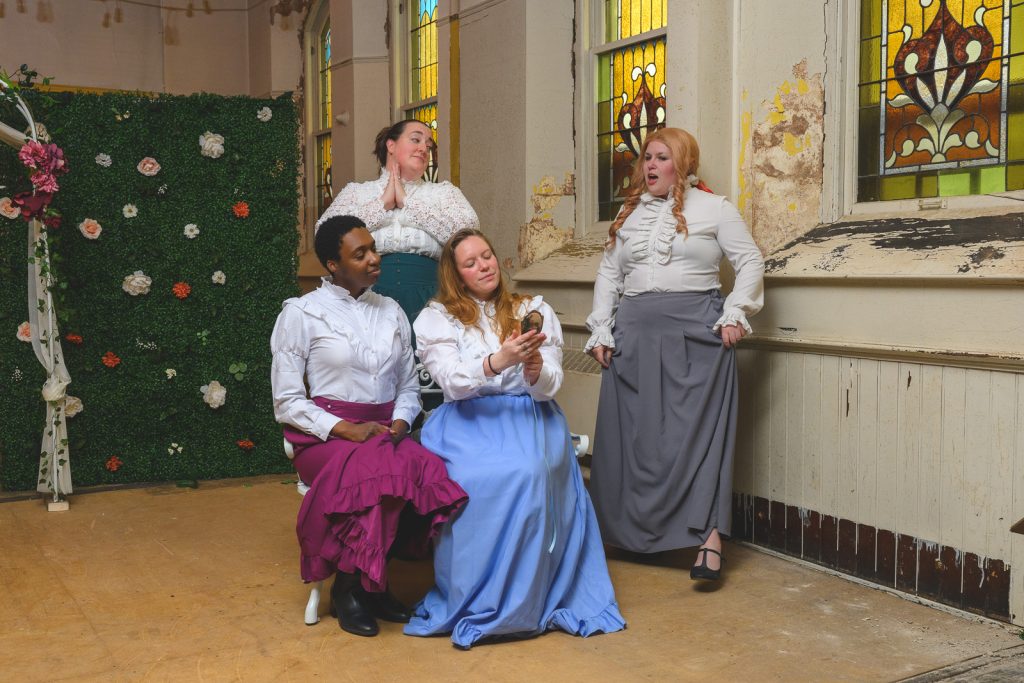
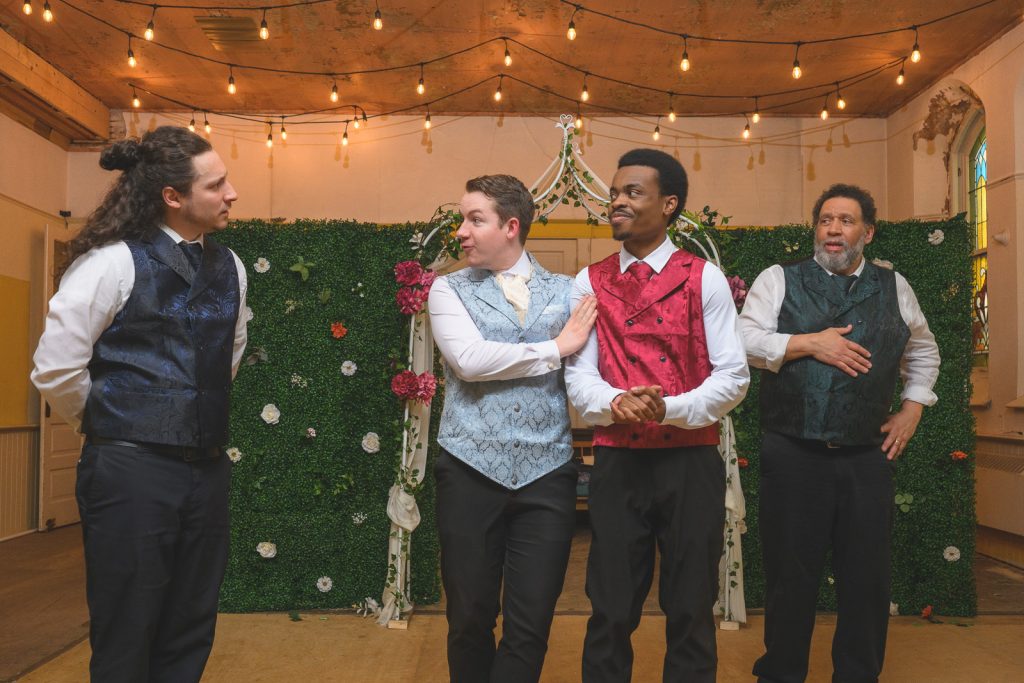
Brevity’s latest production, “Much Ado About Nothing,” runs May 22-29 and May 29-31 at the Ypsilanti Performance Space, 218 N. Adams St. in Ypsi. The play, which Sikkenga notes is “sometimes called the original rom-com,” follows two couples: Beatrice and Benedick, whom he describes as “older and more jaded,” and Hero and Claudio, “the young innocents.”
“Shakespeare is worth doing,” Sikkenga insists. “There’s a reason we’re still doing these plays 400 years later — and it’s not just a sense of responsibility. It’s because there’s something about them that really speaks to us.”
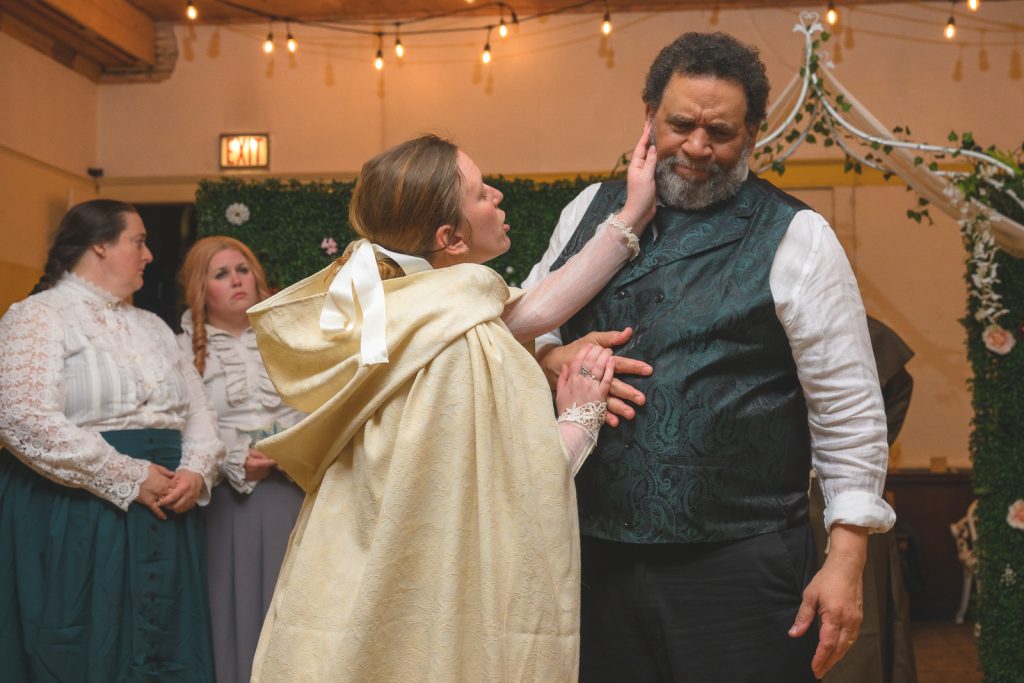
Sikkenga’s approach — and Brevity’s as a whole — runs counter to the idea that we should study Shakespeare the way we take our vitamins (or study algebra): with a sense of obligation. Sikkenga says Shakespeare “wasn’t writing this stuff to be read and parsed out to within an inch of its life.”
“He was writing [the] Marvel movies of their day,” he says.
Sikkenga spent decades working as a teacher and school principal. He describes himself as “a lifelong educator … [with] a lifetime of being interested in storytelling.”
That experience has given him unique insight on how to present the plays.
“You can teach Shakespeare in ways that are magnificently resonant with almost everybody — it’s just not often done that way,” he says. “The way to do it is to get it on its feet and do it right … [and] get inside of it.”
“Would he just slap me?”
“I really love Shakespeare,” Sikkenga says, “and a good chunk of the time I have no idea what [he was] talking about.”
From the 16th- and 17th-century puns to the now-archaic language, it can be difficult to understand what characters want or what their motivations are. You might be presented with a pair of “characters who apparently are in love, but we don’t know why,” Sikkenga says — and that can make it difficult to grasp whatever happens next.
That’s partly why “the plays need to be staged and not only read,” Sikkenga says.
“Then you’re elevated by it,” he says. “You gain insight.”
But Sikkenga also adjusts the scripts themselves through a process he calls “distilling” (though he also says “‘process’ is a pretty flattering word for what [he’s] doing”).
He says he tries to make the language “accessible” – and the same for the play’s length, which he tries to keep to 70 minutes or so. (“Three to four hours is a lot,” he says.)
If he can do so without altering the play’s basic integrity, Sikkenga says he might remove language “that doesn’t necessarily forward the crucial plotlines.” He might also cut or consolidate minor characters or entire subplots. (Reading memoirs by actors from the Royal Shakespeare Company, Sikkenga says it’s been “highly validating” to see that the most highly respected Shakespeare company in the world often does the same thing.)
Still, he’s quick to point out that he doesn’t “contemporize” or rework Shakespeare’s language aside from the “occasional single word.”
And while he says he’s “really glad someone made ’10 Things I Hate About You’” — the 1999 movie based on “The Taming of the Shrew” —he’s not trying to emulate its approach.
“Retaining [Shakespeare’s] language is really important for Brevity,” he says. “The underlying question for me is: what would [Shakespeare] say? Like, if the guy were here, would he just slap me?”
The plays themselves are “kind of living documents,” Sikkenga points out. “Someone else imposed the five-act structure. Shakespeare himself didn’t do that.”
He says the plays aren’t “scripture.”
“They’re not the golden plates that the Mormons say Joseph Smith discovered,” Sikkenga says. “So I do feel comfortable taking the liberty of tinkering with them.”
“My suspicion,” he adds, “is that if Shakespeare were here, he’d be so excited that we’re still doing his stuff.”
“It seemed like something I could do”
Sikkenga says Brevity is as much “a civic organization” as it is community theater.
“Really valuable community theater engages the community, and is built by the community, in particular ways,” he says.
That has meant ensuring that the company reflects the community in which it’s based.
“We made a decision early on that our casts would never be more than 50% white,” Sikkenga says.
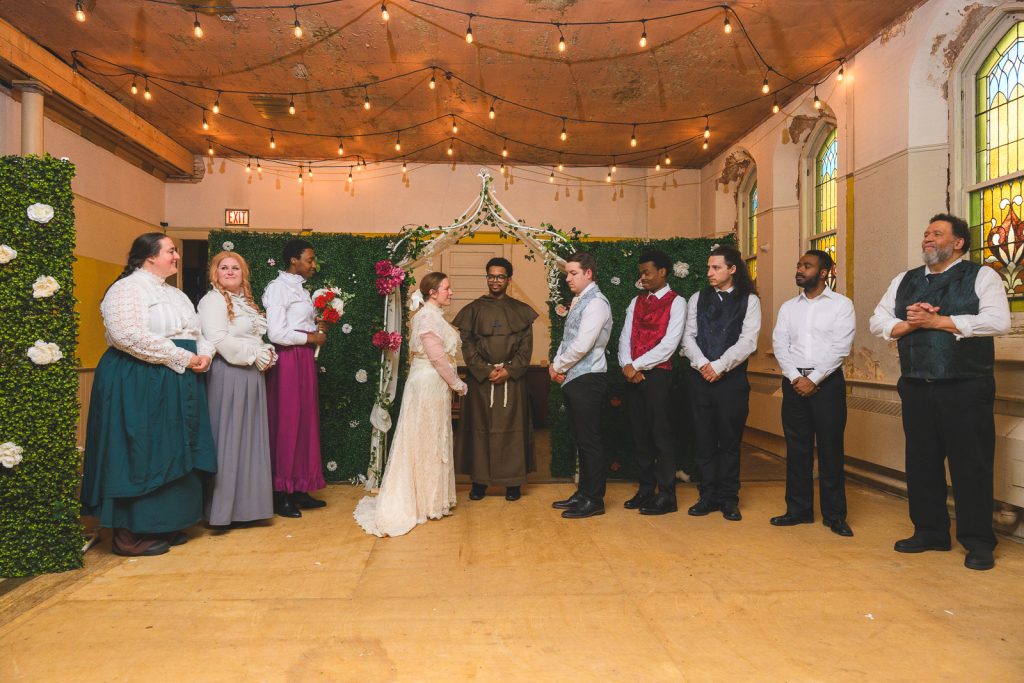
That strategy, he adds, might be “a very blunt instrument,” but an important one.
“If we really want to reflect our community – the makeup, the demographics of our community – …[then] it’s not enough to say that you value ethnic diversity,” he says. “You have to make it not just visible, but a core principle of the company.”
(That metric also applies to the company’s crew and Board of Directors, though it took longer to achieve in those areas, Sikkenga says.)
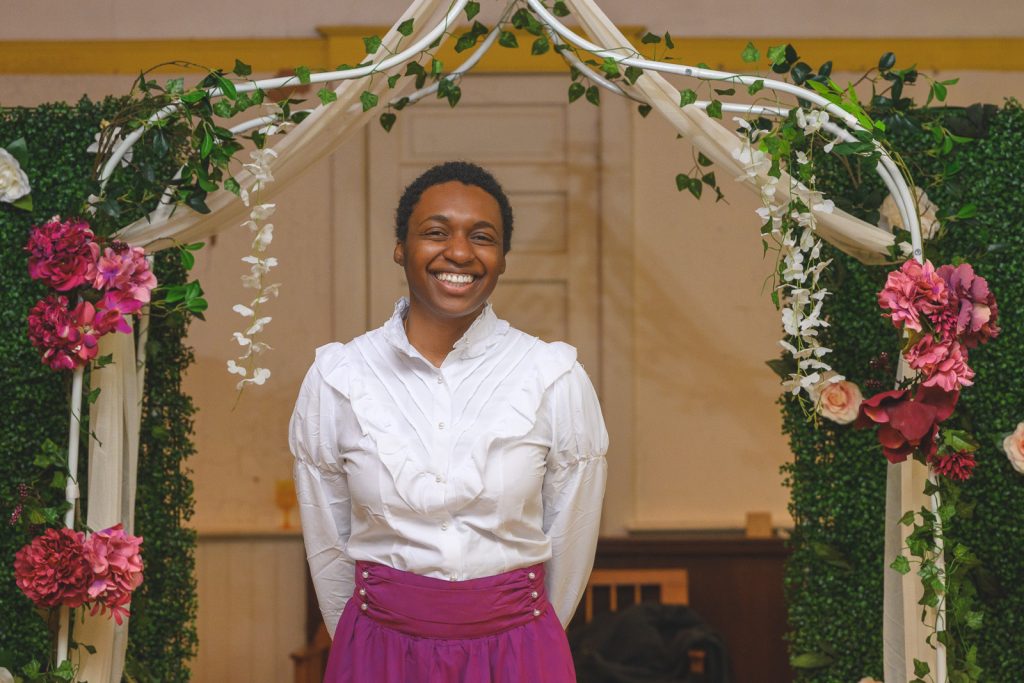
Efe Osagie plays Beatrice, one of the four leads in Brevity’s production of “Much Ado.” Osagie says she and Cameron Graham – who plays Beatrice’s romantic interest, Benedick, in the show – grew up associating Shakespeare plays with “white British people.” For each of them, the idea that actors of color like them could perform Shakespeare arrived as a kind of revelation.
“A lot of acting training programs will teach you, ‘This … is how you do Shakespeare,’ and you have to do it as if you’re a white person,” Osagie says. “If you’re Black, you need to change your dialect, change your speech patterns — things like that. …None of that is how I act, walk, talk, operate.”
Similarly, Graham was still in college when he came across a recording of a Shakespeare in the Park production of “King Lear” starring James Earl Jones. Graham says that to see the iconic Black actor as Lear “at that level, and be so great at it, had a really profound effect on [him].”
“It was seeing someone that looked like me,” Graham says. “Part of what made Shakespeare a little inaccessible to me when I was younger is I would typically see a lot of British white men doing it.”
As an actor, he says performing Shakespeare began to seem “like something [he] could do if [he] wanted to.”

Graham grew up in Ann Arbor and earned a bachelor’s degree in theatre arts from Eastern Michigan University in 2022. Osagie, who grew up in West Bloomfield, graduated from the University of Michigan in 2023. They’ve both worked with Brevity before (Graham played Roderigo in “Othello” last December), as well as with other local and regional theater companies. Since her first Brevity show in 2024, Osagie says she’s seen the number of people of color working with the company grow steadily, which has “been really beautiful to see.”
Osagie is looking forward to an upcoming trip Brevity is planning to Ypsilanti Community High School, where actors will perform a few scenes from “Much Ado” for students.
“We can show people who look like us, ‘Yeah, there are people who look like you who could do Shakespeare, and you don’t have to change,’” she says. “… It’s amazing to be able to show that, no, you can be Black, you can be Asian, you can be yourself and do Shakespeare. I never saw that growing up.”
The next act
This year is the first that Brevity has been able to offer three productions in a single season. Every season going forward, Sikkenga hopes to produce a comedy, a tragedy, and an open slot that could be filled by a history, comedy, or tragedy.
Currently, Brevity has 19 scripts to choose from — 18 that Sikkenga adapted from Shakespeare and an original Sikkenga play that he describes as “Shakespeare-adjacent,” based on the life of Elizabeth I. (“It seems to hold together,” he says.)
Still, Sikkenga insists his ambitions for the company are modest.
“My hope is that if someone comes to see one of our shows, then they want to come and see the next one — or they want to audition for it or work on it,” he says. “What people do with Shakespeare himself after they’ve seen or been involved in a Brevity production — that’s less important to me than [that] they come out of it having been invited to consider some stuff they hadn’t considered before, having laughed, or cried, or both.”
Tickets for Brevity’s production of “Much Ado About Nothing” are available here.
Author

Related Articles

For Banned Books Week, Ann Arbor and Ypsi librarians and booksellers defend the freedom to read
Banned Books Week, Oct. 4 – 10, aims to draw attention to censorship and promote access to information. This year’s theme, “Let Books Be. Protect the Freedom to Read,” will be reflected through programming at local libraries, bookstores, and other institutions.

Ann Arbor artist hosts annual outdoor sale to benefit public art program
Glass artist Larry Nisson hosts an annual sale of his work from noon to 5 p.m. on Sept. 27 at his Ann Arbor home.
The Ann Arbor Symphony Orchestra brings its concert series to Ypsi for the first time
The 2026-27 season offers many firsts for the Ann Arbor Symphony Orchestra, from an Ypsilanti footprint to a live accompaniment of Disney’s ‘Frozen.’


