
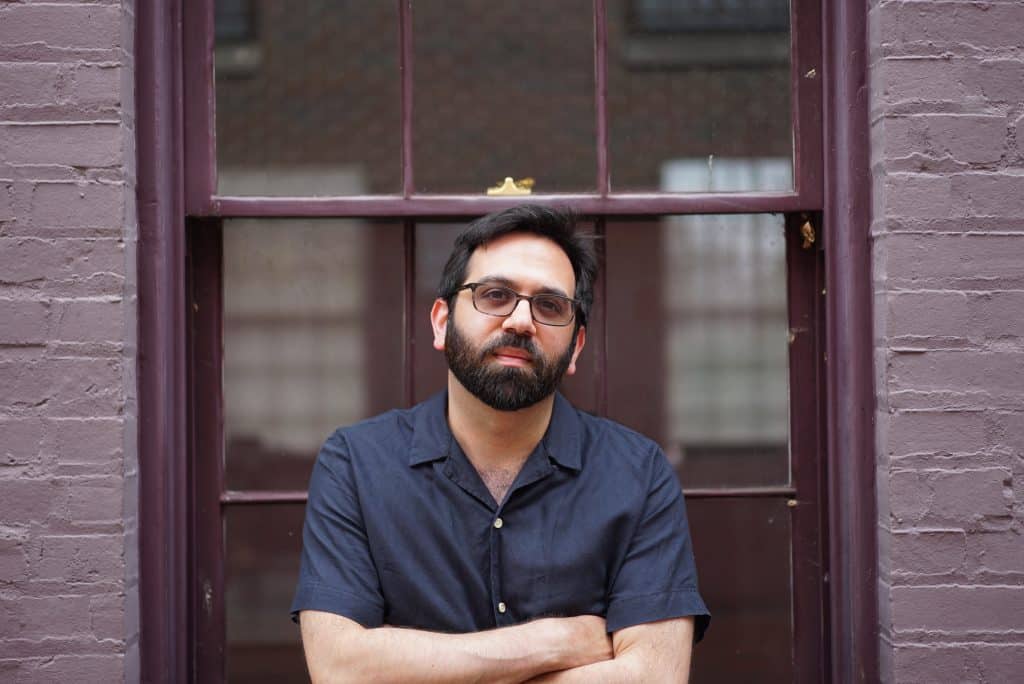
Toledo native Hasan Dudar will spotlight his debut story collection in Ann Arbor reading
Author Hasan Dudar’s new book, “Carryout,” offers a kaleidoscopic look at the life of an Arab family that runs a corner store in Toledo, Ohio.
This story is part of a series about arts and culture in Washtenaw County. It is made possible by the Ann Arbor Art Center, Destination Ann Arbor, Larry and Lucie Nisson, the University of Michigan Arts Initiative, and the University Musical Society.
Hasan Dudar finished piecing together the manuscript that became his debut story collection, “Carryout,” in the first few years after his daughter was born.
As a new parent, he says he “just…began to prioritize differently.” His new attitude, he says, was “just get the thing done.”
“I felt pressed for time, for sleep, for all sorts of things,” he adds. “There [was] just an urgency to everything.”
Dudar, who grew up in Toledo, Ohio, and now lives in Washington, D.C., will celebrate the release of “Carryout” at 6:30 p.m. on May 15 at Literati Bookstore, 124 E. Washington St. in Ann Arbor, where he’ll be joined for discussion by writer Aram Mrjoian.
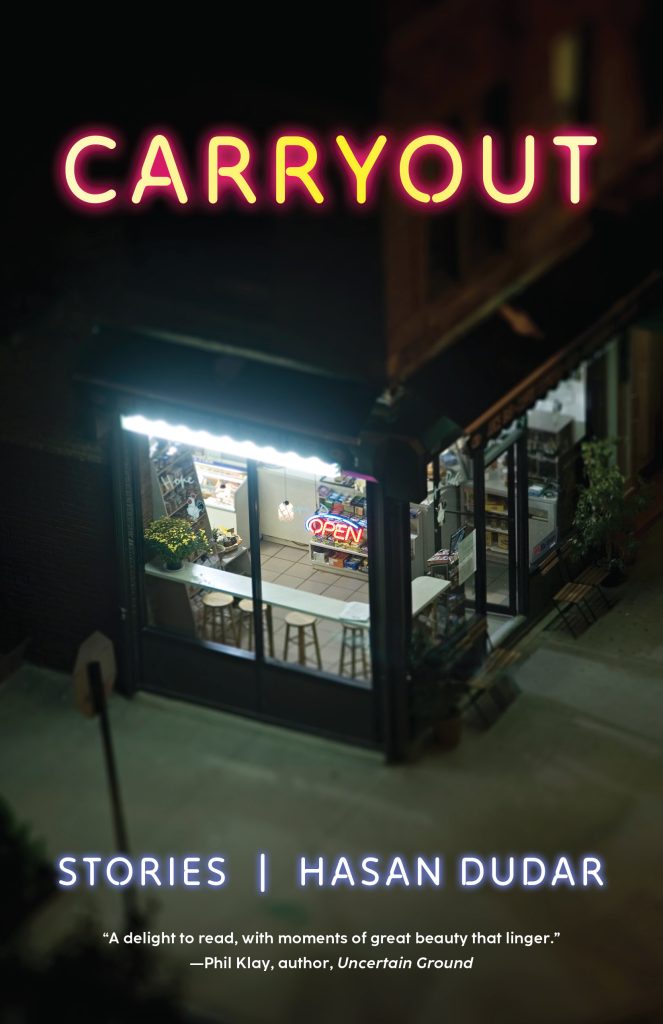
The book, a collection of interlinked stories, offers a kaleidoscopic look at the life of an Arab family that runs a corner store in Toledo. The father, Ziad Idilbi, is a Palestinian who, like Dudar’s own father, grew up in Lebanon before moving to Ohio in the ‘70s. In the U.S., he meets a young Lebanese woman, Salma. The two marry and have three children — Mustafa, who keeps finding himself in trouble; Nawal, who earnestly struggles to establish her own identity; and younger brother Walid, who dreams of becoming a writer.
His characters bear more than a few similarities to Dudar’s own life — his family owned a corner store, too — but the book, he says, is fiction.
It’s also a poignant portrait of a Midwest city marked by blight and economic hardship. Still, Dudar’s loyalty to and love for Toledo (“Toledo is home,” he says) come through on every page.
Growing up, he says he was “surrounded by family — aunts and uncles and cousins,” all of whom “put down roots there.”
Dudar went to college at the University of Toledo, but moved to complete his graduate studies in writing at the University of California, Berkeley. Dudar found plenty to appreciate about the West Coast, but he says he also found himself homesick for his “tightknit extended family and community.” After graduating, he moved back to work as a journalist at the Toledo Blade.
For Dudar, journalism has involved a kind of storytelling slightly different from — but not antithetical to — fiction.
As a journalist, “you have to really sit and listen,” he says. “… It’s not about you. It’s about others — whether that’s the subject in the piece of journalism or the characters in a piece of fiction.”
“Journalism trains you to center other people,” Dudar adds. “That’s [where] a lot of good storytelling comes from. If you’re writing fiction, it’s listening to the characters, listening to what they may want, what the page might need.”
After stints in Egypt, where he spent a year editing an English-language foreign policy journal, and Detroit, where he reported breaking news for the Detroit Free Press, Dudar moved to D.C., where his then-fiancée was living.
When the couple’s daughter was born, Dudar decided to stay home for a period of time to care for her — and managed to finish “Carryout.” Many of the stories had already been drafted, he says, but “the compiling and editing and putting together something that feels like a manuscript” were all done while caring for a newborn.
Now, Dudar works in broadcast operations as a freelancer for a D.C.-based TV outlet. While he’s always considered himself a writer, he’s also deeply interested in a visual medium.
“Images can tell us a lot, and people’s gestures, and the unspoken ways that they carry themselves, or the way that they animate themselves when they speak or move,” he says.
Still, Dudar says the years he spent moving out to Berkeley and then, eventually, back to Toledo were “formative” ones—“years of feeling far from the place [where] I grew up and the community that I grew up in … and then going back and immersing myself in the community again … as a son, as a Toledoan, [and] as a reporter or journalist.”
He says working on “Carryout” became a way to “hold on to those feelings, get back to them, see if I could access them again, and recreate or create something out of them on the page. That’s really where the book came from.”
Author

Related Articles

Ann Arbor artist hosts annual outdoor sale to benefit public art program
Glass artist Larry Nisson hosts an annual sale of his work from noon to 5 p.m. on Sept. 27 at his Ann Arbor home.
The Ann Arbor Symphony Orchestra brings its concert series to Ypsi for the first time
The 2026-27 season offers many firsts for the Ann Arbor Symphony Orchestra, from an Ypsilanti footprint to a live accompaniment of Disney’s ‘Frozen.’
Michigan League of Handweavers’ biennial show in Ann Arbor will feature myriad disciplines
From weaving to doll-making, a broad range of craftsmanship will be featured in both exhibitions and public demonstrations at the Michigan League of Handweavers’ 23rd Biennial Fiber Show.


