Can your ten year-old lay down some hot licks and choice riffs? Is your eight year-old experienced? They can be at Rock Band School. Since 2002, Alex Johnson has not only been teaching Ann Arbor kids to rock, he's been schooling them in music theory.
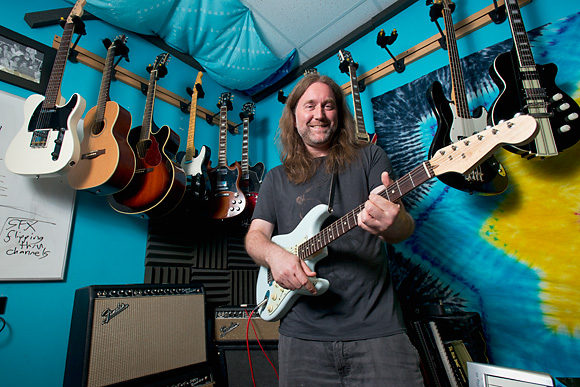
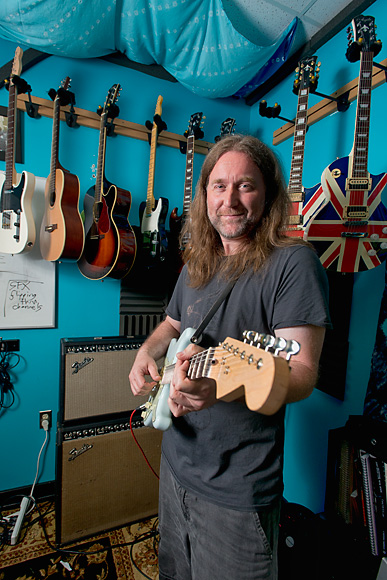
Doug Coombe – Alex Johnson at the Ann Arbor Music Center
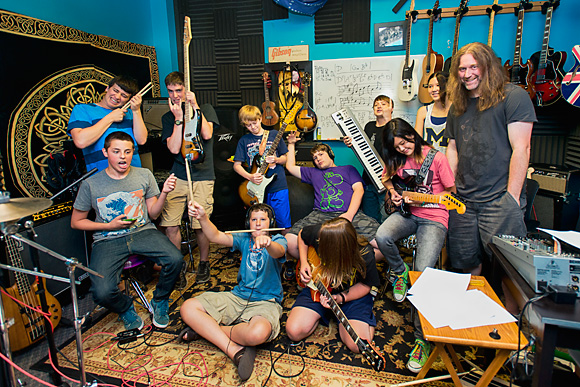
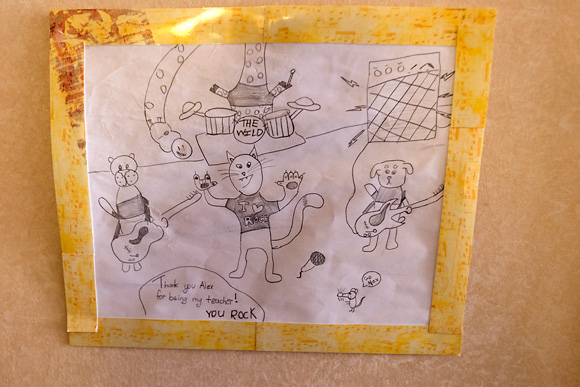
Doug Coombe – Alex Johnson and the Rock Band School
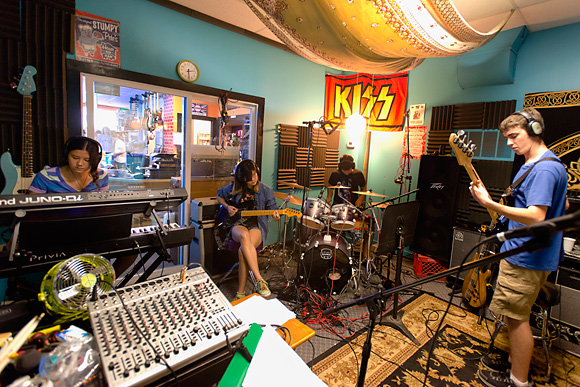
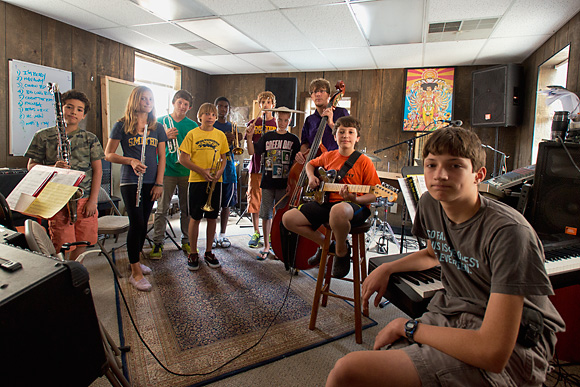
Doug Coombe – Rock Band School at the Ann Arbor Music Center
Doug Coombe – Rock Band School at the Ann Arbor Music Center
Doug Coombe – Rock Band School at the Ann Arbor Music Center
Doug Coombe – Rock Band School at the Ann Arbor Music Center
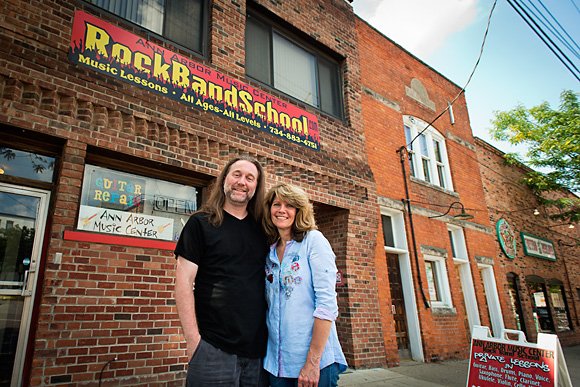
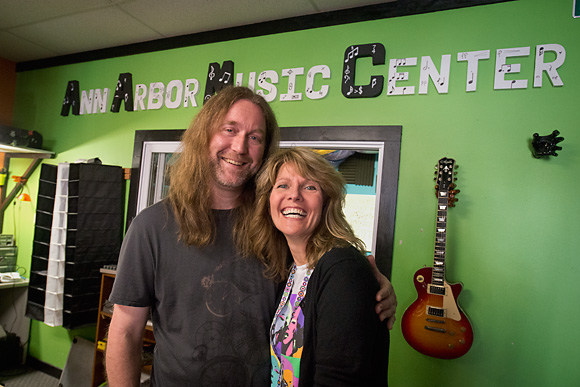
Doug Coombe – Ann Arbor Music Center Co-Owners Alex Johnson and Karen King
Doug Coombe – Alex Johnson at the Ann Arbor Music Center
Doug Coombe – Dave Sharp and the Jazz Band Camp at the Ann Arbor Music Center
Doug Coombe – Ann Arbor Music Center Co-Owners Alex Johnson and Karen King
Doug Coombe – Rock Band School at the Ann Arbor Music Center
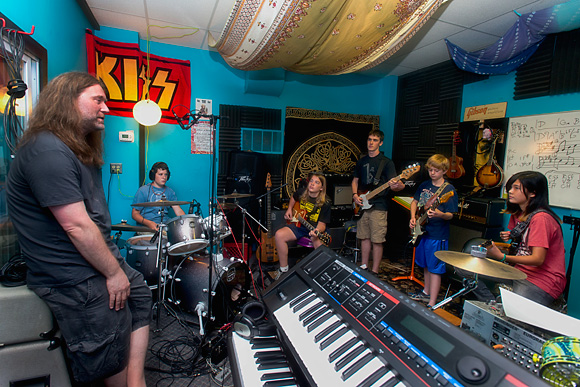
Today in rock band school, Grant Kalem, Joey Hathaway and Evan Ferraro are learning Traffic’s “The Low Spark of High Heeled Boys.” The high school boys’ instructor, Alex Johnson, cranks the song up on the stereo in their practice room.
“Grant’s going to start figuring out the bass part, then Joey’ll come in with the drums,” Johnson says.
But the kids waste no time figuring the song out. Within a minute, Johnson has faded out the original recording and the boys have seamlessly transitioned to jamming on the song without Traffic’s assistance.
“We’ve been working on this for maybe 10 minutes,” Johnson says. “These kids are the band I wish I had in high school.”
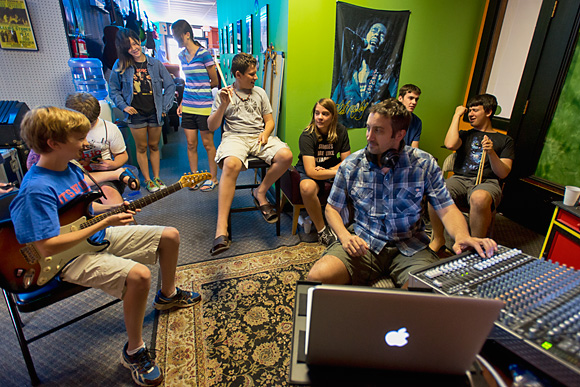
Johnson is the lead instructor of the Rock Band School program at the Ann Arbor Music Center. The program offers a kind of group music lesson, mostly intended for young people (although some adults participate as well). Instead of just learning to play music, students learn how to play together and how to play live.
“We talk about band direction, we talk about band goals, we talk about where we should be,” Johnson says. “It’s just like a real band, except with an old guy who’s been doing this for 30 years and can maybe provide some insight and some guidance.”
Johnson originally hatched the idea for Rock Band School back in 2002.
“I had students who had no outlet for the skills they were learning in their private lessons,” he says. “I remember the day I asked this kid named Nick, ‘What would you think if I had rock band school lessons?’ I didn’t even get the words out of my mouth and he said, ‘Sign me up.'”
Johnson says he had independently hit upon an idea that would soon become popular nationwide. He recalls that another music teacher who’d had a similar idea called shortly after Rock Band School started, asking how Johnson had gotten a hold of his business plan. In the ensuing decade, rock schools have sprung up across the country (and closer to home, like the Detroit School of Rock and Pop Music in Royal Oak). Johnson says rock schools are “the way of the future” in music instruction, but that his approach is distinguished by its emphasis on traditional music theory.
“We’re not only learning how to make the sounds and play the parts,” Johnson says. “We’re dissecting the music in terms of music theory, and that is not normal in rock music. The notion that you should play music without learning music is baffling to me.”
The final payoff to all this training is doing it live. Rock Band School students play live sets at least six times a year at the Tap Room, and they’ve also played venues from the Ann Arbor Farmers Market to the Neutral Zone. Most recently, Hathaway, Ferraro and Kalem played a set of Pink Floyd covers in Liberty Plaza with their band. Hathaway says the group drew considerable attention from passersby who heard the music first and then found themselves surprised at the players’ ages.
“There were so many double-takes,” Hathaway says.
However, many of the program’s young rockers get their start onstage even earlier than Hathaway and his bandmates. Ilene Hogan has the “The Infernal Chimps” – the name of her son Noah’s band – tattooed on her back. She says she was initially worried about how her son would adapt to the stage when he started the program two years ago, at age 8. But, she says, “watching him develop is amazing.”
“He’s more comfortable onstage than he is when he’s sitting at home,” she says. “To see your 10-year-old kid playing ‘White Room’ or ‘Couldn’t Stand the Weather,’ and not just playing it, but finessing it – I’m speechless.
Patrick Dunn is an Ann Arbor-based freelance writer and contributor to Metromode and Concentrate.
Many downtown businesses took a long time to restore their pre-pandemic business hours, but this year has brought several new additions to Ann Arbor’s late-night scene.