
A River Wild Or Tamed?
The Huron River is Ann Arbor’s defining natural feature. From kayakers to fisherman to rowers, it’s waters have become a vital blue park. And like most parks, the balance between recreational use and environmental health has become a tricky one. This is the debate facing Argo Pond and the decaying dam that created it.
 Argo Pond is one of the first things greeting motorists entering and leaving Ann Arbor along north Main Street. Drivers are flanked by lush green woods on one side of the road and flat blue waters of the damned up Huron River on the other side, in arguably the city’s most bucolic gateway.
The dynamic of that scene, one that has welcomed Ann Arborites for a generation, could significantly change soon. Local leaders are debating the merits of removing the Argo Dam, a move that would erase the pond and fundamentally change how people use that section of the river.
Proponents of removal (ArgoNots?) argue that maintaining the dam is too costly while a river allowed to run free is a healthier waterway that provides more recreation opportunities for more people and creates dozens of acres of new parkland. Dam preservationists (NIMRP – Not In My Rowing Pond?) maintain that Argo Pond already is a park used by hundreds of rowers, paddlers and fishermen daily. To them removing the dam would destroy a way of life Ann Arborites have long enjoyed.
What’s obvious is that both sides are passionate about their point of view, making compelling arguments to damn or pardon the dam in what’s shaping up to be a decision with long-lasting consequences for Ann Arbor.
“This is the toughest decision I see coming up,” says Christopher Taylor, Ann Arbor’s City Councilman from the third ward. “There are lots of good reasons to do both things. There are lots of people who have their lives wrapped up in that pond.”
Expensive choices
 This much we know. There isn’t a cheap option in the Argo Dam debate. It’s going to easily cost about as much (seven figures) to remove the dam and recreate the Huron River as it would to maintain the aging structure over the next 20 years.
Detroit Edison built Argo Dam in 1920 to generate hydro electricity. It also created the 92-acre Argo Pond that stretches for about two miles on the city’s north in a lake-like setting. The dam was decommissioned in the 1960s and reconfiguring it to generate hydro power again is seen as prohibitively expensive. Estimates suggest it would take about 40 years for it to generate enough electricity to pay for itself.
Still, Argo Dam is due for about $500,000-$600,000 in repairs and upgrades within the next couple of years. There are also potential associated costs to dredge the pond and remove seaweed and other vegetation in the pond. Costs are similarly high to remove the dam (starting at $1.3 million) and then build up and maintain the dozens of acres of new parkland that would be created by draining the pond.
“It’s unlikely we will continue not spending a dime on Argo,” says Matt Naud, the environmental coordinator for city of Ann Arbor.
The Michigan Department of Natural Resources recommended removing the dam in the 1990s, saying it would help improve the habitat for aquatic life. A Huron River Watershed Council report from earlier this decade argues that the Argo Dam alters the river’s flow more than the city’s other three dams. It advocates removing the dam to improve the rivers health. A U.S. Geological Survey says Argo Dam as one of two dams in Michigan that most dramatically alters the natural stream hydrology of its host river.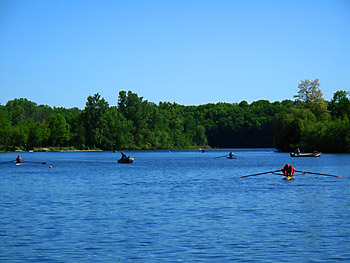 The city’s Park Advisory Commission voted 5-4 to keep Argo Dam earlier this year while the city’s Environmental Commission voted 8-4 for removal shortly after. The City Council is set to decide the dam’s fate this summer, a choice that’s going to prove expensive one way or the other.
“There are several financial interests at play,” Taylor says. “How much will this cost the city in the long run?”
There are also some who ask, should the city be subsidizing a recreation area that caters to a small and rather exclusive group of rowing clubs? Of course, the same could be said of public tennis courts, baseball diamonds and golf courses. Still, it’s telling when a significant coalition of recreation groups associated with the Huron River is in support of dam removal, including Ann Arbor Area Trout Unlimited, Huron River Paddlers and U-M’s Kayak Club.
Torpedo the dam
Laura Rubin has the unenviable job of advocating for change, which isn’t easy, even in a city that overwhelmingly voted for Barack Obama. The executive director of the Huron River Watershed Council is one of the main proponents for removing the Argo Dam.
“We come at it from an environmental perspective,” Rubin says. “In the long run, removal of the dam will be good for the river’s health.”
She argues that removing dam will accelerate the river’s flow to its natural speed. That will produce a plethora of positives, such as reducing the water’s temperature, increasing its oxygen levels and naturally moving sediment. This creation of a Class 1 (beginners) rapids would also create a habitat for greater diversity of aquatic life and reconnect the river to flood plains and wetlands.
It would also shrink the river to about a third of its current size where Argo Pond currently stands. That would free up about 30 acres of new parkland and 20 acres of flood plain. The idea is to keep it as a natural area with some walking trails.
 The exposed river (pond) bed is rich in nutrients so vegetation is expected to flourish quickly there. However, the city would have to choose whether to install native plants there or just let nature take it course. Dexter removed a century old dam next to its downtown last year. The pond area where sediment had built up is turning into a lush green space flanking a fast-moving creek. Proponents of dam removal see the same thing happening at Argo Pond.
Dam removal also seems to be one of the environmental causes de jour in recent years. Most of America’s dams were built in the late 19th and early 20 centuries for industrial purposes, such as logging or hydro electricity. Many of those have stopped serving those original purposes. Some are being torn out in favor of restoring the habitat the way nature originally intended it to be.
Traverse City is in the process of deciding the fate of four of its bridges that were built between 1869 and 1930. The main argument is between restoring the fast-moving river to facilitate things like trout spawning or keeping the dams intact for hyrdo electricity generation.
Rubin also points out that removing the dam and speeding up the river would make it an attraction for kayakers, canoers and fishermen. A common comparison is made to the section of the Huron River in Delhi Metropark. She also points out that displaced rowers who use Argo Pond still have three other ponds in the city to use, along with Belleville Lake just east of the city.
The cost of maintaining the dam is another point Rubin likes to drive home. Maintenance and upgrades are expected to run into the six and seven figures in the near future to keep what she calls a “hulking structure” viable. The city spends $20,000 a year on maintaining Argo Dam, which doesn’t include one-time major improvements.
“Dams have very expensive maintenance costs,” Rubin says. “They’re not meant to be permanent structures. At some point they’re going to be removed.”
Row, row, row your boat
 There are a lot of Ann Arborites who want to see that point put off as long as possible. Most of them are rowers. Crew is a much bigger sport in Ann Arbor than in most towns and Argo Pond has been the home water for Ann Arbor rowers for a long time.
As many as 600 rowers stroke through Argo on a regular basis. They include the crew teams for both of the city’s high schools, the U-M’s men’s club team and the Ann Arbor Rowing Club.
“If the river is not frozen, people are rowing on it,” says Jeff DeBoer, president of the board of directors for the Ann Arbor Pioneer High School Rowing Club. “You have people repeatedly visiting to row. The usage is super intense.”
DeBoer is one of the leaders for preserving Argo Dam. He argues that there is “absolutely nothing wrong with the dam” and that it is in “excellent condition.” He points out it is one of the newest dams on the river and was completely rebuilt in 1972. In his eyes the river is plenty healthy at Argo Pond and not suffering from things like sediment build up. That’s happening at the next dam up the river.
Naud confirms that the dam’s concrete structure and gates are in “fine shape,” so it isn’t in danger of giving way anytime soon. What needs to be done is major work on drains on a nearby millrace embankment ($300,000) and other expensive, one-time maintenance charges that add up to $250,000.
Removing the dam would be a catastrophe for the rowing community in DeBoer’s eyes. He says the other ponds have too many obstacles for rowing, ranging from bridges in the way to too short or just too many users in the waterway already. He likes to point out that 65-foot, fast-moving shells and things like sailboats and canoes don’t mix well. And then there is the conventional wisdom that the longhairs in Barton Hills don’t want the rowers stroking away on nearby Barton Pond.
 The rowers see Argo Pond as their park that almost seems like it was made for their sport. DeBoer says if they had to move to Belleville Lake (where U-M’s women’s team practices) a number of kids would have to drop out because they wouldn’t be able to commute there. Many of them ride their bike or walk to Argo Pond today.
“It’s the only playing field we have in the Ann Arbor community,” DeBoer says. “It’s the only body of water that is suitable for our sport. It’s analogous to the high school losing its football stadium. The difference is they can build another one. We can’t.”
Blue parks
The Argo Dam debate really comes down to a question of park space. It’s no wonder a debate about the future of this blue park is taking place in a city famous for its parks, greenways and greenbelt.
No matter what happens it will have to be managed. The care will range from harvesting seaweed and algae from the pond or managing the plant life that will spring up around the new racing river.
“We have 600 acres of blue park space,” Naud says. “The question is how do we manage it?”
Jon Zemke is the News Editor of Concentrate and its sister publications metromode and Model D. His last feature was the De-evolutuion of Development. No matter what happens to Argo Dam, he is glad the junkyard that once stood next to it is long gone.
Photos:
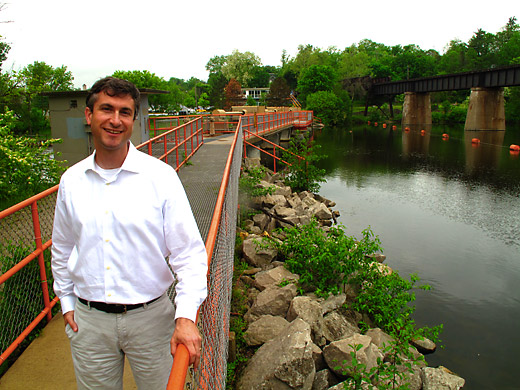
Christopher Taylor, Ann Arbor’s City Councilman from the third ward standing on the Argo Dam-Ann Arbor
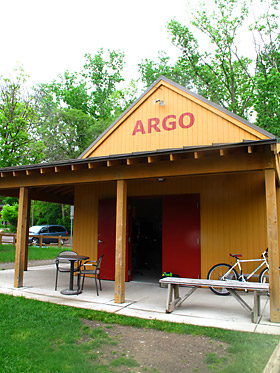
The Argo Canoe Livery-Ann Arbor
A Group of Rowers-Ann Arbor
A Myspace-esque Photo of Photographer Dave Lewinski 5 Minutes after Taking Chris Taylor’s Photo-Argo Pond
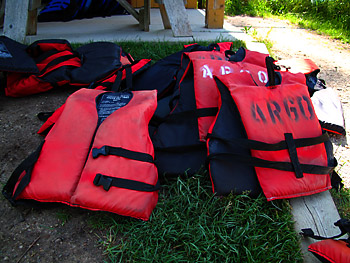
Argo Life Vest-Ann Arbor
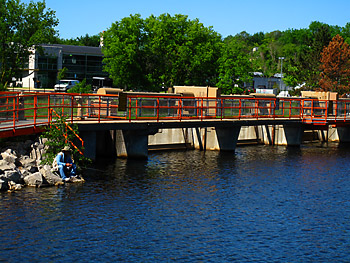
A Fisherman Fishing Off the Argo Dam-Ann Arbor
All Photos by Dave Lewinski
Dave Lewinski is Concentrate’s Managing Photographer. He would sorely miss all the great catches he’d miss if the Argo Pond went away. He would seriously cry.
Related Articles

Ann Arbor artist hosts annual outdoor sale to benefit public art program
Glass artist Larry Nisson hosts an annual sale of his work from noon to 5 p.m. on Sept. 27 at his Ann Arbor home.

Ypsilanti Heritage Foundation hosts 44th annual tour of historic homes
From noon to 5 p.m. on Oct. 4, residents and visitors are invited to join the Ypsilanti Heritage Foundation’s 44th annual historic home tour, which includes six historic homes in Ypsi’s Southside neighborhood.

Michigan League of Handweavers’ biennial show in Ann Arbor will feature myriad disciplines
From weaving to doll-making, a broad range of craftsmanship will be featured in both exhibitions and public demonstrations at the Michigan League of Handweavers’ 23rd Biennial Fiber Show.


