
NIGHT & DAY: Theatrical Inspiration
Amidst the half dozen cultural events spotlighted in this week’s FilterD, editor Jeff Meyers finds inspiration from a film about Orson Welles and connection to Ann Arbor’s ongoing discussion of public art.
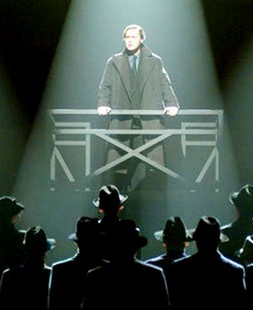 This week at the Michigan Theater Richard Linklater’s Orson Welles And Me also reminds audiences of the unexpected influences of art. While the movie lays bare the incredible genius and unfettered arrogance of Welles, it also captures the man’s consuming passion for theater and the arts. In charting the onstage and backstage dramas, personalities and politics of Welles’ 1937 staging of Julius Caesar, Linklater conveys the dedication, professionalism and inspiration (as well as craven egotism) of the artists involved.
What the film misses, unfortunately, is the political relevance of Welles’ production, which took its staging inspiration from the Nazi rallies in Nuremberg and confronted contemporary fascism openly. At a time when the U.S. was watching the disturbing events in Europe unfold, Welles’ modestly budgeted play went on to be the longest running production of Julius Caesar in Broadway’s history and ended up touring the country. While it would be silly to suggest that the play inspired American’s to support our participation in WW2, it certainly became part of the national dialogue and reflected the issues at hand.
This is what draws me to art; its ability to slip into the public’s consciousness and inspire questions, inspiration, and even discomfort. Whether it’s a mural, a stage performance, a sculpture or challenging film, the effects can be profound. They can also be subtle.
This past summer I was talking with my best friend in Seattle and he mentioned how some bizarre and edgy arts performance was opening that weekend, and how the people in his office had been talking about it. Neither he nor I can recall what the event was but I asked him at the time if he thought he or any of his coworkers were going to attend. He answered: “Probably not. But I like knowing that stuff like that goes on in the city.”
I think that sentiment reflects most people’s attitudes about art, culture and recreation. You don’t have to play basketball to appreciate the need for courts in our parks. You don’t have to hike to see the value in dense, wooded areas. You don’t have to sculpt or paint to understand how art can inspire. They are all a part of Ann Arbor’s quality of life and as such deserve equal consideration and support. Heck, even during the height of the Great Depression Orson Welles and his Mercury Theater company acquired funding from the Works Progress Administration.
Something I hope Concentrate’s readers will consider in the coming New Year is the value of artistic expression in our community… or rather, keep a fair and open mind when it comes to the issue of arts funding. Public art has long been an all-too easy and unfair target for those who have an political axe to grind. As I mentioned in my column a few weeks ago, it’s always easy to ask someone to give up something you don’t personally care about. Shared sacrifice is quite a bit harder.
Outside the politics of whether Ann Arbor’s newly empowered Public Arts Commission chose well with its first major project, I hope we, as a community, will take a longer view and start to discuss how public art can positively impact our neighborhoods and downtown.
The Percent For Public Art (now Half A Percent For Public Art) Program is an opportunity to celebrate and unify our community while fostering an ongoing discussion of the arts (and hopefully employ local artists). Though I am not necessarily a fan of the Dreiseitl project (or the process that generated it) I am reminded of the scorn and controversy that accompanied the Chicago Picasso sculpture in Daley Plaza in 1967. Today, the sculpture is a hugely popular landmark and world famous icon. Now, I’m not saying the Dreiseitl project is anywhere near the equivalent, but I do think it’s a useful reminder that no one project should be a litmus test for success or failure.
There are many important issues for Ann Arbor to address in the coming year. Budgets are tight and the allocation of community resources is stressed. If the funding of public art is to be a part of that conversation I hope that it is dealt with in a fair-minded and long term manner, one that puts all amenties and interests on the table despite the personal preferences of elected leaders and interest groups.
And whether its social services, educational support or cultural organizations give as generously as you can this season. One of the hallmarks of a successful community is its ability to sacrifice for the good of others.
Have a happy and healthy holiday, and a wonderrful New Year. We’ll be back January 13th!
-Jeff Meyers
Editor
Have a response? Want your event in FilterD? Press comments, feedback or releases for upcoming events in the Ann Arbor area should be sent by the Sunday before to jeff@concentratemedia.com.
For consideration in FilterD, please include high res jpg images that are at least 500 pixels wide.
Related Articles
New Ypsi-based program offers free training for women entering or re-entering workforce
Dress for Success Michigan is launching a new, free, four-week workforce development program designed to help women move directly from education to employment.

National swimming and rowing events to bring thousands to Ypsi area
Thousands of athletes and their families will be in Ypsi and Ypsi Township this month for the USA Artistic Swimming Junior Olympics and the RowFest National Championship.
On-Demand Coaching helps Ypsi’s government and small businesses build a winning team
A Michigan Municipal League program helps Ypsi and other municipalities connect small businesses and entrepreneurs with existing capital and technical assistance.


