Fitness

Always Running: Ann Arbor Track Club

It's no surprise when Ann Arbor gets singled out for its academically inclined achievements. Writers, thinkers, researchers, and innovators are an obvious by-product of the University's presence. Add to that list runners. For nearly 45 years the Ann Arbor Track Club has produced not only topnotch runners, but world-class Olympic hopefuls.

Latest in Fitness
Olympic hopefuls train in Ann Arbor

Ann Arbor adds Olypmic class running to its reputation as an incubator for topnotch athletes (see: swimming). Excerpt: Just down the hall, a few training partners are in various stages of rest and recovery near the storefront window of The Running Institute in Ann Arbor. Among them is Will Leer, who in just over a week -- on Day 10 of the U.S. Olympic track and field trials that starts today in Eugene, Ore. -- hopes to be on the starting line in the 1,500 final with a chance to join New Zealander Willis at the London Games this summer. Read the rest here.

Dexter Wellness Center to open doors, create at least 100 jobs

At long last, the Dexter Wellness Center is getting in shape to open its doors. The Chelsea-Area Wellness Foundation has signed on to operate the center, which will be constructed by A.R. Brouwer at 2810 Baker Road, a half-mile's walking distance from downtown Dexter. The 46,000-square-foot family center will be a full-service facility with a swimming pool, a therapy pool, mind-body space for pilates and yoga, massage therapy, a gym, and strength and aerobic conditioning equipment. Programming for children of all ages will be offered, as will assistance for medical patients. "We'll work with local providers to transition patients from the hospital ... We have programs for them when they're discharged so we can help with strengthening and make their quality of life better," says Amy Heydlauff, executive director of the Chelsea-Area Wellness Foundation (CWF). A physical therapy practice run by Medical Rehabilitation Specialists, but not affiliated with CWF, will occupy 2,000 square feet in the building. Construction will commence after the builder removes some existing structures on the property. "We're anticipating an opening date of either summer or early fall of '13," Heydlauff says. Usage fees have not been set yet, but will be commensurate with comparable facilities in Ann Arbor and Chelsea. She figures the center will employ, at minimum, 100 people. Source:  Amy Heydlauff, executive director, Chelsea-Area Wellness Foundation Writer: Tanya Muzumdar

New path opens in Dexter for Border-to-Border Trail

With 80-degree spring days feeling like summer, a new Border-to-Border Trail segment is becoming a well-worn path already, and other segments are following. Even prior to last weekend's ribbon-cutting ceremony, the freshly completed West Side Connector running from downtown Dexter to Warrior Creek Park was getting a lot of traffic. "Every time I'm out there, there are families using it," notes Coy Vaughn, deputy director of the Washtenaw County Parks & Recreation Commission. "Especially from the [West Ridge] subdivision, because they were basically, from a pedestrian standpoint, cut off from the village." Another section currently under construction that will run from Dexter-Huron Metropark to the village of Dexter should be done by June, Vaughn says. A bridge over the Huron River and a quarter-mile path is being laid in the first phase, followed by a link-up to downtown. And since the bridge-crossing over Mill Creek that connects to the West Ridge subdivision and the border of Hudson Mills Park is done, the next phase commences in August. A 2.9-mile stretch will begin at the park border and follow the Huron River valley, adjacent to the Huron River. "That will provide direct access to residents of Dexter all the way through to the Hudson Mills trail system," Vaughn says. The majority of that project should be done by winter, with wrap-up next spring. Source:  Coy Vaughn, deputy director of the Washtenaw County Parks & Recreation Commission Writer: Tanya Muzumdar

Ann Arbor Skatepark rolls to RFP for design stage

Coming off the heels of a successful fundraiser last month, the Ann Arbor Skatepark is now over a critical hill. The latest $18,000 raised gets the nonprofit Friends of the Ann Arbor Skatepark to the six-figure mark in total funding thus far – and the next stage. "We reached a point where it's a milestone for us because it allows us to put forward a [request for proposal] for a design of the project," says Scott Rosencrans, project liasion for the Ann Arbor Skatepark. The Washtenaw County Parks and Recreation Commission has pledged $400,000 towards the project if the Friends of the Ann Arbor Skatepark can match that amount. The nonprofit partnered with the city of Ann Arbor on an application for a $300,000 grant from the Michigan Natural Resources Trust Fund, the outcome of which should be known sometime in December, Rosencrans says. The projected cost to build the all-concrete skatepark is between $800,000 and $900,000. "What our nonprofit brought to the table was that it would also include a maintenance endowment to cover all of the maintenance costs of the project so that taxpayers of Ann Arbor wouldn't be on the hook for that," he says. Ten percent of every donation goes into that fund, which at this point already has about two years' worth of money for upkeep. The city of Ann Arbor has donated land for the facility in the northwest corner of Veterans Memorial Park. It will be located next to a hardball field and in a grove of mature trees, to be left intact. There are between 5-7,000 skateboarders in Washtenaw County, says Rosencrans. Every year, 20 million kids get into sports in the U.S., but 70 percent drop out by the age of 13. However, Rosencrans says, "Kids will stick with skateboarding into adulthood. It's just that they're looking for something to do that doesn't have a numeric value attached to their performance. They just want to be creative and express." Source: Scott Rosencrans, project liasion for the Ann Arbor Skatepark Writer: Tanya Muzumdar

Rain, shine, or snow, bike commuters to gain traction this winter

The Iceman Cometh, by way of the nationally-known mountain bike race held in northern Michigan last weekend, but that doesn't mean city bike commuters need to leave their wheels in the garage this winter. New this year, getDowntown, Ann Arbor's green commuting advocacy organization, has launched its Conquer the Cold program as a resource for winter commuting by alternative means. "We're asking people to try extending their commute and seeing that it's really not so bad and you can get some exercise, you can have some fun, and you don't have to deal with potentially having to warm up your car and dealing with paying for parking and all those sorts of things," says Nancy Shore, director of getDowntown. According to a survey of bike commuters during 2010's Commuter Challenge, an annual program for downtown employees to log alternative transportation commutes during the month of May, Shore says 21% continue riding to work over the winter. That's not an insignificant amount, but there is room for growth. There is no similar drop-off in bus usage over the cold months, Shore says. January and February logged 50,000 and 52,000 rides, respectively, using the go!Pass, a bus pass program for downtown workers. "Last year we didn't see [any decline], and that was a cold and snowy winter," she adds. Conquer the Cold is sponsoring a winter commuting essay contest, with a $500 grand prize shopping spree to outdoor retailer Moosejaw. Essays are due by November 12. And Common Cycle is holding free winter bike commuting and maintenance workshops at 301 E. Liberty Street in downtown Ann Arbor from 5:30 to 6:30 today and from 12 to 1 p.m. on November 10. Winter commuters will also be blogging on the getDowntown website, and guides are available at downtown coffee shops, the library, and online. Source: Nancy Shore, director of getDowntown Writer: Tanya Muzumdar

Washtenaw County floats rec center idea for Ypsilanti’s Water Street parcel

Is Ypsilanti's undeveloped Water Street parcel in for a watershed development? After floating a proposal to build a rec center on the Huron riverfront to the Ypsilanti City Council earlier this month, the Washtenaw County Parks and Recreation Department is gathering requested supporting information to strengthen its case for the center, which would front on Michigan Avenue. The information will include examples of how adjacent parkland and rec centers have affected property values in other locations. In addition, a preliminary market study has yielded favorable results, says Bob Tetens, director of Washtenaw County Parks and Recreation. Officials are touting the project as a catalyst for downtown Ypsilanti, with the rec center anchoring other commercial frontage on Michigan Avenue and residential development on the river side of the undeveloped Water Street parcel. While the idea generally garnered a favorable response from city council members, some pointed to its footprint and parcel size, and the loss of tax revenue on one-third of the 38-acre plot. The proposal calls for the city to give up to 12 acres of land to Washtenaw County. The city currently has $31 million in outstanding debt on the property. "Understandably they would feel a sense of loss at giving something away and getting nothing in return other than $15 million worth of development," says Tetens. "Conversely, if we had to purchase it at the rates they would like to sell it for, we wouldn't have the money to build the building." About half of the construction costs would be financed with cash from development millage funds and the balance with a bond issue to be repaid over 10 to 15 years, Tetens says. No formal design has been completed, but Tetens puts the center's size at 50,000 to 60,000 square feet, with construction costs ranging from $10 to 15 million. The center would be comparable in size to the Meri Lou Murray recreation center in Ann Arbor. Features include a natatorium, possibly with water park features, a gymnasium and weight room, and community meeting rooms and classrooms. The center would use its location on the Border to Border Trail and the riverfront in outdoor recreational programming. Officials would also like to have a management agreement with the YMCA, Tetens says. While the total plot size is close to 12 acres, included in that is a 100-foot easement for a trail along the river's edge that would run the length of the property. Subtracting out the easement, Tetens says, "You're looking at something that's more in the range of eight acres." The two-story center "will not appear to be sprawling as much as it will appear to be vertical," he contends. "Again, we're hoping to design this in concert or in cooperation with the city because we want to adhere to the architectural style and heritage of the city and still be a landmark downtown." The lack of utilities and roads on the parcel has hindered other development alternatives. "Most companies that would come into a site like that are going to want at least a minimum amount of infrastructure they can start with," Tetens notes. "Frankly, we'd probably be involved; if we were the first ones to go in there, we'd probably be involved in helping to make those roads and utilities accessible to other portions of the site." County officials are also bolstered by the number of visitors to the Meri Lou Murray center -- close to 400,000 a year. "You can do the math," Tetens says. "This is going to generate traffic. Downtown Ypsilanti needs traffic more than it needs anything else right now." Source: Bob Tetens, director of Washtenaw County Parks and Recreation Writer: Tanya Muzumdar


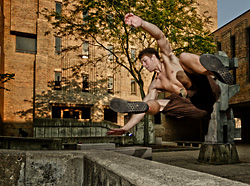
Parkour: Go Ahead and Jump!

Parkour is the art of overcoming obstacles, the ability to get from point A to point B as efficiently as possible. A test of strength, agility, and flexibility, it attracts athletes looking for new ways to explore their urban environment.  And three times a week, local fans practice on U-M's Dental School.

Tech Brewery’s Saagara offers meditative mobile app, aims to hire 20

Saagara is gaining traction, both for its meditative breathing apps and its workforce. So much so that the Tech Brewery-based start-up plans to hire 20 people over the next year. Saagara, which is Sanskrit for ocean of ideas, focuses on providing a holistic approach to better health, centered around breathing called Pranayama. Its president, Dr. Bobby Peddi, started the company shortly after he left his surgical residency about two years ago. Today it has a host of Internet and mobile phone apps with close to 500 users. "We're looking to expand rapidly," Dr. Peddi says. "That's it. We have no choice." Saagara currently employs five people full-time and four part-time, including one worker who is transitioning from part-time to full-time. That's up significantly from the last time we touched base with Saagara a little more than a year ago. Then it employed Dr. Peddi and a half dozen independent contractors and interns. Dr. Peddi plans to continue to evolve Saagara so it becomes increasingly user friendly for groups. He hopes the meditative app will be picked up by health insurers, schools and hospitals. "We're going to try and get people to exercise together," Dr. Peddi says. Source: Dr. Bobby Peddi, founder and president of Saagara Writer: Jon Zemke Read more about Metro Detroit's growing entrepreneurial ecosystem at SEMichiganStartup.com.

Commuter Challenge saves over 14,400 gallons of gas, has 17% more participating groups

Another year, another Commuter Challenge, another dip in fuel usage. Driving Commuter Challenge 2011 was a 17% uptick in the number of organizations taking part as compared to last year. Also of note and maybe because spring 2011 hailed as the wettest on record for Ann Arbor, any given car-less person used multiple ways to get to work this May. "Overall this year, people tended to be more flexible with their commuting habits, taking the bus one day and biking the next," says Nancy Shore, director of Ann Arbor's getDowntown program.While the total number of persons ditching the solo car ride to work, at 1,817, was slightly less than last year, more organizations – 192 as compared to 164 last spring – signed on to the challenge. And not surprisingly, outfits with fewer than 100 employees had higher join rates. Exceptions to the rule, Shore notes, were the 115-employee Infor Global Solutions and 582-headcount U-M School of Public Health, with just over 70% and 22% of their people, respectively, getting involved.Commuters made 21,452 trips and logged 331,301 miles' worth of biking, busing, walking, van pooling, and, yes, paddling the Huron River from Ypsi to Tree Town (a Menlo Innovations innovation). Their eco-forward approach prevented the discharge of 283,559 pounds of CO² into the troposphere – equivalent to the annual greenhouse gas emissions of 25 passenger cars and a savings of 14,419 gallons of gas in the process, according to EPA calculations.  Put globally, that also means not "driving your car around the world 13 times," Shore says. We'll fly instead – and buy carbon offsets.Source: Nancy Shore, director of Ann Arbor's getDowntown programWriter: Tanya Muzumdar

Our Partners

30044
30045
30046
30047
30049
Washtenaw ISD logo
Eastern Michigan University
Ann Arbor Art Center
UMS
U of M Arts Initiative
Engage EMU

Common Ground Is Brewing

Support local stories and receive our signature roast straight to your door when you join at the Standard level (or above).

Drink Better, Read Local

Close the CTA

Don't miss out!

Everything Ann Arbor and Ypsilanti, in your inbox every week.

Close the CTA

Already a subscriber? Enter your email to hide this popup in the future.