Ann Arbor

U-M has most Fulbright students… again

You know your university is doing something right when it bests both Harvard and Brown. And not by a little. Fulbright student tally for the top 3 schools: U-M with 40, Harvard with 31, Brown with 29. Takes a little of the sting away from the Wolverine's loss this weekend. Excerpt: "Michigan says this marks the sixth time in the past eight years it has held that honor. It also led the nation in Fulbrights in 2005, 2007, 2008, 2010 and 2011." Read the rest here. In related news, U-M increased enrolled 1.7% in 2012.

AMF-Nano leverages microloan to help commercialize tech

A small Ann Arbor-based bio-tech start-up recently received a little infusion of cash, with which it expects to make a big splash next year. AMF-Nano recently received financing from the Michigan Microloan Fund, where the microloans usually average about five figures in size. The 3-year-old start-up plans to use that money to continue the development of its innovative nano sensor that could help detect heart attacks and be implanted in pacemakers. "There is a need for instruments to be smaller, cheaper and better for the human body," says Rakesh Kapragadda, president & chief scientist of AMF-Nano. The two-person team is working out of the University of Michigan's Kellogg Eye Institute where it is developing a smart sensor system. That system could be used by cardiac patients to help self-monitor their own heart for signs of heart attacks instead of habitually visiting medical centers for checkups. Another version of the platform could be used in pacemakers. "All of the funds will go toward the commercialization of these technologies at the University of Michigan," Kapragadda says, adding he expects his start-up to commercialize the technology within six months. Source: Rakesh Kapragadda, president & chief scientist of AMF-Nano Writer: Jon Zemke Read more about Metro Detroit's growing entrepreneurial ecosystem at SEMichiganStartup.com.

Dare to Dream grants send $28.5K in seed capital to U-M start-ups
Can Kickstarter double A2 sauerkraut production?

Sure Kickstarter is great for projects involving computer games, indie films, CD releases, graphic novels, and pop culture doo-dads. But what about fermented cabbage? David Klingenberger of Ann Arbor's The Brinery is hoping to raise enough funds to buy 12,000 pounds of locally grown cabbage, a bunch of barrels, and the staff to help him on his “40 Barrels in 40 Nights” project. Excerpt: "The Brinery, whose biggest customer is Zingerman’s Deli, is ready to double production, producing 40 more 55-gallon barrels of sauerkraut, Klingenberger said, as the local cabbage crop is nearing the end of its harvest time. He has 12,000 pounds of cabbage lined up from local farms. He also needs to purchase 40 plastic barrels, where the fermentation process takes places. And he needs to pay staff." Read the rest here. 

Ann Arbor VC chairs launch of TiE Detroit Angels

An Ann Arbor-based venture capitalist is helping connect Metro Detroit's emerging investment community with the rest of the world by opening the Detroit chapter of TiE called TiE Detroit Angels. Sonali Vijayavargiya is the managing partner of Augment Ventures, an early stage venture capital firm that launched out of Ann Arbor last year. She is now chairing TiE Detroit Angels as a way of growing the region's investment community and connecting it with opportunities around the world. TiE Detroit Angels will focus on investing in a broad range of promising start-ups. "This group is made up of a diverse group of people," Vijayavargiya says. "We have physicians and entrepreneurs. We will invest across sectors." TiE is a global, not-for-profit, non-political, and non-religious organization dedicated to fostering entrepreneurs around the world. When TiE first started it stood for The Indus Entrepreneurs, which signifies the ethnic South Asian or Indus roots of the founders. Today TiE stands for Talent, Ideas and Enterprise. TiD Detroit Angels will focus on forming an investment consortium of wealthy individuals willing to provide seed capital to promising startups in Metro Detroit. The group expects to grow to a size of about 30 members within its first year and will look at the pitches from dozens of local startups from a number of different sectors. Source: Sonali Vijayavargiya, chair of TiE Detroit Writer: Jon Zemke Read more about Metro Detroit's growing entrepreneurial ecosystem at SEMichiganStartup.com.

Going blue by train instead of car

Reporter and blogger Jeff Wattrick decides to travel from Royal Oak to Ann Arbor (a mere 52 miles) to take in the U-M vs MSU football game on Saturday. This is his story. Excerpt: "It’s certainly the less stressful choice. I might have gone full-on Michael Douglas in Falling Down trying to endure Michigan Stadium traffic. Seriously, traffic jams before and after the game were like a goddamned REM video. Instead of living out traffic hell scenarios from early 1990s entertainment, I sat on the train and watched an episode of The Wire on my iPad. What’s more, if the planned Detroit-Ann Arbor commuter rail line ever comes to fruition, the train to a Michigan game could be even more cost-effective. Compared to fares for the long-haul Amtrak, commuter rail is generally less expensive. The most expensive ride on the Massachusetts Bay Transit Authority commuter rail, for example, costs $11 and MBTA lines run with greater frequency." Read the rest here.

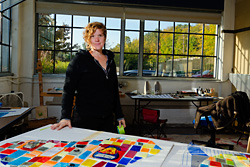
Mary Thiefels at her studio on North Main Street
Photo Essay: The Art Of Transformation

Aesthetically speaking, the shelter in Ann Arbor's Allmendinger Park is best described as functional. Others might be less generously inclined. This weekend, however, it becomes an example of how public art and community engagement can transform a nondescript building into a vibrant neighborhood asset. 

AdAdapted expands staff as it expands mobile app platform

Internet companies big and small have been struggling with how best to commercialize advertising on mobile devices. A new start-up based in Ann Arbor, AdAdapted, thinks it has an answer. "Mobile advertising really isn't working for anyone," says Michael Pedersen, founder of AdAdapted. The Tech Brewery-based start-up's software solves this problem with an advertising platform that allows advertisers to work with developers to strategically place ads in things like mobile video games. Think of it as an in-app product placement. "We allow the developer to have more control where an ad will go," Pedersen says. AdAdapted recently received financing from the Michigan Microloan Fund. Loan amounts from that fund aren't disclosed but are about five-figures in size on average. The 4-month-old start-up and its seven team members plan to use its loan to expand its product platform and prepare for the launch of its Beta version. "The Beta should be done with in the next few weeks," Pedersen says. "We're also working on landing our first pilot." Source: Michael Pedersen, founder of AdAdapted Writer: Jon Zemke Read more about Metro Detroit's growing entrepreneurial ecosystem at SEMichiganStartup.com.

U-M offers student course that explains its own finances

Let's say you're a student at the University Of Michigan, and you're wondering why your tuition is what it is. Well, now there's a course for that. Excerpt: "Fifty-six students are registered this semester for "The Challenge of College Affordability: Financing the University," a series of seven two-hour lectures taught by top administrators at the public university. The course, geared toward sophomores, is designed to explain where the school gets revenue, what drives its costs and how that translates into tuition rates and financial-aid packages." Read the rest here. 

Violin firm Weinreich Labs scores Michigan microloan

Weinreich Labs is reinventing the violin in Ann Arbor, creating technology that preserves the quality of the amplified and recorded sounds of the instrument. The 2-year-old start-up was founded by a violin maker, a physicist, an engineer and a designer. The company's instrument is a violin that produces heirloom quality music when amplified or recorded. It is expected to give musicians the ability to amplify a acoustic sound (think stereo speakers) without feedback or loss of tonal character, problems that have long plagued the music industry. "If a players buys one of our products they're buying an instrument that sounds great in an amplified setting," says Alex Sobolev, CEO of Weinreich Labs. "It also works in a recording studio where it can be very challenging to properly mic stringed instruments." Weinreich Labs' four person team is putting the finishing touches on its prototypes and plans to begin commercializing its violins early next year. The firm recently received financing from the Michigan Microloan Fund (each microloan is worth about five figures worth of seed capital on average) that it is using to buy production-quality electronics and develop a mobile app. "This loan does a number of things for us," Sobolev says. "In the worst-case scenario, this gets us to a trade show with a number of prototypes to showcase." Source: Alex Sobolev, CEO of Weinreich Labs Writer: Jon Zemke

Our Partners

30044
30045
30046
30047
30049
Washtenaw ISD logo
Eastern Michigan University
Ann Arbor Art Center
UMS
U of M Arts Initiative
Engage EMU
Ann Arbor Housing Commission

Don't miss out!

Everything Ann Arbor and Ypsilanti, in your inbox every week.

Close the CTA

Already a subscriber? Enter your email to hide this popup in the future.