
Ann Arbor

Love Book turns gift for wife into Ann Arbor start-up

A few years ago, Rob Patterson created a gift for his wife that he hopes will pay dividends for them for years to come.Patterson made a small book that explained why he loved her so much. It was a Christmas gift that meant so much to her that it turned on the CFL over his head."She loved it and thought it was the greatest gift she had ever gotten," Patterson says.That inspired the creation of Love Book last year. The four founders have been perfecting the website that allows people to create customized message books for anybody they care about. It has only been live for a few weeks now."We’re trying to figure out our marketing plan right now," Patterson says.The books can be used for anything from birthdays to anniversaries or other important days. "Pretty much any time you want to give a gift to somebody you love," Patterson says.Love Book is still developing its product. It hopes to hire and create a few spin-off businesses in the future, but right now the foursome just wants to establish their product.Source: Rob Patterson, founder of Love BookWriter: Jon Zemke

Ghostly International capitalizes on a successful decade in Ann Arbor

Ten years ago this August the idea behind Ghostly International was only a dream for Sam Valenti, a dream that the University of Michigan student incubated in his dorm room in Couzens Hall.Today it's an internationally recognized electronic and ambient music label that supplies pay checks for six employees, a handful of independent contractors and numerous musical artists. It continues to grow, moving into places like retail stores and iPhone applications. "We've tried to move with the times," Valenti says. "Obviously, the record industry was in tumult or recession before the country was."That doesn't mean Ghostly is abandoning the music that made it famous. It still plans to produce the records and shows that its fans yearn for, but also use them as a launching pad for diversify its business plan. Among its target industries are film and beauty shows.Valenti expects such diversification will lead to further expansion of the record label's payroll and its fan base. But big growth or no, he still plans to keep the business' headquarters in downtown Ann Arbor.Source: Sam Valenti, founder and owner of Ghostly InternationalWriter: Jon Zemke

Free Internet access makes Ann Arbor area coffee shops surrogate offices or libraries

Not all offices are in office buildings these days. But, heck, if you read Concentrate regularly, you already knew that. Excerpt:A single laptop user might sit at a table meant for four people and surf the Web for hours. The more daring might even sneak in their own food and drinks.Offering free wireless Internet access, Ann Arbor's coffee shops and cafes can sometimes look like surrogate offices or libraries, with more customers staring intently at laptop screens than talking with a friend or drinking a coffee.Laptop users say the attraction is simple: They're trying to study or work and encounter fewer distractions there - no stressed-out colleagues, no televisions to switch on, and no family members to interrupt."I'm pretty productive when I'm working in an environment like this, just because of the fewer distractions," said Tracy Barsheff, who was studying in Espresso Royale on State Street Friday.Read the rest of the story here and when Concentrate's sister publication Metromode reported on this phenomenon two years ago here.

Ann Arbor VeoProject focuses on growth and partnerships

Ann Arbor's VeoProject continues to grow as evidenced by its expanding payroll.Ann Arbor-based Bitcarvers, the creators of VeoProject, have increased its employee base to 10 people and are looking to add interns this summer. It hopes to add more employees later this year. "The market for our software has been expanding dramatically over the last year," says John Wyderko, chief technology officer of VeoProject. He adds that southeast Michigan is "a gold mine" for finding quality project managers.VeoProject is a lot like Microsoft Project. It helps users manage projects, tasks and their everyday worklife ...except its done from a website. This allows users to access it from anywhere they can get an Internet connection. In comparison, Microsoft Office is run from a single computer or system. The idea is to make it appealing to business travelers far from their home computing base or telecommuters working from home. Bitcarvers are now incorporating VeoProject with social media outlets, such as Twitter. The idea is to use these programs to help keep projects and their managers on track. Bitcarvers are also working to establish partnerships to help it hit its financial milestones and spur more growth.Source: John Wyderko, chief technology office for VeoProjectWriter: Jon Zemke

Local art exhibit explores what it means to lose a home

Ann Arbor once again pushes the boundaries of local art, incorporating timely themes and the uncomfortable truth.Excerpt:On the floor, a suitcase sits overflowing.Family photos, pots and pans and books pour out around it. For Dexter resident and artist Christy Kelly-Bentgen, who filled and painted the suitcase for an Ann Arbor art exhibit, it represents the emotional experience for many Americans who have lost their home in the last year."When we were kids, we'd say, 'If your house was burning down, what things would you take?" Kelly-Bentgen said. "And that's the idea of what's happening."It's one of several pieces of art included in an exhibit this month called "Home: Loving It, Losing It, Leaving it." The Michigan Chapter of the Women's Caucus for Art chose to feature the art exhibit at the University of Michigan's Duderstadt Center to explore the feelings behind losing a home for many reasons, not least of all the current housing crisis.Read the rest of the story here.

U-M takes in $5 million gift, expands Google agreement

The University of Michigan took two big steps forward recently, accepting a $5 million gift and expanding its relationship with Google.The D. Dan and Betty Kahn Foundation recently awarded $5 million to the University of Michigan Cardiovascular Center. The money will fund research in biomedicine and bioengineering, such as understanding irregular heartbeats and other heart or blood vessel diseases.Dr. Kim Eagle, a director of U-M's Cardiovascular Center, says this money will help push forward the research of dozens of doctors at U-M and Israel's Technion University. The money is expected to last many years and produce a number of collaborations in higher education and medicine under the name of Dr. Kahn, a West Bloomfield-based physician."He is establishing a legacy that will last forever," Eagle says.U-M is also continuing its legacy of working with Google. The two institutions have expanded their agreement to digitize U-M’s library so it will create millions of copies of U-M texts. The expansion is made possible thanks to the settlement reached between Google and a broad class of authors and publishers.The idea behind the project is to put the enormous wealth of U-M’s libraries at the fingertips of any Internet surfer in the world. Making these 8 million books and more (Google has similar partnerships with other notable libraries) available will give everyone equal access to this wealth of information.Source: Dr. Kim Eagle, a director of U-M’s Cardiovascular Center and the University of MichiganWriter: Jon Zemke

Zahn Medical moves forward with new building in Ann Arbor

A bit of old Ann Arbor is getting ready to be broomed away to make room for a new medical office building on the city’s far west side.Zahn Medical, a dental office, plans to tear down a vacant old church on Jackson, across the street from Veterans Memorial Park. The Pentecostal Church of God occupied the building since the 1950s when most of the surrounding neighborhood was developed into a mix of strip mall-style commercial and post-World War II ranch brick bungalows.The proposed 2,854-square-foot medical building is designed to complement those surroundings in more ways than one. The new 20-foot-tall, single-story building incorporates a modern brick and stone work in a style that was in fashion in the mid 20th Century. A large glass entrance atrium welcomes people coming into the building. A bakers dozen of surface parking spaces split the lot with the building, much like the rest of the commercial buildings on the nearby Stadium Boulevard commercial strip. Updating this less-than new urbanist 1950’s design are two covered bicycle parking spots and three rain gardens along the perimeter of the building. The rain gardens will also be hooked into the city’s sewer system to help facilitate drainage during heavy rains. Repeated attempts over several days to reach the Zahn Medical Office for further comment of the plans were not returned.Source: City of Ann ArborWriter: Jon Zemke

Ann Arbor and Warren: A Tale of Two Economies

Ann Arbor is once again held up as the example of the direction that Michigan needs to point its economy.Excerpt:ANN ARBOR, Mich. -- Michigan's economy is the worst in the country, dragged down by its dependency on an ailing auto industry. But in a lab at Accio Energy in Ann Arbor, engineers Dawn White and David Carmein are driving in a different direction.They have built what they call an "aerovoltaic" device, a two-inch loop of piping that generates electricity -- without moving blades or turbines -- when air flows through it. The engineers' next step: linking a series of these loops into screens that they see eventually generating wind electricity where windmills are too big, dangerous or noisy to go.Innovative companies like Accio are common in Ann Arbor, home to the University of Michigan, where a highly educated population has created a burgeoning economy, and a street-corner conversation can develop into a company and create jobs.Michigan's economic future rests on making the state look more like Ann Arbor, and less like Warren, 50 miles to the northeast, where factory buildings and warehouses built on the riches of the Big Three auto makers bear signs saying they are "priced to sell." The latest blow came earlier this month, when Chrysler LLC shut down its two plants in Warren as part of its bankruptcy filing.Read the rest of the story here.

Ann Arbor’s Nanosystems turns sustainable foam into big growth

The products from John Nanos' company Nanosystems find themselves in the oddest places, ranging from surfboards to ear plugs to big, nasty, bleeding wounds.Nanos, a University of Michigan graduate, took his experience in specialty foams nearly four years ago and created his own company that specializes in the organic versions of these foams. Today that company employs four people, three independent contractors and an intern.The company now makes soy bean-based foam used in the rigid cores of surfboards and those aforementioned ear plugs and cosmetic foams. The former manufacturer of those surfboard cores ruled the market but lost it when their signature material turned out to be less than environmentally friendly. Nanosystems stepped in with its organic foam and an industry was cornered."It helped my clients find an environmentally friendly material to use," Nanos says.One of the most promising sectors is using the foam for medical purposes. The foam has an almost insatiable appetite for absorbing liquid. Nanosystems is making an organic foam that could be used in deep injuries to soak up blood, water and other bodily fluids."Instead of using gauze they’re starting to use foam," Nanos says.Nanosystems, a product of Ann Arbor SPARK, hopes add as many as 6-8 technologists next year as it breaks into new markets and grows vertically. The idea is to grow vertically into manufacturing its own products, which will mean more local jobs on top of the 6-8 already planned."There's going to be a tipping point where it makes more sense for us to make it ourselves," Nanos says.Source: John Nanos, president and owner of NanosystemsWriter: Jon Zemke

Ann Arbor debates height restrictions at public meetings

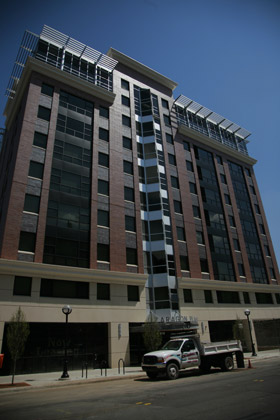
How high is too high? It is a long-fought argument that has been brought up in Ann Arbor in more ways than one over and over again. And it will be broached widely in public this summer as part of a series of public meetings on proposed building height restrictions.Building heights have become a heated topic in Ann Arbor these days as developers push for taller and taller buildings in the downtown area while groups of local NIMBY residents have fought to at least shrink if not destroy these plans. The arguments range from developers saying they are responding to increased demand for downtown (only 2% of the city's population resides downtown) and student housing while locals argue they are trying to preserve Ann Arbor’s unique sense of place.A height restriction of 180 feet (about 15-16 stories) has been floated this year while these battles continue and city planners get ready to update the city’s downtown zoning master plan. Different version of this plan, called A2D2, have been floated since 200X when the process began. The downtown master plan hasn’t been revamped since 1992.The meetings will be held tonight at the CTN Studios, 2805 S Industrial;  June 4 and 17 in the Traverwood Library Branch, 3333 Traverwood Dr.; July 1 and 23 at Cobblestone Farm, 2781 Packard Road; and on July 30 at Forsythe Middle School, 1655 Newport Road. All of the meetings will begin at 6:30 p.m.For information, contact Jeff Kahan at (734) 794-6265 ext. 42614 or at jkahan@a2gov.org.Source: City of Ann ArborWriter: Jon Zemke

Our Partners

30044
30045
30046
30047
30049
Washtenaw ISD logo
Eastern Michigan University
Ann Arbor Art Center
UMS
U of M Arts Initiative
Engage EMU
Ann Arbor Housing Commission

Don't miss out!

Everything Ann Arbor and Ypsilanti, in your inbox every week.

Close the CTA

Already a subscriber? Enter your email to hide this popup in the future.