
MASTERMIND: Bena Burda
Necessity is the mother of invention. In search of a bluer corn chip, Bena Burda ended up founding Maggie's Organics. Eighteen years later the company is still going strong, setting the bar for eco and social responsibility.
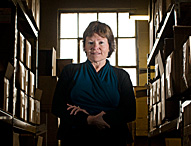
Necessity is the mother of invention. In search of a bluer corn chip, Bena Burda ended up founding Maggie's Organics. Eighteen years later the company is still going strong, setting the bar for eco and social responsibility.

If there was a recession going on, New Eagle largely missed it if it experienced it at all. The Ypsilanti-based company has watched its orders and staff grow recently and expects to double in size within the next year.New Eagle specializes in creating electronic control modules (think of the computer systems that help make your car run) for hybrids and their supporting engineering services. It is continuing to grow sales of its core products and expand into specialty parts."We've experienced continual orders," says Rich Swortzel, founder and president of New Eagle. "That's a good indicator because people are still investing in new technology."Rich and Mickey Swortzel started New Eagle two years ago when the company they worked for (MotoTron) was acquired and moved many of its operations to Colorado. The Swortzels stayed and brought the MotoHawk, New Eagle's principal product, to the market. "This year has been good to us and next year should be good to us," Swortzel says.Source: Rich Swortzel, founder and president of New EagleWriter: Jon Zemke
Ypsilanti's wireless co-op is becoming the city's wireless startup now that Wireless Ypsi is spreading its wings and picking up customers across Metro Detroit and even the U.S.Wireless Ypsi started out two years ago when local community activists Steve Pierce and Brian Robb wanted to bring free Wi-Fi to downtown Ypsilanti. The startup now has 100 customers and the service covers large swaths of the city, including downtown, Depot Town, parks along the Huron River, and some neighborhoods. It's also in the process of setting up a wireless network in downtown Clawson and is receiving similar requests from communities, apartment complexes, and businesses across the metro area."This is the growth phase," Pierce says. "We're trying to turn it into a full business." That can be a tricky transition, going from community project to for-profit venture. Wireless Ypsi still provides its services for free to the city of Ypsilanti, including heavily used service at its public housing projects. So far 85,000 unique devices have logged onto the Wireless Ypsi's Meraki-based Wi-Fi network. An average of 1,000 unique devices use it every day, creating another perk that raises the city's quality of life. "It's a wonderful extra when you can carry your notebook around anywhere and surf the net," says Eric Maurer, a developer and landlord with 100 apartments in Ypsilanti, including 25 downtown. Mark Maynard (Ypsilanti's blogger, puppet debator, and local art baron) calls it "a nice thing to have" that helps showcase the freedom to do new things and turn them into businesses that Ypsilanti offers. The venture is keeping Pierce, Robb, and a few independent contractors busy right now. They hope to double their customer base within the next year and spread it not only across Metro Detroit but the continent, too, in an effort to make the venture profitable. However, the duo still plans to keep offering Wireless Ypsi free to its hometown."We'll give back to our community that we live and work in because we love this place," Pierce says.Source: Steve Pierce, co-founder of Wireless Ypsi; Eric Maurer, co-owner of Maurer Management; and Mark Maynard, creator of MarkMaynard.comWriter: Jon Zemke
A handful of start-ups that are dreaming big took a step towards reality now that they have received seed funding from the Dare to Dream program at the Zell Lurie Institute for Entrepreneurial Studies at the University of Michigan Ross School of Business.The program gave $40,000 in seed capital grants to promising start-ups at the university and in the Ann Arbor area. Thirteen companies received the awards and also tenancy at the TechArb incubator for student-founded businesses. Among the big winners were Bebaroo, a subscription-based rental service for baby clothes, and OWN, which develops comprehensive point-of-sale software for coffee houses. Both businesses received $10,000 each.The Dare to Dream program is part of a growing entrepreneurial-based curriculum that focuses on what the school calls "action-based learning." Those programs include the Wolverine Venture Fund and the Social Venture Fund, which are run by students and make significant investments in real, growing companies with ties to the university or Ann Arbor."It's one thing to work on a case study and it's another thing to work on your own business idea," says Paul Kirsch, associate director of the Zell Lurie Institute for Entrepreneurial Studies. The Dare to Dream program distributes up to $100,000 per academic year to students at the university who are creating their own innovative businesses. It has awarded more than $700,000 to over 1,000 student entrepreneurs since it began in 2002.Source: Paul Kirsch, associate director of the Zell Lurie Institute for Entrepreneurial Studies at the University of Michigan Ross School of BusinessWriter: Jon Zemke
Ypsilanti's Clean Energy Coalition will be funneling $4.4 million in grant money to seven distressed Michigan cities for clean energy programs.Pontiac, Hamtramck, and Highland Park are among the cities receiving funds from the Michigan Public Service Commission through the "Cities of Promise" program. Cities will receive $463,000 for installation of renewable energy technology and setting up a revolving energy fund to pay for the energy management support and future investments.Joshua Brugeman, a divison manager with the CEC, says the initial money helps distressed cities overcome two key hurdles: not having capital for the investments, and not having the budget to pay a staff person to manage them. "We provide them with that initial seed capital to improve their buildings from an energy perspective, establishing an ongoing program and revolving energy fund, to turn that initial seed capital into future investments," he says.Although the cities are distressed, it's still important to invest in energy because of the savings and jobs it could create long-term, says Jenny Oorbeck, also a CEC division manager. And the funded staff person is also important: "You need someone who knows what they're looking at," she says. "We feel like we're doing the right thing for them, helping them put their arms around the data they need to understand and set up a program going forward."The CEC is still working out the details of what the final investments will be. Also, some cities, including Pontiac and Hamtramck, received federal stimulus money, so the CEC can co-invest with that funding to create a more robust program.The CEC, a non-profit organization that works with both public and private partners for smart energy strategies, has also subcontracted with the company Planet Footprint to keep tabs on the energy usage and savings for the cities, which will help them make informed decisions about their energy projects.Other cities receiving funds are Benton Harbor, Flint, Muskegon Heights, and Saginaw. All seven cities are part of the Michigan State Housing Development Authority's Cities of Promise program, a program created in 2006 to help redevelopment in distressed urban cities.Sources: Jenny Oorbeck and Joshua Brugeman, division managers for Clean Energy CoalitionWriter: Kristin Lukowski
The region's planners hope to use the cool $2.8 million awarded to the Southeast Michigan Council of Governments to unify transportation with sustainable housing and redevelopment.Paul Tait, SEMCOG executive director and an Ypsilanti resident, says the Sustainable Communities grant will help in part because the region's older central cities, including Ann Arbor and Ypsilanti, are facing challenges with declining property values and state revenue sharing."Communities are all looking at 20-30 percent less revenues than they had just a few years ago," he says. "At the same time, our older communities have aging infrastructure -- roads, bridges, sewer and water systems -- that are all getting older."The grant will help communities look at how they can be sustainable over the long haul, including better linking workforce training to the business communities; redeveloping older community assets, such as the Ypsilanti Ford plant; and looking at housing, streets, green infrastructure, and energy efficiency. Also necessary is taking a look at infrastructure -- those roads, bridges, and water and sewer systems -- which is about to reach crisis status, Tait says."Those are older systems, and if we can't find the revenue to replace, repair, or rebuild them, our quality of life is going to suffer," he says.Conan Smith, executive director of the Michigan Suburbs Alliance and also a Washtenaw County commissioner and member of SEMCOG's executive committee, adds that plans for the grant include more of a physical connection between Ann Arbor and Ypsilanti, including growing neighborhoods in the Washtenaw Avenue corridor and connecting those places with the rest of the region.The grants, from a partnership between the US Dept of Housing and Urban Development, the US Dept of Transportation, and the Environmental Protection Agency, focus on actually implementing plans, rather than just funding yet another study. "We really want to make a difference as quickly as we can," Tait says. "Just to do more plans to sit on a shelf doesn't make our region and our communities more sustainable. We've got to make a difference."Source: Paul Tait, executive director, SEMCOG; Conan Smith, executive committee member, SEMCOGWriter: Kristin Lukowski
RealKidz is changing up its game and getting some points on the board with its new business plan.The 3-year-old firm, based in Ypsilanti's Depot Town, makes clothing that fits larger children, mainly girls. It started out selling these garments with direct sales, a la Mary Kay. It has since moved to a primary e-commerce platform after upgrading its website with a proven Internet retailing platform in August."We're starting to see some growth from that," says Merrill Guerra, founder and CEO of RealKidz. "We have doubled our website traffic and conversion rate over the last couple of months. It's moving exactly in the direction we were hoping."The two-person startup, also a former Ann Arbor SPARK East Incubator tenant, is now looking to raise a round of seed capital so it can flesh out its staff and business infrastructure. RealKidz hopes to hires a COO and webmaster, among other positions over the next year, with this capital.Source: Merrill Guerra, founder and CEO of RealKidzWriter: Jon Zemke
Work has gone better than expected on Ypsilanti's Water Street Trail, which means people are taking advantage of the walking trail while there's still good weather to be had this year.Part of the boost came from $2,000 in funding from the Washtenaw County Department of Health via the Building Healthy Communities program, which makes areas more walkable and accessible to non-motorized transportation. Part of that grant was also used to secure the help of TSP Environmental to do the physical labor to construct the new stretch of trail, work that would have been almost impossible to do by hand, says Andrew Clock, project coordinator for the Water Street Trail."It's actually gone better than we could have possibly imagined," he says. "Everything has fallen into place, from getting the grant to getting the work done."The Water Street Trail, which follows the north shore of the Huron River from the Michigan Avenue Bridge to Park Street, is only about 100 and 150 yards long, but serves as a connector and will likely eventually become part of the Border-to-Border Trail, a larger, county-wide trail network.The path is made of crushed concrete, which allows for it to become a trail bed when it does become part of the Border to Border Trail. "Most of their work is already done," he says. "The trail built can act as a trail bed for a paved area."Washtenaw County Parks and Recreation will be providing signage indicating that the path is a future stretch of the Border to Border trail, and it's planning for a grand opening sometime at the end of October. Another work day is scheduled for Nov. 6, a kind of fall cleanup day to remove any trash that had been hidden by foliage. Clock also expects that trail organizers will meet one more time to talk about what to do in the spring, including what people have interest in, and how to improve. "We're pleasantly surprised at the amount of people already back there using the trail," he says. "There are quite a few people using it already."Clock says part of the goal of the project is to put a positive spin on Water Street, a point of contention between the city and potential developers. "We want developers, we want people to see Water Street as something valuable, something useful, a good piece of waterfront property," he says. "There is still value in the area, and hopefully someday that will lead to development."For information about the plan or to volunteer, e-mail Clock at waterstreetparkypsi@gmail.com or click here.Source: Andrew Clock, project coordinator for the Water Street TrailWriter: Kristin Lukowski
With a wood stove that uses scrap wood and, soon, solar panels, the Ypsilanti Food Co-op's RiverSide Bakery could very well be producing carbon-neutral bread.The 30 solar panels are now in place above the bakery and just have to be wired, explains Dave Strenski, who started the grass roots project Solar Ypsi and was the force behind the solar projects on the co-op and on Ypsilanti City Hall. The bakery is on a separate circuit from the rest of the co-op, he explains, and if his calculations hold true, the panels could provide 100 percent of the power needed for the bakery.Over the past two weekends, with the help of volunteers, he hauled steel for the panel racks up to the roof, installed them, and then hauled up the panels. The 30 panels are about 30 pounds each, he says, and they also used cinder blocks to act as weights. "I was definitely tired," Strenski jokes.This week, his goal, now that all the heavy lifting is done, is to run some conduit and get the panels wired.The panels are the same as the 12 used on the co-op, but the new ones are a bit more efficient. The co-op will be able to bank its exported power for when it creates less in the wintertime, thanks to a one-year window DTE Energy offers."It should be interesting," he says. "We're hoping that through the summer, we'll be exporting lots of power, all the time."Daily, weekly, and monthly usage from both the co-op and the city hall can be seen here.Next on the docket is a solar tour on Oct. 2, a kind of open house where people can visit and learn about different solar systems. Strenski will be showing off the system at Ypsilanti City Hall, with another volunteer showing off the co-op's system. Strenski will be a guest speaker at Concentrate's October 7th Speaker Event. Read about it here.Source: Dave Strenski, volunteer with Solar YpsiWriter: Kristin Lukowski
Eastern Michigan University is leading a group of the state's top universities, including Michigan State University and the University of Michigan, that are sharing in a $1 million federal grant to add educational programs about climate change."We have all kinds of different people who are associated with it," says Sandra Rutherford, a geo-science education professor at EMU and the lead investigator for the grant.The project plans to set up a national network of educational partnerships devoted to incorporating climate change and its effects into school curriculums. It will focus on pairing those who are working on climate change research with research and educational programs in the Great Lakes region. Everyone from science teachers to business stakeholders to the general public is targeted for the program. Within the next two years, these educators should be able to access a network of researchers and scientists focusing on climate change. The three universities are working with the College of Exploration of the National Oceanic and Atmospheric Administration, the Ann Arbor Hands-On Museum, and a consulting faculty member from Ashland College.Source: Sandra Rutherford, geo-science education professor at Eastern Michigan UniversityWriter: Jon Zemke
Our Partners


