Architecture

U-M laboratories, Crisler Arena to get nearly $100 million in upgrades

Last week the University of Michigan Board of Regents advanced a couple more big projects totaling nearly $100 million in capital outlay. The regents approved a $47 million, inside-out renovation of the George Granger Brown Memorial Laboratories building. The 1958-era, 220,000 square-foot structure will get new finishes in common areas, an HVAC upgrade, new electrical and safety systems, new exterior windows, and better accessibility. The state of Michigan will cover about $30 million of the cost, with the balance coming from the university's investment proceeds and other resources from the College of Engineering and the Office of the Provost.   Troy, Mich.-based architecture firm Integrated Design Solutions will manage the design phase, with a construction start date to be determined upon completion of the design. And soon the roars in Crisler Arena won't just be from basketball fans. The arena's $52 million expansion and renovation project is ready to go out for construction bids. Funding will be provided by the U-M Athletic Department. The 63,000-square-foot addition will host retail spaces, ticketing areas, and a private club area. New spectator entries will also be installed. An existing 54,000 square feet will be redone with disability-accessible seating and better circulation and egress. Additional restrooms, concession stands, and fan amenities are also in the game plan. Work is expected to be complete by winter of 2014. Source: University of Michigan Board of Regents Writer: Tanya Muzumdar

Latest in Architecture
EMU’s Pray-Harrold building rehab done and greener than ever

With school back in season, stat-happy football fans would do well to take note of the recycling numbers posted by Eastern Michigan University's Pray-Harrold building renovation project. The university is seeking Leadership in Energy and Environmental Design (LEED) certification for the $42 million redo of the building used by 10,000 students a day, says Sean Braden, planning and design manager at EMU. This project was the biggest shake-up in the 1969-era building's structural history. Of the 1,200 tons of debris generated, 950 were diverted from the landfill, for a recycling rate in excess of 75%, according to Braden. Off to the recycling plant are 200 tons of masonry block; 30 tons of ceiling tiles; 15 tons of metal; and 3,163 lighting ballasts and 4,317 lamps. In shooting for LEED certification, Braden says, "A lot of our focus on this was in the recycling of debris created and just trying to use low-maintenance materials or those with recycled content." The new design includes recycled ceiling tiles, carpeting with recycled content, bamboo doors, low-flow plumbing fixtures, floor tiles made of a lower-hassle polymer composite as opposed to industry-standard vinyl composite, and a bamboo ceiling in the new glass-enclosed student commons area. The project design also called for using the vast majority of the existing walls and pre-existing layouts of the seven-story, 235,000-square-foot building whenever possible, he explains. "We didn't move every wall in the building; we kept what we could when we could." And vines will slowly be twining up the second through the fifth stories of its south wall. The intent of the green wall is to temper heating and cooling levels. "[The green wall] will absorb the rays of the sun rather than the building doing it and then from a storm water standpoint it will use some of the water that might otherwise have just been run-off." A determination on LEED status could take up to a year to receive from the U.S. Green Building Council, says Braden. Meanwhile, students who used to have to sit in hallways between classes are enjoying the new commons area. All 60 classrooms were redone, and two of the four auditoriums were converted from movie theater-style seating to seminar-style designs. "It's hard to pick one [standout] thing," Braden says. A Pray-Harrold building open house is set for September 20 at 10 a.m. in the new student commons area. Source: Sean Braden, planning and design manager at EMU Writer: Tanya Muzumdar

WebUrbanist praises Ann Arbor library as one of 14 Marvelous Modern Libraries

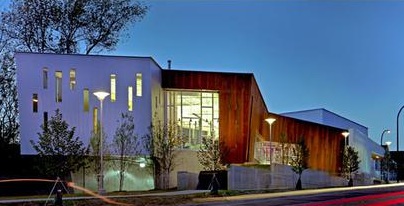
With its recent inclusion on WebUrbanist's list of 14 Marvelous Modern Libraries, the Ann Arbor District Library's Traverwood branch is on the same page with fantastical book spots like the underground TU Delft Library in the Netherlands; Colombia's stone and pine lattice Villaneuva Public Library; and the National Library of Belarus, wrapped in an LED-lit globe reminiscent of a holiday ornament. The 16,500-square-foot library opened in 2008 on a four-acre site in northeast Ann Arbor that had a thick canopy of ash trees felled by Emerald Ash Borer disease. Entire trunks of those original trees were worked into the interior, says Josie Parker, director of the Ann Arbor District Library. "And the ash borer's patterns are apparent on the trunks of those trees. So it's clear what killed the tree, and why so much ash was available. It's a social statement, an environmental statement, as well as an architectural statement, all being made in one design." Its other notable features include an L-shaped design to accommodate the irregular lot shape, a light-bathed interior, a storm water management system with a rain garden, and a cafe. Parker puts the total project cost at $10 million, including the lot, construction, and furnishings. The Traverwood branch made such a lofty list because, "First of all, it's not a big major city library," says Parker. "It's a highly sustainable and a very progressive site in an urban city without being in a major metropolitan area, and I think that  [WebUrbanist] understood it for that and that's why they chose it." Source: Josie Parker, director of the Ann Arbor District Library Writer: Tanya Muzumdar

Ann Arbor’s City Hall goes live with green roof

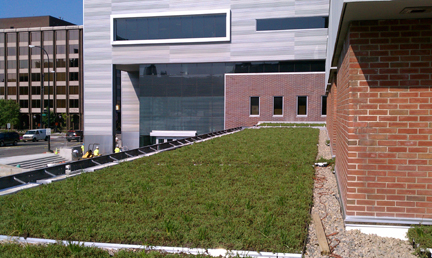
When it rains, the green roof on Ann Arbor's Larcom City Hall will be grateful for the soaking. The 18,000-square-foot expanse of roof will be planted during the first week in September, says Nancy Stone, a spokesperson for the city of Ann Arbor. The roof will have 10,318 square feet devoted to sedum plantings, with alium (wild onion) plants interspersed for a mix of height and color. The plants come in four-inch-deep trays, over 5,000 of which will be used. The remainder of the space will be topped with walking pavers. The installation is costing roughly $450,000, or $25 per square foot, according to George Cook, chief executive of roof installer CEI. "Using the promenade open space over the exposed original flat roof of the first floor of the Larcom City Hall was a natural location for a green roof. This type of vegetative roof absorbs rain water to prevent flooding and helps insulate the building, keeping it warmer in winter and cooler in the summer," Stone says in an email. Excess water from heavy rain will flow into roof drains and then ground-level rain gardens and cisterns around the building.   Green roofs last two to three times longer than standard roofs, according to an estimate by Live Roof, the city's vendor. It offers protection in the form of shielding it from UV radiation, temperature swings, wind, and perforations. The rooftop, which will have seating areas, will be accessible to visitors once the stair rails are installed at the end of September, Stone says. Sources: Nancy Stone, spokesperson for the city of Ann Arbor; CEI chief executive George Cook Writer: Tanya Muzumdar Image courtesy of city of Ann Arbor

It’s a long row to hoe for the Ypsilanti Freighthouse Cafe

The anticipated cafe opening at the Ypsilanti Freighthouse this summer didn't come to pass, as project leaders need to make tracks on a couple other items first. The Friends of the Ypsilanti Freighthouse (FOYF), the citizen group tasked with managing the 1878 facility, has asked to amend the management agreement it has with the city of Ypsilanti to give the FOYF the authority to rent the property out for long-term leases. Such an arrangement would provide the group with the cash flow it needs to make interior renovations and add the kitchen and bathroom facilities required to operate a cafe, says Ed Penet, chair of the FOYF building committee. He's been in discussions with parties interested in operating the cafe, but their identities are under wraps for the moment. Besides dining, retail is a possibility for the space, Penet says. The Freighthouse would also serve as a train depot for the potential Ann Arbor to Detroit commuter rail line. The FOYF also submitted architectural and engineering plans to the Michigan State Historic Preservation Office in mid-July and is awaiting their clearance, Penet says. The group has budgeted $300-$350,000 for interior work, and another $30,000-40,000 for a fire suppression system. "The [Cross Street] streetscape project that's ongoing right now...was very fortunate for us," Penet says. It enabled the group to use extra monies from the MDOT project to finance the running of several hundred feet of water line from Cross Street to an exterior wall of the Freighthouse. The water lines will serve as part of the fire suppression system and for plumbing the interior. "That was a really, really important breakthrough during the summer." Rail rumbles or not, Penet's new bullseye date for a cafe opening is spring 2012. "With or without the train, the Ypsilanti Freighthouse is a long term commitment to be a community center and a focal point for the city and the citizens and southeastern Michigan," he adds. Source: Ed Penet, chair of the Friends of the Ypsilanti Freighthouse building committee Writer: Tanya Muzumdar  

In Ann Arbor, historic preservation and rehabilitation has its rewards

Vintage home and commercial property owners in Ann Arbor who go to the extent of jimmying off asbestos siding to reveal original clapboards and replacing decayed trim with historically accurate replicas don't go unnoticed. Every February a vanful of preservation buffs makes the rounds of the icy streets, looking to spotlight exemplary historic properties. For the last 23 years, the Ann Arbor Historic District Commission has presented awards to citizens and businesses for rehabs and projects deserving special merit, as well as preservation of properties they've owned and maintained for 10 years. Mayor John Hieftje presents the certificates at a city council meeting every June. "We try to recognize people, some of whom are not getting any financial benefits out of it. They're just doing it because they believe in it," says Susan Wineberg, chair of the awards committee. The nine-member group is a mix of residents city-wide, some of whom are historic district commission members. To be eligible, a property must be at least 50 years old. Among those honored in 2011 with a rehabilitation award was the Linder House, a bright aqua-hued co-op at 711 Catherine Street that's owned by the Inter Cooperative Council at the University of Michigan. "The ICC is doing a great job... they seem to have a project every year," Wineberg says. The rehab included remilling of new wood trim to match the old, and historically accurate replacement windows and roof. "Usually things are not that much of a 100-percent overhaul, but that was a really major overhaul."An adaptive re-use of the garage home base of Old House Gardens, an internationally-known antique flower bulb purveyor at 536 Third Street, also got the nod with a special merit award. After abandoning the search for a historic farm to use for his business, owner Scott Kunst remade the upper level of his barn-like garage into new office space. "Here's a local business guy who's really made good and is staying in Ann Arbor and reusing what he has," Wineberg notes.Source: Susan Wineberg, Ann Arbor Historic District Commission awards committee chairWriter: Tanya Muzumdar

Ann Arbor builder a national leader in environmental design

Ann Arbor's Doug Selby is a finalist for a national award that heralds architects who show business acumen, financial strength, community and industry involvement, and entrepreneurial spirit. The Fred Case Remodeling Entrepreneur of the Year Award comes with a cash prize and brings prestige. Selby, who's made a name for himself by building homes that fit in with their environment architecturally with minimal energy or materials waste and with regard for historic preservation, is president of Meadowlark Builders. He was chosen as a finalist by a panel of judges from Case Design/Remodeling Inc., Harvard University's Center for Joint Housing Studies and Hanley Wood, a media company covering construction.Case founder, CEO and co-chairman, Fred Case, says “Doug Selby represents not only entrepreneurial thinking but action on that thinking which is especially enviable in these more uncertain times.  Doug’s entrepreneurial spirit continually sets a higher bar not only for his business but for the remodeling industry as a whole.”Case is credited with pioneering the design/build concept in remodeling in the 1970s and with developing the first certification system for remodelers.Source: Greening of Detroit and Doug Selby, Meadowlark BuildersWriter: Kim North Shine

Pratt Block restoration is a “Queen Anne front with a Mary Ann behind”

The Pratt Block building has shrugged off its damaged upper facade and now has a new front on Main Street. Detroit Cornice & Slate recently completed a restoration of the cornice on the building at 301-306 S. Main Street in downtown Ann Arbor. The circa-1896 building formerly housed Kline's department store and now has nine residential lofts and other businesses. The new cornice was fashioned from sheet metal and replaced 80 1-foot by 18-inch brackets removed when flat porcelain panels were installed on the facade. The cornice was then painted to give the appearance of being cast from stone, a common sight in towns with 1800s roots. In that era it was common to construct buildings with ornate facade fronts and unadorned common brick backsides. "Mark Twain referred to that as a Queen Anne front with a Mary Ann behind!" says Doneen Hesse, owner of Detroit Cornice & Slate.The 122-year-old business has also had a hand in many of the ornamental slate or copper roofs on the University of Michigan's academic buildings and dormitories. In 1995, the Lurie Engineering Building was topped with a copper roof – 30 tons' worth. And last year the company installed a full new slate roof and copper metalwork such as gutters, downspouts, and fascia, as part of the historical restoration of the Mosher Jordan dormitory. That project cost just over $1.5 million and used about 140,000 pieces of slate, Hesse says.Hesse ticks off a list of other work, including the installation of ornamental purple and grape green slate on the First Congregational Church as well as slate roofing for Stockwell Hall, Lorch Hall, Hutchens Hall, and fraternities and private Ann Arbor residences.Source: Doneen Hesse, owner of Detroit Cornice & SlateWriter: Tanya Muzumdar

Gordon Hall landmark gets a grand restoration plan

Gordon Hall, a circa-1840s manse with a suspected tie to the Underground Railroad, is getting the once-over from a team of consultants preparing a historic building rehabilitation master plan. The Dexter Area Historical Society & Museum (DAHSM) owned property sits on a 50-acre plot in Webster and Scio Townships but is visible from downtown Dexter, says Melissa Milton-Pung, a project manager with the Washtenaw County Department of Economic Development and Energy. "I believe that there is a connection to the Underground Railroad - a lot of people do," Milton-Pung says. "It's just difficult to find documentation, obviously, for something that was so hidden during the time when it was active."The work on the storied property is funded by a $14,752 grant from the Michigan State Historic Preservation Office along with a $10,000 grant from the Knight Foundation. Local architecture firm HopkinsBurns Design Studio won out over a dozen bidders to lead the project, which Milton-Pung expects will be completed this summer. Katherine Dexter McCormick, early supporter of birth control pill research and granddaughter of original owner Judge Samuel Dexter, for whom the village of Dexter is named, gifted the property to the University of Michigan in 1950. In 2000, the DAHSM purchased the 9,900-square-foot home from the university, which had divided it into four faculty apartments in the 1950s. "In doing so...they gutted the entire interior, and so there is practically no original historic fabric left on the interior, and the exterior has been sided aluminum," explains Milton-Pung. "So there is a lot that needs to be done to assess the current condition of the property in terms of its historic integrity, but the property is not in disrepair." The original central staircase and grand entry foyer were removed during the reconfiguration.The team will have access to drawings done by U-M's first dean of architecture, Emile Lorch, (for whom Lorch Hall is named) and the Historic American Building Survey prior to its alteration, which Milton-Pung believes will be incorporated into the consultants' recommendations. Estimated rehab costs are unavailable but will be addressed in the plan.Its purpose, she says, is to make recommendations for maintenance and restoration of the property for different possible uses. "There is some desire to have it as a house museum, and there is also some desire to make sure that we have it in a more active use so that people can continue to want to go there and not say, 'Oh, well, I've already been there.'" Gordon Hall has hosted weddings and other events, school trips, and it is also the site of a Civil War days commemorative event from June 10-12.And the completed plan will be a mark of credibility behind future funding requests when it comes time to do the actual rehabilitation. Says Milton-Pung, "I have every confidence that major work will be taking place at the property over the next several years."Source: Melissa Milton-Pung, project manager with the Washtenaw County Department of Economic Development and EnergyWriter: Tanya Muzumdar

Modern architecture tours to circle Ann Arbor ‘hoods

Modernism in architecture is defined in broad strokes as building design that employs a simple, unadorned form. Washtenaw County, particularly Ann Arbor, has a plethora of residential examples built between about 1940 and 1970, many designed by professors at the University of Michigan School of Architecture, an embracer of the Modernist movement. To that end, the county has just received a $6,000 grant from the Michigan State Historic Preservation Office (SHPO) to develop walk/bike/drive tours of residential neighborhoods with large concentrations of Ann Arbor's Modern architecture. This grant falls under the SHPO's sponsoring of a statewide survey to document Michigan's rich Modern design heritage. "We're hooking into that and we're saying, 'You know what, Michigan was very important in the development of midcentury Modern design, and here's some evidence.'" Milton-Pung explains.The focus area will be just east of the University of Michigan campus, in the Ann Arbor Hills neighborhood and north of Geddes Road, says Melissa Milton-Pung, a project manager in the Washtenaw County Office of Economic Development and Energy. Many of the homes are located on Arlington, Devonshire, Heather Way, and Avon Roads. While it's largely too soon to release specific locations, Milton-Pung mentions 830 Avon Road, a home built in 1954 for H. Richard Crane, a professor and physicist who was involved in the Manhattan project and instrumental in the development of the atomic bomb. And Indian River Place, off the north side of Geddes Road, has four properties inspired by modern interpretations of Japanese architecture.The county is working with homeowners, the a2Modern group, archivists at the Bentley Historical Museum, and U-M's Taubman College of Architecture, to list about 40 properties that are fine stylistic examples of Mid-century Modern homes. The collection spans the work of about 11 architects, many of whom are or were U-M professors of architecture and had connections with luminaries such as Mies van de Rohe and Charles and Ray Eames. The work of Robert Metcalf, a former dean of the Taubman College, will be featured prominently, Milton-Pung says. The tour will also include the designs of George Brigham, Bennett Wells, William Muschenheim, and Alden B. Dow, as well as Frank Lloyd Wright's Palmer House.The properties will be designated on a downloadable map and brochure to be used for self-guided tours. The county is shooting to have the brochure ready by late summer or early fall, but definitely by year-end, Milton-Pung says. She also sees the potential to widen the scope to include guided tours and other neighborhoods county-wide, and commercial properties as well. The goal is not just touring, but to draw eyes to Modern architecture potentially at risk of being flattened."I think anybody who's interested in Mid-Century Modern understands that oftentimes because these don't look like traditional "historic" properties like you would think of, say, a Beaux Arts courthouse or a Victorian house on the West Side, these properties are somewhat vulnerable because you'll have somebody come in and say, "you know I like the property but I just want to tear it down and put something new where they are because it isn't really that important.'" Milton-Pung would also like to see the restoration of a former victim of budget cuts - an updated countywide survey of Modern residential and commercial properties. "We are in the process of seeing one of the icons of eastern Washtenaw county being lost to the community...the Ann Arbor-Ypsi bowl sign. If that property had been designated or there had been other ways to protect it, we wouldn't necessarily see it go away." Source: Melissa Milton-Pung, project manager, Washtenaw County Office of Economic Development and EnergyWriter: Tanya Muzumdar


Our Partners

30044
30045
30046
30047
30049
Washtenaw ISD logo
Eastern Michigan University
Ann Arbor Art Center
UMS
U of M Arts Initiative
Engage EMU

Common Ground Is Brewing

Support local stories and receive our signature roast straight to your door when you join at the Standard level (or above).

Drink Better, Read Local

Close the CTA

Don't miss out!

Everything Ann Arbor and Ypsilanti, in your inbox every week.

Close the CTA

Already a subscriber? Enter your email to hide this popup in the future.