
Architecture
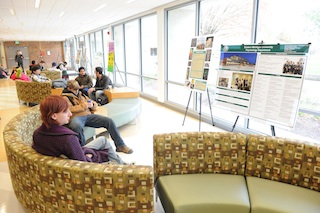
Latest in Architecture
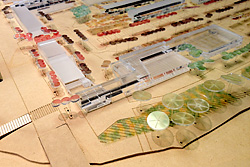
Ypsilanti’s Eastside Recreation Center: Two Visions
A trio of U-M architecture grad students were tasked with envisioning what the proposed $12 million rec center on Ypsilanti's Water Street property might look like. One plan highlights Ypsi's downtown, the other its park. Both are exciting and innovative approaches to urban development.

From boarded-up gas station to flatiron office and condos
The nothingness of a boarded up gas station on Detroit Street in Kerrytown is likely to make way for a building that a local architect sees becoming a landmark for the city. Though small, the proposed flat iron style building - roughly a triangular shaped structure with a nose that faces the convergence of two streets, will stand out, says Marc Rueter of Rueter Associates Architects. And true flat iron structures in Ann Arbor are rare - though there is one down the street near Zingerman's deli at Fifth and Detroit. Rueter is the architect on the project that's being developed by Dan Williams of Maven Development. "He recognized this was a really cool site..It's a hard site to develop because it's such a small footprint, but it could be very much a landmark, something to be seen when you cross the bridge over the river, something people will notice and remember." The building would be three stories and about 4,000 total square feet. The ground floor would be office space, and the second and third floors would each be condominiums of about 1,650 square feet. The top condo would have access to a rooftop patio and a view of the Huron River. Parking would be located underground. And the location to Kerrytown market makes it attractive. "I think it's one of the nicer areas to live in Ann Arbor if you want the urban lifestyle," Rueter says. "It's a short walk to a lot of the things you need and great places." The project, which involves demolishing a Clark service station that was boarded up about 30 years ago, is supported by city officials but most go before the historic district commission because of its location in a historic area. The commission meets Thursday. If it is approved, as expected, the project would go for other approvals and likely be done by year's end. Construction could start in the spring, Rueter says. Source: Marc Rueter, Rueter Associates Architects Writer: Kim North Shine
A2 Modern designs A2 walking-tour map, hosts architecture event
As Michigan gained dominance in the new-car market in the mid-19th century, leading architects were also designing of-the-moment housing. The decades spanning 1940-1970 spawned Modernism - a spare, clean style which abounds in Ann Arbor, where renowned architects and professors of architecture - think Eero Saarinen, George Brigham, and Alden B. Dow - designed many of the iconic Modern homes still standing today. "There was a lot happening in Ann Arbor - the college was moving from the Beaux Arts style to Modern, there was a large influx of new students after the war, more faculty, and the need to build. The faculty were doing cutting-edge research and were really open to a new and different way of living," explains Nancy Deromedi, co-founder of A2 Modern, an educational group and promoter of Ann Arbor's collection of Modern architecture. Although no firm count of Modern properties in Ann Arbor has been completed yet, A2 Modern, together with U-M's College of Architecture, has developed a walking-tour map highlighting 86 sites around the city. Many can be found in Ann Arbor Hills, Barton Hills, near Spring Street, and along E. Huron River Drive. "I think what is interesting to see is if you start in the Geddes-Arb area, you can see the changing styles of what was Modern, starting with the home George Brigham designed for two families...It is on Oswego, [made of] concrete block and has more of an International Modern feel. And then you can work your way over a few blocks to see what Alden Dow did for his sister in 1932, which is a fabulous low-ground hugging structure on Berkshire; then go a few blocks further and see an example of Bauhaus with the home William Muschenheim designed for himself on Heatherway. So, it is really a fascinating collection of ideas and influences," Deromedi says. Modern fans and the merely curious can meet at 7 p.m. on October 9 at the Bentley Historical Library in Ann Arbor, where A2 Modern will host state historic preservation officer Brian Conway, who will be discussing Michigan's role in the Modern movement. To obtain walking tour maps and for more information on upcoming programming from A2 Modern, click here. Source: Nancy Deromedi, co-founder of A2 Modern Writer: Tanya Muzumdar
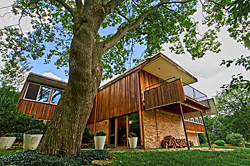
Modern Yet Historic, Vintage Yet Sustainable
When Ann Arbor's most prolific Modern architect, Robert C. Metcalf, completed his first commission, it was on the forefront of energy efficient design. Now, sixty years later, our standards have evolved and the house is being lovingly revived in a way that improves the efficiency without compromising the design.

Summers-Knoll School: Fresh Spirit In An Old Space
From a dairy to an organ donation headquarters, the building at 2203 Platt Road has morphed and mutated over the years, making it a challenge for anyone new to call it home. Enter the progressive private school Summers-Knoll, which saw a diamond in the rough. Now classroom "front porches," courtyard gardens, and a cavernous music room are key features in this ambitious architectural transformation.
Geodesic dome shapes artistic and entertainment possibilities
An Ann Arbor group that promotes creativity in the community has designed a traveling geodesic dome that can be used for any number of creative outlets. The dome, 16 feet in radius, is a project of Syncytium, a group dedicated to creating large-scale, interactive art in Ann Arbor, Detroit and surrounding communities. A2Awesome, the Washtenaw County arm of a Boston-based micro-philanthropic organization, The Awesome Foundation, awarded $1,000 to artist Amanda Sari Perez to help complete the dome, which is made out of 1.5 inch thick electrical conduit. Perez told A2Awesome that she wants the dome to be a "platform on which others in the community can express their creativity. The dome has already been a guest at Ann Arbor and Detroit Maker Faires, Figment and Lakes of Fire. Future plans for the dome include covering it with cargo net so that it could be used as a climbing gym. Add lights and it's a great DJ stand. “Other people,” says Perez, “may want to use it for parties, fundraisers, gatherings, or performances. They may want to hang hammocks or swings inside of it. They may want to cover it in some way, or leave it open.” Ultimately, according to Perez, she would like to see it find a semi-permanent home where it could exist as a giant instrument, filled with cords that would trigger sound, either electronically or mechanically, when tugged or clambered upon. Linh Song, board member of A2Awesome, where the mission is "Forwarding the interest in Awesome in Washtenaw County, $1,000 at a time, says the dome was chose as a grant recipient in June because “it’s the kind of thing that could continue to foster awesomeness for years to come. Not only will people be able to play on it at Maker Faire, which is awesome in its own right, but it’ll exist as an easily-transportable cultural asset that could be used in hundreds of different ways. We’re excited to see how it inspires people. The potential is endless.” Source: A2Awesome Writer: Kim North Shine
Ann Arbor homes and buildings receive preservation, rehab awards
A little-known function of the Ann Arbor Historic District Commission has been to circle Ann Arbor neighborhoods in search of homes and buildings whose owners have done exceptional jobs of rehabilitation and preservation. The search committee didn't come up short this year. Fifteen homes and businesses, dating from pre-Civil War days to the mid-century, and a handful of other individuals received awards for their efforts at last Monday's Ann Arbor City Council meeting. To qualify, among other criteria, the homes and buildings must be at least 50 years old but they do not have to be in a designated historic district. Award recipient Herb David, owner of Herb David Guitar Studio in a Dutch Colonial Revival house at 302 E. Liberty St., has "just been a big advocate for the block that he's on, despite all the development pressures," Awards Committee Chair Susan Wineberg says. And Martin Soave rehabbed a small home at 508 Fourth St. on the Old West Side that sat "empty for 12 years, and it had raccoons living in it." New this year, "Mid-Century Modern is getting more attention," says Wineberg. Six such properties were recognized, five of which are in the Ann Arbor Hills neighborhood. Many homes in the neighborhood were designed by architect luminaries such as Eero Saarinen and Alden Dow. Nancy Deromedi and Tracy Aris, founders of the group A2Modern, received a special merit award for their work in promoting this architecture through walking tours, exhibits, lectures and publications. Source: Susan Wineberg, awards committee chair, Ann Arbor Historic District Commission Writer: Tanya Muzumdar
Ann Arbor’s modern architecture matters too
The period from 1940 to 1970 was the heyday for the Modernist movement in architecture - a clean, natural style that is the flipside of ornately-trimmed homes from earlier epochs. A large contingent of Modern architects and designers, such as Charles and Ray Eames and Alden B. Dow, had Michigan ties. "Michigan did play a really important role in the development of Modernism after World War II, specifically because Michigan was booming in that period. Michigan was and still is a center for design, particularly when you consider the auto industry, the furniture industry, plus the major institutions such as Cranbrook and the University of Michigan...." says Michigan State Historic Preservation Officer Brian Conway. To inform the public of Michigan's strong design heritage, the Michigan Historic Preservation Network will be holding its annual conference in Flint, Mich. from May 10-12. The Michigan Modern Project presentation from 3:15 to 5 p.m. on Thursday, May 10 at the Flint Masonic Temple will be of especial interest to Ann Arborites, due to the city's extensive collection of Modern architecture - particularly residential. "Because of the [University of Michigan] and the architecture program, Ann Arbor does have a wealth of very good architecture from this period, particularly residential architecture that was designed by architecture school faculty," Conway notes. The Michigan State Historic Preservation Office last year gave a grant to the A2Modern group to develop a walking tour of Modern architecture in Ann Arbor. This year the group is developing an even more comprehensive walking tour, Conway says. And at the national conference of the Society of Architectural Historians held in Detroit a couple of weeks ago, A2Modern hosted an Ann Arbor tour for a contingent of academics and scholars. "Long story short, Ann Arbor's very important to this story," Conway says. Source: Brian Conway, Michigan State Historic Preservation Officer Writer: Tanya Muzumdar
Rural setting makes room for modern architecture
Ann Arbor moons over its older housing stock, so what's a modern architect to do? Well, Washtenaw's prairie offers up some opportunities for those who scribble outside the standard-issue housing lines. Excerpt: "When architect Wilfred Armster walked through a two-acre meadow on the outskirts of Ann Arbor to ponder a project, a dream house for a couple who loved modern architecture, he said he was struck with a sudden vision of the waist-high grass being left untouched. "And that was it," he said. The result: a long, slim bar of a building that bridges two low mounds in the field, suspended over the ground at certain points by more than 8 feet." Read the rest of the story here.
Ypsilanti’s Eastside Recreation Center: Two Visions
A trio of U-M architecture grad students were tasked with envisioning what the proposed $12 million rec center on Ypsilanti's Water Street property might look like. One plan highlights Ypsi's downtown, the other its park. Both are exciting and innovative approaches to urban development.
From boarded-up gas station to flatiron office and condos
The nothingness of a boarded up gas station on Detroit Street in Kerrytown is likely to make way for a building that a local architect sees becoming a landmark for the city. Though small, the proposed flat iron style building - roughly a triangular shaped structure with a nose that faces the convergence of two streets, will stand out, says Marc Rueter of Rueter Associates Architects. And true flat iron structures in Ann Arbor are rare - though there is one down the street near Zingerman's deli at Fifth and Detroit. Rueter is the architect on the project that's being developed by Dan Williams of Maven Development. "He recognized this was a really cool site..It's a hard site to develop because it's such a small footprint, but it could be very much a landmark, something to be seen when you cross the bridge over the river, something people will notice and remember." The building would be three stories and about 4,000 total square feet. The ground floor would be office space, and the second and third floors would each be condominiums of about 1,650 square feet. The top condo would have access to a rooftop patio and a view of the Huron River. Parking would be located underground. And the location to Kerrytown market makes it attractive. "I think it's one of the nicer areas to live in Ann Arbor if you want the urban lifestyle," Rueter says. "It's a short walk to a lot of the things you need and great places." The project, which involves demolishing a Clark service station that was boarded up about 30 years ago, is supported by city officials but most go before the historic district commission because of its location in a historic area. The commission meets Thursday. If it is approved, as expected, the project would go for other approvals and likely be done by year's end. Construction could start in the spring, Rueter says. Source: Marc Rueter, Rueter Associates Architects Writer: Kim North Shine
A2 Modern designs A2 walking-tour map, hosts architecture event
As Michigan gained dominance in the new-car market in the mid-19th century, leading architects were also designing of-the-moment housing. The decades spanning 1940-1970 spawned Modernism - a spare, clean style which abounds in Ann Arbor, where renowned architects and professors of architecture - think Eero Saarinen, George Brigham, and Alden B. Dow - designed many of the iconic Modern homes still standing today. "There was a lot happening in Ann Arbor - the college was moving from the Beaux Arts style to Modern, there was a large influx of new students after the war, more faculty, and the need to build. The faculty were doing cutting-edge research and were really open to a new and different way of living," explains Nancy Deromedi, co-founder of A2 Modern, an educational group and promoter of Ann Arbor's collection of Modern architecture. Although no firm count of Modern properties in Ann Arbor has been completed yet, A2 Modern, together with U-M's College of Architecture, has developed a walking-tour map highlighting 86 sites around the city. Many can be found in Ann Arbor Hills, Barton Hills, near Spring Street, and along E. Huron River Drive. "I think what is interesting to see is if you start in the Geddes-Arb area, you can see the changing styles of what was Modern, starting with the home George Brigham designed for two families...It is on Oswego, [made of] concrete block and has more of an International Modern feel. And then you can work your way over a few blocks to see what Alden Dow did for his sister in 1932, which is a fabulous low-ground hugging structure on Berkshire; then go a few blocks further and see an example of Bauhaus with the home William Muschenheim designed for himself on Heatherway. So, it is really a fascinating collection of ideas and influences," Deromedi says. Modern fans and the merely curious can meet at 7 p.m. on October 9 at the Bentley Historical Library in Ann Arbor, where A2 Modern will host state historic preservation officer Brian Conway, who will be discussing Michigan's role in the Modern movement. To obtain walking tour maps and for more information on upcoming programming from A2 Modern, click here. Source: Nancy Deromedi, co-founder of A2 Modern Writer: Tanya Muzumdar
Modern Yet Historic, Vintage Yet Sustainable
When Ann Arbor's most prolific Modern architect, Robert C. Metcalf, completed his first commission, it was on the forefront of energy efficient design. Now, sixty years later, our standards have evolved and the house is being lovingly revived in a way that improves the efficiency without compromising the design.
Summers-Knoll School: Fresh Spirit In An Old Space
From a dairy to an organ donation headquarters, the building at 2203 Platt Road has morphed and mutated over the years, making it a challenge for anyone new to call it home. Enter the progressive private school Summers-Knoll, which saw a diamond in the rough. Now classroom "front porches," courtyard gardens, and a cavernous music room are key features in this ambitious architectural transformation.
Geodesic dome shapes artistic and entertainment possibilities
An Ann Arbor group that promotes creativity in the community has designed a traveling geodesic dome that can be used for any number of creative outlets. The dome, 16 feet in radius, is a project of Syncytium, a group dedicated to creating large-scale, interactive art in Ann Arbor, Detroit and surrounding communities. A2Awesome, the Washtenaw County arm of a Boston-based micro-philanthropic organization, The Awesome Foundation, awarded $1,000 to artist Amanda Sari Perez to help complete the dome, which is made out of 1.5 inch thick electrical conduit. Perez told A2Awesome that she wants the dome to be a "platform on which others in the community can express their creativity. The dome has already been a guest at Ann Arbor and Detroit Maker Faires, Figment and Lakes of Fire. Future plans for the dome include covering it with cargo net so that it could be used as a climbing gym. Add lights and it's a great DJ stand. “Other people,” says Perez, “may want to use it for parties, fundraisers, gatherings, or performances. They may want to hang hammocks or swings inside of it. They may want to cover it in some way, or leave it open.” Ultimately, according to Perez, she would like to see it find a semi-permanent home where it could exist as a giant instrument, filled with cords that would trigger sound, either electronically or mechanically, when tugged or clambered upon. Linh Song, board member of A2Awesome, where the mission is "Forwarding the interest in Awesome in Washtenaw County, $1,000 at a time, says the dome was chose as a grant recipient in June because “it’s the kind of thing that could continue to foster awesomeness for years to come. Not only will people be able to play on it at Maker Faire, which is awesome in its own right, but it’ll exist as an easily-transportable cultural asset that could be used in hundreds of different ways. We’re excited to see how it inspires people. The potential is endless.” Source: A2Awesome Writer: Kim North Shine
Ann Arbor homes and buildings receive preservation, rehab awards
A little-known function of the Ann Arbor Historic District Commission has been to circle Ann Arbor neighborhoods in search of homes and buildings whose owners have done exceptional jobs of rehabilitation and preservation. The search committee didn't come up short this year. Fifteen homes and businesses, dating from pre-Civil War days to the mid-century, and a handful of other individuals received awards for their efforts at last Monday's Ann Arbor City Council meeting. To qualify, among other criteria, the homes and buildings must be at least 50 years old but they do not have to be in a designated historic district. Award recipient Herb David, owner of Herb David Guitar Studio in a Dutch Colonial Revival house at 302 E. Liberty St., has "just been a big advocate for the block that he's on, despite all the development pressures," Awards Committee Chair Susan Wineberg says. And Martin Soave rehabbed a small home at 508 Fourth St. on the Old West Side that sat "empty for 12 years, and it had raccoons living in it." New this year, "Mid-Century Modern is getting more attention," says Wineberg. Six such properties were recognized, five of which are in the Ann Arbor Hills neighborhood. Many homes in the neighborhood were designed by architect luminaries such as Eero Saarinen and Alden Dow. Nancy Deromedi and Tracy Aris, founders of the group A2Modern, received a special merit award for their work in promoting this architecture through walking tours, exhibits, lectures and publications. Source: Susan Wineberg, awards committee chair, Ann Arbor Historic District Commission Writer: Tanya Muzumdar
Ann Arbor’s modern architecture matters too
The period from 1940 to 1970 was the heyday for the Modernist movement in architecture - a clean, natural style that is the flipside of ornately-trimmed homes from earlier epochs. A large contingent of Modern architects and designers, such as Charles and Ray Eames and Alden B. Dow, had Michigan ties. "Michigan did play a really important role in the development of Modernism after World War II, specifically because Michigan was booming in that period. Michigan was and still is a center for design, particularly when you consider the auto industry, the furniture industry, plus the major institutions such as Cranbrook and the University of Michigan...." says Michigan State Historic Preservation Officer Brian Conway. To inform the public of Michigan's strong design heritage, the Michigan Historic Preservation Network will be holding its annual conference in Flint, Mich. from May 10-12. The Michigan Modern Project presentation from 3:15 to 5 p.m. on Thursday, May 10 at the Flint Masonic Temple will be of especial interest to Ann Arborites, due to the city's extensive collection of Modern architecture - particularly residential. "Because of the [University of Michigan] and the architecture program, Ann Arbor does have a wealth of very good architecture from this period, particularly residential architecture that was designed by architecture school faculty," Conway notes. The Michigan State Historic Preservation Office last year gave a grant to the A2Modern group to develop a walking tour of Modern architecture in Ann Arbor. This year the group is developing an even more comprehensive walking tour, Conway says. And at the national conference of the Society of Architectural Historians held in Detroit a couple of weeks ago, A2Modern hosted an Ann Arbor tour for a contingent of academics and scholars. "Long story short, Ann Arbor's very important to this story," Conway says. Source: Brian Conway, Michigan State Historic Preservation Officer Writer: Tanya Muzumdar
Rural setting makes room for modern architecture
Ann Arbor moons over its older housing stock, so what's a modern architect to do? Well, Washtenaw's prairie offers up some opportunities for those who scribble outside the standard-issue housing lines. Excerpt: "When architect Wilfred Armster walked through a two-acre meadow on the outskirts of Ann Arbor to ponder a project, a dream house for a couple who loved modern architecture, he said he was struck with a sudden vision of the waist-high grass being left untouched. "And that was it," he said. The result: a long, slim bar of a building that bridges two low mounds in the field, suspended over the ground at certain points by more than 8 feet." Read the rest of the story here.


