Architecture

Domino’s Farms celebrates 25 years of diverse business environments

Twenty five years ago, Domino's Farms opened as Ann Arbor's premiere office address, boasting about 1 million square feet of space and marquee tenants in its namesake pizza company, a law firm, and the University of Michigan's Med Sport, the university's first outpatient care center outside of U-M Hospital. Today the iconic campus overlooking the intersection of M-14 and U.S. 23 on Ann Arbor's northeast side is the home to dozens of companies and non-profits of all shapes and sizes. More than 2,000 people work at the complex, which attracts about another 1,000 people who do business there. More than 50 companies call it home, ranging from Domino's Pizza to smaller law, engineering, and insurance firms. "We really cover all facets from entrepreneurial and research to professional," says John Petz, director of government and community relations for Domino's Farms. It is now about 94 percent occupied. The spaces still up for lease range in size from 800-15,000 square feet. "We can still handle start-up companies to companies in the first and second phase of growth," Petz says.The accompanying petting zoo/farm, which comes complete with a herd of buffalo, complements the complex's Prairie-style architecture, inspired by Frank Lloyd Wright. That influence can be seen in everything from the main building's long, horizontal design from the freeway to the furniture in its conference rooms."It has a timeless, American iconic design," Petz says.Source: John Petz, director of government and community relations for Domino's FarmsWriter: Jon Zemke

Latest in Architecture
UM’s College of Architecture and Urban Planning takes over Liberty Lofts commercial space

The University of Michigan will soon put the commercial space of a loft building to good use.The U-M Taubman College of Architecture and Urban Planning will be using 19,000 square feet of Liberty Lofts, on the western edge of downtown, for architectural research, says Kim Broekhuizen, a public affairs specialist for the university. "The (college) examined several university space options, but none met the school's needs," she says.She couldn't yet offer details on what specifically the space would be used for.Developer Ron Mucha, a member of Morningside Ann Arbor, says he's expecting the space to be occupied around the first of November, and construction is already underway. "We think that this is a good use for the property, complementary with the neighborhood and surrounding uses."Liberty Lofts residential units had sold out several years ago, winning awards along the way for its redevelopment of an old factory on the western edge of downtown. The commercial section of the building remained up for sale or lease.Source: Ronald Mucha, developer with Morningside Ann Arbor and Kim Broekhuizen, spokeswoman for the University of MichiganWriter: Kristin Lukowski

Ann Arbor architect creates LEED student apts

Several years ago, architect Warren Samberg purchased an old Victorian student rental house on Packard and saw the large parking lot to the rear of the Ann Arbor property as an opportunity.Students are now living in a LEED-certified building constructed behind the Victorian. The new addition is approximately 3,000 square feet and holds two, six-bedroom apartments in two stories above covered parking."I'm an architect, so I believe in the idea that if you're going to build, it should be environmentally friendly," he says. Plus, most students have grown up reducing, reusing, and recycling. "It's part of their everyday life to live a greener lifestyle. They already understand what a green building is. Most support living that way."The Victorian, like other old houses around town, is inefficient energy-wise, but Samberg replaced the steam boiler system with geothermal heat, since he was already digging a well for the new building. "The idea was if I'm digging all these wells, I might as well dig a few more wells to supply the existing house as well," he says. "It made sense to do this all at the same time."And since the addition is new construction, built by Bloom General Contracting, he was able to add extra insulation and use a light-colored roof to reflect the sun. He'll probably add new windows and blown-in insulation to the old house down the road, he says. "Over the years, I want to continuously improve the existing old house."It also makes financial sense as a landlord to build buildings with high energy efficiency, he points out. And, rent is competitive with similar buildings around campus. "I'm not charging more just because it's a green building," he says. "Many of the green elements of the building are not any more costly than a project that doesn't have green products."The addition was completed about a month ago and tenants moved in for fall semester. "So far, the feedback's been great," he says. "They like living there."Source: Warren Samberg, owner of 523 PackardWriter: Kristin Lukowski

Quinn Evans Architects hires 3, named AIA Michigan Firm of Year

If there is a name brand for historic preservation in Michigan, it would be Quinn Evans. The Ann Arbor-based firm is using that specialty to grow its staff at a time when architecture firms are shrinking or disappearing. It's also roping in some major awards, such as being named Firm of the Year by the Michigan chapter of the American Institute of Architects."That's probably where the market is the strongest," says Michael Quinn, FAIA and founding principal of Quinn Evans Architects, referring to the reuse of existing buildings. "People have to take care of what they have right now."Quinn Evans Architects has quite the resume to back that, including heading up the restorations of the former Wayne County Building in downtown Detroit, the Michigan State Capitol building and Hill Auditorium, among many others. It uses those projects as a springboard to help land others in an economy when there is precious little new building occurring. The architecture firm to add three employees over the last year and now employs 63 people between its Ann Arbor and Washington, D.C., offices and a satellite office in Madison, Wisc. It hopes to continue to expand its staff as necessary and is seriously looking at opening a Detroit-based office."We've been fortunate," Quinn says. "We have been able to find new work and keep existing work."AIA Michigan has named it the top architecture firm in the state, just another feather in the cap of the 25-year-old company that has collected more than 100 awards for 60 of its projects."There are only a few higher awards," Quinn says. "It's a boost to everyone in the firm."Source: Michael Quinn, founding principal of Quinn Evans ArchitectsWriter: Jon Zemke

U-M architects win award for innovative tower design

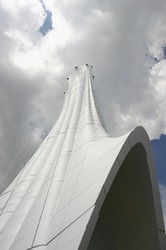
Members of the University of Michigan's architecture faculty are reaching new heights -- literally. Periscope, the 45-foot structure created by full-time faculty member Wes McGee, director of the fabrication laboratory at the Taubman College of Architecture and Urban Planning at the University of Michigan and co-founder of Matter of Design Studio with Brandon Clifford, won the 10UP! National Architecture Competition recently held in Atlanta, Ga. The tower is built almost entirely from recyclable expanded polystyrene, which was cut into approximately 500 unique blocks on the FABLab's robotic hotwire cutting system. Once assembled, the tower is post compressed with a cable network. McGee, who has an industrial design background, explains that since the competition's guidelines were pretty open, his team wanted to take a more experimental approach. The geotechnical foam they used actually serves as infill for building roads. It's recyclable and easy to move, although it took up a surprising amount of space, he adds. "It's actually pretty strong for its weight," he says. "There was foam everywhere in the lab." After he and Clifford developed the concept in April, they didn't hear whether or not their idea had been accepted. They found out with only two weeks to spare, which meant nearly round-the-clock work. "Luckily, classes finished here right at the end of April," he says. They built pieces of the structure, which was then shipped to Atlanta, and assembled it there. McGee says they drew their inspiration for the hollow structure from the look of fabric stretched to make a tent, and knew they wanted to use the lab's robotic cutting tool even before they came up with a design. The proposed projects needed to cost less than $5,000 to create and assemble, in addition to being able to be assembled on site within 24 hours. McGee is interested in entering another competition like this in the future. "We keep a running list of these kinds of competitions," he says. "I don't know if we will build a 45-foot tower, but we are looking at using foam." Source: Wes McGee, faculty member and director of the fabrication laboratory at the Taubman College of Architecture and Urban Planning at the University of Michigan, and co-founder of Matter of Design Studio Writer: Kristin Lukowski

Ann Arbor’s Project Green creates building internships galore

Project Green intended to become a center for green building education in Ann Arbor, but it has also turned into a place for landing an internship in this emerging field.The think tank, run by JS Vig Construction, employs one person from the Taylor-based firm and a handful of interns from the University of Michigan. That staff hosts tours and seminars centered on sustainable building at 157 E Hoover St. in the shadow of Michigan Stadium. It central location just south of downtown has made it convenient for both participants and interns."Essentially, it's on the campus," says Joe Vig, CEO of JS Vig Construction. "It's walkable to Central Campus." That in itself is an environmentally friendly attribute and one that helps facilitate the internship program, which Vig expects to expand later this year.So far 600 people have utilized Project Green's green building resources since it opened in late 2008. Those people include local building owners, architects and engineers, among others. They have participated in classes, seminars and tours that specialize in everything from LEED certification to building retrofits.Vig sees the later as a significant growth area in Michigan, a state that is fighting to rightsize itself and reinvent its economy. Put simply, there will be more demand for cheap existing building stock than creating expensive new construction."There is very little new construction and you have a lot of existing building stock," Vig says. "The average building is 30 years old and not very energy efficient."Source: Joe Vig, CEO of JS Vig ConstructionWriter: Jon Zemke

MASTERMIND: Peter Allen

Whether you agree or disagree with him, developer and U-M prof Peter Allen has had his fingers in many of A2's pies. Concentrate's Constance Crump calls shotgun in his drive through the city and gets a candid view of downtown development.

Dangerous Architects plans to hire 1 in downtown Chelsea

Scott McElrath had been around the building-design block a few times when he started Dangerous Architects 16 years ago.The Chelsea resident had worked for architecture firms across the U.S. and even overseas in Scotland. Then he decided to make the leap into starting his own firm."It seemed like it was time," McElrath says. "I had absorbed enough information from other firms so I could start my own firm."Today Dangerous Architects employs three people and a summer intern or two. One of its interns has turned into McElrath's righthand man as the firm keeps its portfolio diverse with projects in residential, commercial, light industrial and education sectors. McElrath sees work picking up this summer to the point that he expects to a hire someone in the coming months.McElrath decided to name his company Dangerous Architects because he wanted something that stood out. He wanted to break away from the quiet, tree-hugging stereotype of architects and go with something that is a little more emotionally charged."I have a peculiar sense of humor," McElrath says. "I wanted something that might outlive me."Source: Scott McElrath, president of Dangerous ArchitectsWriter: Jon Zemke

New plans surface for Chelsea’s historic livery buildings

A new plan for renovating the historic livery buildings in downtown Chelsea have surfaced thanks to the friends group working to preserve the vacant structures.Downtown Chelsea-based Dangerous Architects has put forward a plan that would turn the livery's three buildings into a mixed-use development complete with space for retail, restaurants and residential. It was the only submission for the the city's request for proposals for the building. The Chelsea Downtown Development Authority, which had once planned to raze the livery, will entertain the proposal on Thursday."The three main buildings are historic," says Scott McElrath, president of Dangerous Architects. "The structures and their foundations are strong. There is no reason to take them down."McElrath proposed turning the original livery building into a non-profit craftsman space on the ground floor. Five to six apartments would go on the roof and underground parking in the basement.The adjacent Daniels and Mack buildings would be turned into groundfloor retail space for a business that has shown interest in the property. The second floor would become restaurant space, complete with a rooftop deck."We do have a tenant interested in both buildings," McElrath says. "That would be out first major tenant and the major income producer that allows us to save the building."McElrath estimates its would cost $1.8 million to renovate the livery buildings so they would be move-in ready. That cost doesn't include acquisition costs.Source: Scott McElrath, president of Dangerous ArchitectsWriter: Jon Zemke

Unique Ann Arbor house turns heads

No two houses are exactly alike in Ann Arbor, and this little cottage is definitely one of a kind.Excerpt:Tim and Cyndy Vachon took a 500-square-foot, single-story, cinder block house, added creative touches that come from being artists and eco-friendly touches that come from being green to create what they call the "Curious House."This whimsical, eclectic and - yes - curious house is hidden behind a stand of trees on South Maple Road near Pauline Road in Ann Arbor. It is a showcase for stone and tile, with leanings toward Arts and Crafts style and a cottage look. But it is also a repository for discarded material that could have ended up in the landfill: A sturdy glass light shade that turned on its head and is used as a bathroom sink, the soapstone kitchen countertops with a rich patina that once served as the tabletops in a chemistry lab of a old Detroit high school and the walnut and oak discarded by relatives used for trim and to make the stairway that leads to the second floor.While the Vachons had the artistic and architectural skills to create the Curious House, they also had the building skills to turn the vision into a house. Except for part of the framing, the drywall and the roof, the couple built Curious House themselves, adding another 1,200 or so square feet to the original structure.Read the rest of the story here.

Our Partners

30044
30045
30046
30047
30049
Washtenaw ISD logo
Eastern Michigan University
Ann Arbor Art Center
UMS
U of M Arts Initiative
Engage EMU
Ann Arbor Housing Commission

Don't miss out!

Everything Ann Arbor and Ypsilanti, in your inbox every week.

Close the CTA

Already a subscriber? Enter your email to hide this popup in the future.