Building Communities

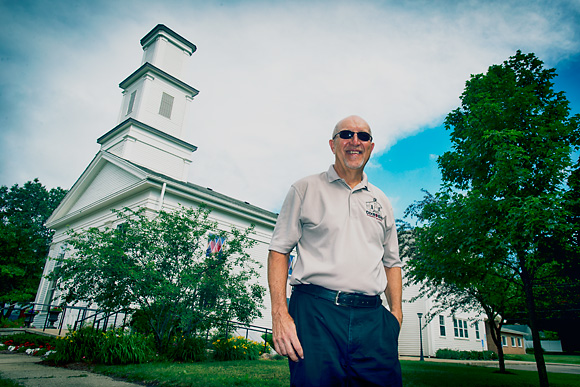
Tom Freeman on the Dixboro Village Green

Growth Without Growing in Historic Dixboro

While there may not be a consensus on what Dixboro is, everyone agrees that the community that surrounds Village Green is quite special. Plans are afoot to restore and enliven the area without changing its unique character. That means moving in small deliberate steps that honor the hamlet's historic integrity.

Latest in Building Communities
Local leaders honored at second annual Regional Transit Awards dinner

With southeast Michigan's Regional Transit Authority underway and M1-Rail about to break ground, a crowd of over 150 transit advocates had considerable cause for a buoyant mood as they strolled the stately gardens and ballroom of the Grosse Pointe War Memorial at Transit Riders United's second annual Regional Transit Awards dinner on May 21st. "Developing a quality regional transit system is a marathon, not a sprint," said Megan Owens, TRU's Executive Director. "It's important to pause and recognize progress, and the people who are making a difference." The Citizen Activist of the Year Award went to Neil Greenburg, whoseFreshwater Railway website depicts a fictional Michigan rail system. Greenberg, a self-taught professional transit cartographer and operations consultant, developed the site to garner support for transit by offering a visual experience of the possibilities. Tools to rally public support are needed now more than ever, according to Greenberg. "It's too early to say 'Mission Accomplished'," he said.  "We are at the beginning, not the end." Michele Hodges, who until recently served as Executive Director of the Troy Chamber of Commerce, won the Corporate Transit Champion Award forengaging business, education, and labor leaders in the successful fight against former Troy mayor Janice Daniel's attempt to reject federal funding for the Troy Transit Center. The Unsung Hero Award went to former legislator Marie Donigan, who worked to establish the RTA and make state laws and funding sources friendlier to transit. Donigan continues her transit advocacy work, recently helping to coordinate a 2-day Metro Detroit Transit Workshop. Dennis Schornack, Senior Strategic Advisor to Governor Snyder, won Most Effective Public Servant Award for his work shepherding the RTA legislation through the political process. A Transit Employee of the Year Award went to Detroit Department of Transportation bus driver Michael Childs, who was nominated by a rider for being on-time with a big, welcoming smile every day, despite an increased workload owing to recent cuts in DDOT funding and service. Ann Arbor Transit Authority's new AirRide program, which now provides daily round-trip service between Ann Arbor and Detroit Metropolitan Airport, won the Exemplary Innovation Award. The TRU board sprung two surprises: a Transit Opportunities Award for the entire RTA Board, and an Above and Beyond Award for Owens for her work at TRU. Winners were selected by a panel of 4 judges, including Clark Harder, former legislator and Michigan Public Transit Association Executive Director, Heather Carmona, chief administrative officer of M1 Rail, Sue Zielinsli, managing director of Sustainable Mobility & Accessibility & Research & Transformation at the University of Michigan, and Polly Sedewa, transit activist and past TRU board member. Writer: Nina Ignaczak 

Reimagine Washtenaw seeks feedback on future of Washtenaw Ave.

It's no secret that things are happening on Washtenaw Ave. From the forthcoming Arbor Hills Crossing shopping center to new pedestrian walkways, the corridor between Ann Arbor and Ypsilanti is in the midst of a transformation. With these changes in mind, the multi-jurisdictional land use planning and public transit initiative, ReImagine Washtenaw, wants to get public feedback on the future of the avenue. "We want the public to review various corridor cross-section alternatives and give us their preference," says ReImagine Washtenaw Project Manager Nathan Voght. "We’re also asking for feedback on best locations for mid-block pedestrian crossings, and where other pedestrian safety enhancements may be needed." The initiative is already involved in multiple projects to make Washtenaw Ave. friendlier to pedestrians and bicyclists and addressing traffic congestion and land use issues. Based on feedback from the public forums scheduled this month, future projects could address traffic congestion with a boulevard, a “road diet” or other variations. Voght says knowing what the public wants Washtenaw Ave. to be like will help ReImagine Washtenaw partners know how to act when the time is right. "When MDOT funding becomes available, they will have a strong sense of what the community wants for the corridor," says Voght, "and we’ll be able to work quickly and efficiently to develop construction drawings for the work that achieves our goals."  The public forums will take place on May 28 and 29 at the Washtenaw County Service Center, May 30 at Carpenter Elementary School, and May 31 at EMU's McKenny Union. Additional details are available at: washtenawavenue.org.  Source: Nathan Voght, Washtenaw County Writer: Natalie Burg

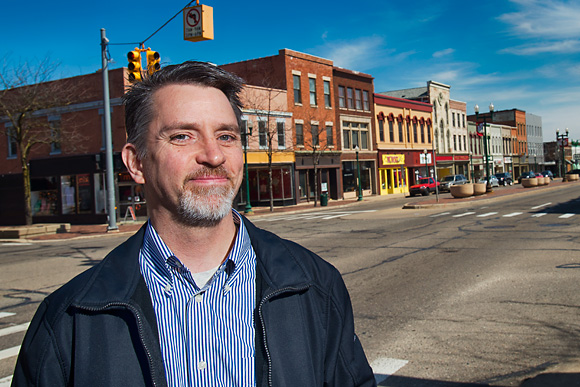
Tim Colbeck in downtown Ypsilanti
Guest Blogger: Tim Colbeck

After makeovers from Depot Town to Michigan Avenue, Ypsilanti is rebuilding and renovating its core. And the march continues. Ypsilanti DDA director Tim Colbeck discusses what else he'd like to see in terms of a more perfect downtown.

How to turn city-owned properties into downtown residences

In a terrific opinion piece, former dean of architecture and urban planning at U-M Doug Kelbaugh lays out an ambitious but achievable plan for greater residential density in Ann Arbor's downtown. Check it out! Excerpt: "There are other benefits of downtown living, such as the fiscal bounce to the city, which can more easily provide municipal services, as well as maintain a more compact infrastructure. There's a less automobile dependence and higher transit ridership, which cuts AA's energy/carbon footprint and reduces traffic. And there's a vibrant sidewalk life, for all ages and tastes, supporting and feeding off of downtown culture and commerce while building a cosmopolitan community. So, for starters, the city should prioritize residential development over office space on these four lots. We have plenty of workers downtown — too many come the 5 o'clock rush hour! - but not enough permanent residents. We need as broad a demographic mix as possible — rich, poor and in-between, with a healthy ethnic, racial, age and size mix of households — and, like central cities the world over, some families with children. Downtown can be a 24/7 neighborhood as well as a central business district." Read the rest here

What makes for a successful park?

Writer Kevin Klinkenberg looks into why some parks are successful and others are woefully (or ipappropriately) used. The short answer: Location, location, location. Excerpt: "Integration with the surrounding streets and buildings. While Forsyth is bounded by two streets on the east and west that are one-way, and have traffic that generally moves far too fast, the streets themselves are not wide. This makes them easy to cross for pedestrians, in spite of the high traffic speeds. And, around the park are located small businesses, hotels, bed and breakfasts in addition to the many residences. The park does not feel as though it’s set apart from the neighborhood – it feels as though it’s distinctly part of the neighborhood." Read the rest here.

Ypsi rain garden showered with attention

Rain gardens that are part of a project to remake Ypsilanti's Depot Town are undergoing some additional work to make sure they look good, function properly, and most importantly last. Tim Colbeck, executive director of the Ypsilanti Downtown Development Authority, says there have been questions and concerns about the Cross Street Rain Gardens and what's going wrong with them. The five gardens are a small part of a $1 million streetscape upgrade for the area, but an important one. They are also a component of the Cross Street Corridor Non-Motorized Enhancement Project Some of the plants have had trouble surviving and the gardens haven't fully absorbed stormwater to keep it out of drains - the purpose of their design. Recent declines in rainfall may be part of the issue. However, the Ypsi DDA, the city and the state of Michigan are working with contractors to make things right by adjusting the inlets to each garden to ensure that they have the proper soil mix. The new and improved rain gardens should be completed by the fall of 2012. Source: Tim Colbeck, executive director, Ypsilanti Downtown Development Authority Writer: Kim North Shine

Can density decrease traffic congestion?

Propose a building over three stories and what's the typical response? "Oh, the traffic!" Plantizen blogger Todd Litman points to an Arizona study that shows greater density can actually reduce traffic congestion. Excerpt: "There is plenty of evidence that land use factors such as density, mix and road connectivity affect the amount people travel. However, the study made an important additional discovery. It found that roadways in more compact, mixed, multi-modal communities tend to be less congested. This results from the lower vehicle trip generation, particularly for local errands, more walking and public transit travel, and because the more connected street networks offer more route options so traffic is less concentrated on a few urban arterials. This contradicts our earlier assumptions." Read the rest of the story here.

When the 1 percent become NIMBYs

From affordable housing to density to bike lanes to public transit, Salon's Will Doig offers an interesting view on how privilege often leads to NIMBYism and roadblocks community progress and sound public policy. Excerpt: "From bike lanes in Brooklyn to desperately needed housing in D.C., public micromanagement has become such a problem that several cities are now trying to rein in the Not-In-My-Backyard crowd. “The current process does not work for anyone,” one urban design expert told the San Francisco Chronicle. “We want the Planning Commission to focus on big planning issues, not micro-design issues.” How tiny bands of refuseniks and wealthy obstructionists absorbed so much power provides instructive lessons for how they might be stopped." Read the rest of the story here.

Work at EMU? Get up to $10K to live in Ypsi

Much like a Wayne State program that's found success in Detroit, EMU is trying to persuade some of its full time employees to buy a home in Ypsilanti by offer sweet loan deals. Excerpt: "The Live Ypsi program, which is currently being finalized and will likely be announced later this month, will use EMU, Washtenaw County government and DTE Foundation resources to offer forgivable loans to full-time faculty and staff who purchase a home in the Ypsilanti area. Officials say loans will likely range from $5,000 to $10,000 per individual. For each year that the homeowner lives in the Ypsilanti area and maintains employment at EMU, 20 percent of the loan will be forgiven. After five years, the loan will be completely forgiven." Read the rest of the story here.

Our Partners

30044
30045
30046
30047
30049
Washtenaw ISD logo
Eastern Michigan University
Ann Arbor Art Center
UMS
U of M Arts Initiative
Engage EMU
Ann Arbor Housing Commission

Don't miss out!

Everything Ann Arbor and Ypsilanti, in your inbox every week.

Close the CTA

Already a subscriber? Enter your email to hide this popup in the future.