Technology

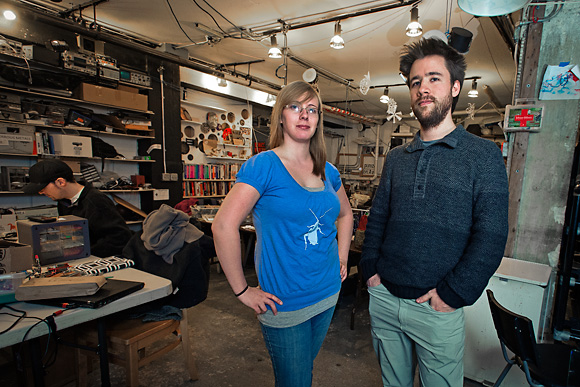
Dana Nelson and Josh Williams at All Hands Active Makerspace, Ann Arbor

Hands on deck for All Hands Active

Hackerspaces, makerspaces, whatever you call them, they're pretty dang cool. All Hands Active churns out high, low and in-between tech inventions in downtown Ann Arbor, accomodating everyone from kids to start-ups. Concentrate's Tanya Muzumdar descends into their subterranean lair to get the low down.

Latest in Technology
Evigia has 80% growth, looks to expand wireless product lineup

Evigia grew its revenue by 80 percent and hired two new people in 2012, setting the stage for more of the same this year. The Ann Arbor-based company develops and creates wireless sensing products. Its EV3 platform delivers smaller-size, higher energy efficiency and lower-cost products which allow significant improvement in the performance and cost of wireless sensing networks. "We are projecting about 80-90 percent growth," says Navid Yazdi, CEO of Evigia. "We expect to hire another 5-6 people." Evigia's sales are being driven by industrial firms and companies looking to better manage workflow and inventory. Yazdi wants his company to become one of the larger players in these markets and more. Evigia is planning to expand its client base to more businesses in the chemical and energy industries. "That will increase our growth," Yazdi says. "We are also in the process of introducing new products in late 2013 and early 2014." Source: Navid Yazdi, CEO of Evigia Writer: Jon Zemke Read more about Metro Detroit's growing entrepreneurial ecosystem at SEMichiganStartup.com.

Pinoccio works to commercialize micro-controller tech

Pinoccio is looking to raise some seed capital in a new way, crowd funding. The Ann Arbor-based start-up has launched an Indiegogo campaign to raise $60,000 to produce its new microcontroller technology and the company is nearly halfway there. "We're in a state now where we feel good about reproducing them," says Sally Carson, co-founder of Pinoccio. "We just need the funding to do that." Pinoccio is developing a wireless, web-ready microcontroller with WiFi, LiPo battery and built-in radio. This technology allows users to send commands to the microcontroller, about the size of your thumb, from their laptop using the Internet. Carson and Eric Jennings began developing this technology about six months ago. They choose to base the company in Ann Arbor because Carson's husband is pursuing a PhD in biology at the University of Michigan. They hope to raise the $60,000 from the Indiegogo campaign by Valentines Day and have raised $25,000 as of Tuesday. "I'd like to see this become a sustainable business," Carson says. "I am excited to see what people build with Pinoccio. It's exciting to build a tool and see what clever and smart people build with it." Source: Sally Carson, co-founder of Pinoccio Writer: Jon Zemke Read more about Metro Detroit's growing entrepreneurial ecosystem at SEMichiganStartup.com.

For art house movie theaters going digital can mean do or die

The move toward digital projection has mostly taken hold in cineplexes around the country, but what about art houses and vintage historic theaters? There, the transition hasn't always beena smooth one. The Michgan Theater's Russ Collins weighs in in a recent article on the topic. Excerpt: "It's a paramount moment for the industry. The National Association of Theater Owners calls the transition to digital the most important change since the invention of talkies. That late-1920s revolution, coupled with the Great Depression, killed theaters for much the same reason that digital threatens -- cost. "Most people are going to figure out a way to do it," said Russ Collins, director of the Michigan-based Art House Convergence, an organization of independent community theaters. "And there are probably going to be some very tragic stories. Change causes those things."" Read the rest here.

Cataphora lands $300K MEDC grant, plans new jobs, larger Ann Arbor office

California-based software firm Cataphora, Inc. will be putting the proceeds of a $300,000 Michigan Business Development Program performance-based grant from the Michigan Economic Development Corp. (MEDC) to work at expanding its Ann Arbor headcount and office space. The company provides tools for the analysis of digital communications and documents in large organizations to help employers understand characteristics and define trends. "We intend on spending approximately $200,000 and creating 30 new jobs over the next few years," says Chris Kurecka, manager of the Ann Arbor office. Cataphora has three employees in an office at 500 E. Washington St. in downtown Ann Arbor, but is looking to move to a larger space in or near downtown during the first half of 2013, according to Kurecka. He is searching for a new office within a several-block radius of State Street, near the University of Michigan campus. About 25% of Cataphora's employees are U-M grads, Kurecka says, and the company has an internship program. "Having that proximity to campus really helps us because we don't want students figuring out how to drive five miles or take a bus or whatever, necessarily, to get to work," Kurecka adds. Source: Chris Kurecka, Ann Arbor office manager, Cataphora, Inc. Writer: Tanya Muzumdar

Kymeira leverages Accelerate Michigan win for product development

Kymeira is finding a number of ways to leverage its win at the student competition for the Accelerate Michigan Innovation Competition. Kymeira is developing a new chemistry for ceramics, which brings the benefits of existing advanced ceramics to new parts and markets. It took $25,000 in seed capital to its Ann Arbor home after winning at Accelerate Michigan, but that's not the only thing it walked away with. "We had an extremely positive experience in terms of meeting possible investors and other parties who are potential customers and mentors," says David Hatfield, new business development director for Kymeira. The technology coming from Kymeira was developed over the last three years. The start-up launched in September of this year and now employs a team of four people. The company plans to use its Accelerate Michigan winnings and other amounts of seed capital to continue product development and line up its first customers. "We're trying to get our first sale by next fall," Hatfield says. Source: David Hatfield, new business development director for Kymeira Writer: Jon Zemke Read more about Metro Detroit's growing entrepreneurial ecosystem at SEMichiganStartup.com.

Guest Blogger: Larry Eiler

Michigan has always been ground zero for cutting-edge engineering. And with the technological sophistication of today's auto industry, that fact couldn't be truer. Larry Eiler, CEO of Eiler Communications, thinks the state could do a much better job of telling the world that story.

Echo360 acquires U-M spin-out LectureTools, grows staff

Echo360, a Virginia-based educational technology company, has acquired LectureTools and plans to continue growing the start-up in Ann Arbor. LectureTools' technology is working to reinvent the software programs used for educational materials, such as course packs, handouts and quizzes. It was originally developed at the University of Michigan and spun out of the university two years ago. The company now employs five people and an intern. Details of its acquisition were not released but it does appear the start-up will stay rooted in its downtown Ann Arbor office. Echo360 specializes in educational learning tools and plans to use LectureTools' technology not only in its own software but also to build up the brand independently. "One of the reasons we were acquired is so we can build it out to our true vision quickly," says Jason Aubrey, co-founder of LectureTools. "We're also building it out with Echo360s products." Aubrey expects to begin really scaling LectureTools technology in January. The company recently hired one person in customer development and is looking to hire two more people in design and user-experience. Source: Jason Aubrey, co-founder of LectureTools Writer: Jon Zemke Read more about Metro Detroit's growing entrepreneurial ecosystem at SEMichiganStartup.com.

AMF-Nano leverages microloan to help commercialize tech

A small Ann Arbor-based bio-tech start-up recently received a little infusion of cash, with which it expects to make a big splash next year. AMF-Nano recently received financing from the Michigan Microloan Fund, where the microloans usually average about five figures in size. The 3-year-old start-up plans to use that money to continue the development of its innovative nano sensor that could help detect heart attacks and be implanted in pacemakers. "There is a need for instruments to be smaller, cheaper and better for the human body," says Rakesh Kapragadda, president & chief scientist of AMF-Nano. The two-person team is working out of the University of Michigan's Kellogg Eye Institute where it is developing a smart sensor system. That system could be used by cardiac patients to help self-monitor their own heart for signs of heart attacks instead of habitually visiting medical centers for checkups. Another version of the platform could be used in pacemakers. "All of the funds will go toward the commercialization of these technologies at the University of Michigan," Kapragadda says, adding he expects his start-up to commercialize the technology within six months. Source: Rakesh Kapragadda, president & chief scientist of AMF-Nano Writer: Jon Zemke Read more about Metro Detroit's growing entrepreneurial ecosystem at SEMichiganStartup.com.

OcuSciences grows team as it pushes toward commercialization

OcuSciences is growing its product portfolio and its staff in Ann Arbor, leveraging its ocular test for diabetes technology. The Ann Arbor-based start-up, a University of Michigan spin-out, is developing an ocular diagnostic technology for metabolomic diseases that allows doctors to diagnose patients with diseases like diabetes by scanning their eyes. The process has the potential to be more accurate and catch a diabetes diagnosis much earlier than traditional methods. The 4-year-old company is already selling the high-end version of its product (retails for $115,000) and is preparing to sell the lower-cost version of it ($30,000-$35,000) before the end of this year. "That will be a high-volume device," says Kurt Riegger, CEO of OcuSciences. The company has hired two people over the last year, expanding its staff to eight people. That could grow again as it continues to spin-out more versions of its principal technology. OcuSciences conducted a clinical trial for a new version of its technology that can work with therapy for Dry Age Related Macular Degeneration, which can cause blindness in older people. The firm is currently conducting two, two-year clinical trials on the technology with an international partner that Riegger declined to name. If the therapy proves effective, Riegger hopes it will prove to be a viagra for the eye by helping it improve delivery of nutrients to the eyes and removal of waste products from it. "We hope we can slow and reverse this disease if we can catch it early enough," Riegger says. Source: Kurt Riegger, CEO of OcuSciences Writer: Jon Zemke Read more about Metro Detroit's growing entrepreneurial ecosystem at SEMichiganStartup.com.

Our Partners

30044
30045
30046
30047
30049
Washtenaw ISD logo
Eastern Michigan University
Ann Arbor Art Center
UMS
U of M Arts Initiative
Engage EMU

Common Ground Is Brewing

Support local stories and receive our signature roast straight to your door when you join at the Standard level (or above).

Drink Better, Read Local

Close the CTA

Don't miss out!

Everything Ann Arbor and Ypsilanti, in your inbox every week.

Close the CTA

Already a subscriber? Enter your email to hide this popup in the future.