
Ann Arbor DDA expands its boundaries for first time, enabling new projects on city’s North Side
The goal of the Ann Arbor Downtown Development Authority’s expansion is to strengthen connections between downtown, the Huron River, and Ann Arbor’s North Side.
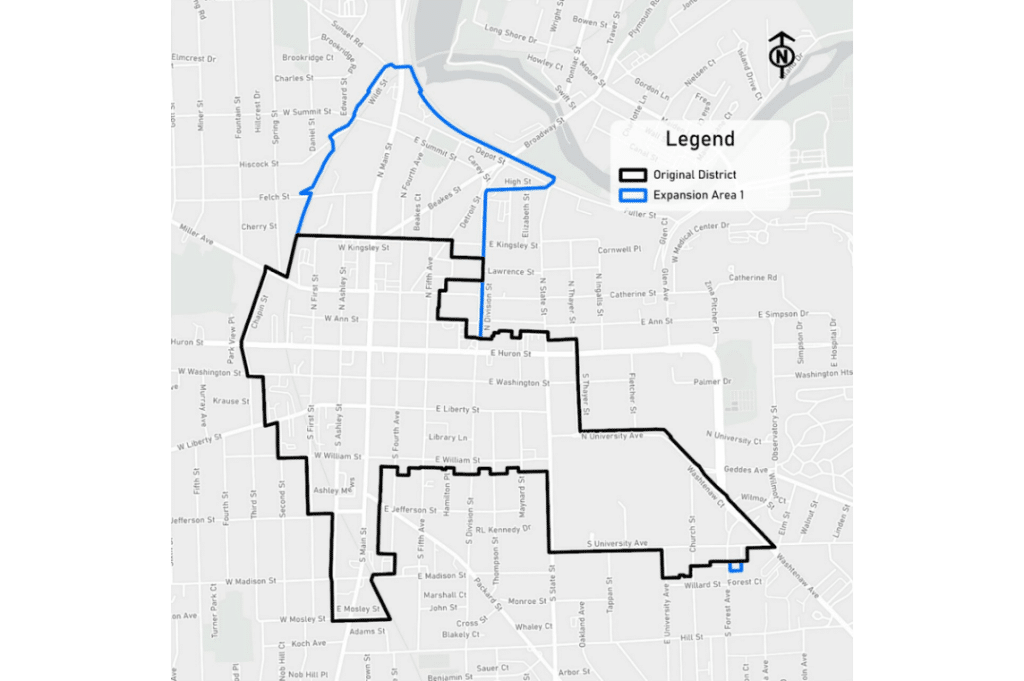
On April 20, Ann Arbor City Council unanimously approved the Ann Arbor Downtown Development Authority’s (DDA) updated development and financing plan, allowing the DDA to expand its work further into Ann Arbor’s north side. The decision extends the DDA’s boundaries from Kingsley Street to include 19 blocks north of downtown Ann Arbor, with the new northernmost boundary being the intersection of Sunset Road and North Main Street. The goal of the expansion is to strengthen connections between downtown, the Huron River, and Ann Arbor’s North Side. The decision also allows the DDA to be involved in improving North Main Street and the Broadway Bridge, two important downtown gateways.
“We have had the same boundaries since the DDA was established 44 years ago,” says DDA Executive Director Maura Thomson. “That was really kind of a momentous occasion for us.”
The DDA started working on the new development plan in 2023, with consideration given to multiple city planning efforts such as the city’s Comprehensive Land Use Plan, the A2Zero Plan, the Ann Arbor Moving Together Towards Vision Zero Plan, and TheRide’s 2045 Long Range Plan. Input from downtown stakeholders and public feedback was also invaluable. Thomson is looking forward to similar support and public engagement in the future.
“It’s from 2026 through 2055, so really this plan is the DDA roadmap for the next 30 years,” Thomson says. “We look at this as our commitment to our community on how we will focus our dollars into the future.”
The new plan will roll out in phases with an eye toward the next 10 years. Overall, there are 150 plans and programs, with 38 falling within the DDA’s expanded borders.
Starting in 2027, one of the first initiatives under the new plan will be extending the existing two-way bike lane on Division Street that ends at Catherine Street. Thomson says the DDA will begin public engagement on that project by the end of this summer.
Another early initiative will be a redesign of North Main Street. A public design workshop is planned this month as a follow-up to earlier engagement.
“We’re now able to participate in that project in a more meaningful way,” Thomson says. “We had a series of public meetings and heard concerns about the corridor. The design workshop is the follow-up where our consultant team will be coming back with some initial design concepts.”
Thomson also hopes to see near-term traction at 721 N. Main St., the former city yard that is currently an empty, contaminated site.
“We will be remediating that site, landscaping it, and putting a trail through it,” she says. “So really turning an empty site that’s kind of an eyesore into an amenity for the North Main Street neighborhood.”
She is also excited that the DDA will be able to participate in the Fifth and Division Two-Way Restoration and Bus Rapid Transit plan.
“That includes a reconfiguration of the Broadway interchange, which is a dangerous, messy section of road right now. It’s a very complex project,” Thomson says. “We would definitely be taking this project on with partners. But it’s a project that, without the DDA’s participation, would not get off the ground, at least in the short term.”
Supporting the city’s work to reimagine the Ann Arbor Farmers Market is another priority. There will be a year-long community visioning process with a study phase anticipated to start this summer.
“We have an estimated $13 million in our plan that we will be able to contribute to that redesign,” Thomson says. “So our impact will be significant.”
Thomson says the DDA’s new plan will focus on “catalyzing, enhancing, and promoting core Ann Arbor values of affordability, equity, and sustainability.”
“Downtowns are vulnerable and always evolving,” Thomson says. “Having an agency that is focused only on the vitality, strength, and vibrancy of the downtown is critical to supporting a downtown into the future.”
Author

Related Articles
Washtenaw My Brother’s Keeper hosts annual gala on Sunday
The nonprofit’s fourth annual gala will be held Sunday, Oct. 18, at EMU’s Student Center Ballroom, with the theme Keepers & Kicks.
Michigan Folk School holds annual Folk Festival with free demonstrations of traditional skills
The Michigan Folk School holds its free annual Folk Festival on Saturday, Oct. 17, at Staebler Farm County Park.
State of the Arts program brings U-M faculty artists to communities across the state
U-M’s State of the Arts program, launched by the Arts Initiative, aims to bring meaningful experiences in the arts to communities around the state.


