
As AAPS union contract negotiation continues, students and teachers feel mental health impacts
Ann Arbor Public Schools teachers have been working on an expired contract this year, causing stress, confusion, and frustration in students and teachers alike.
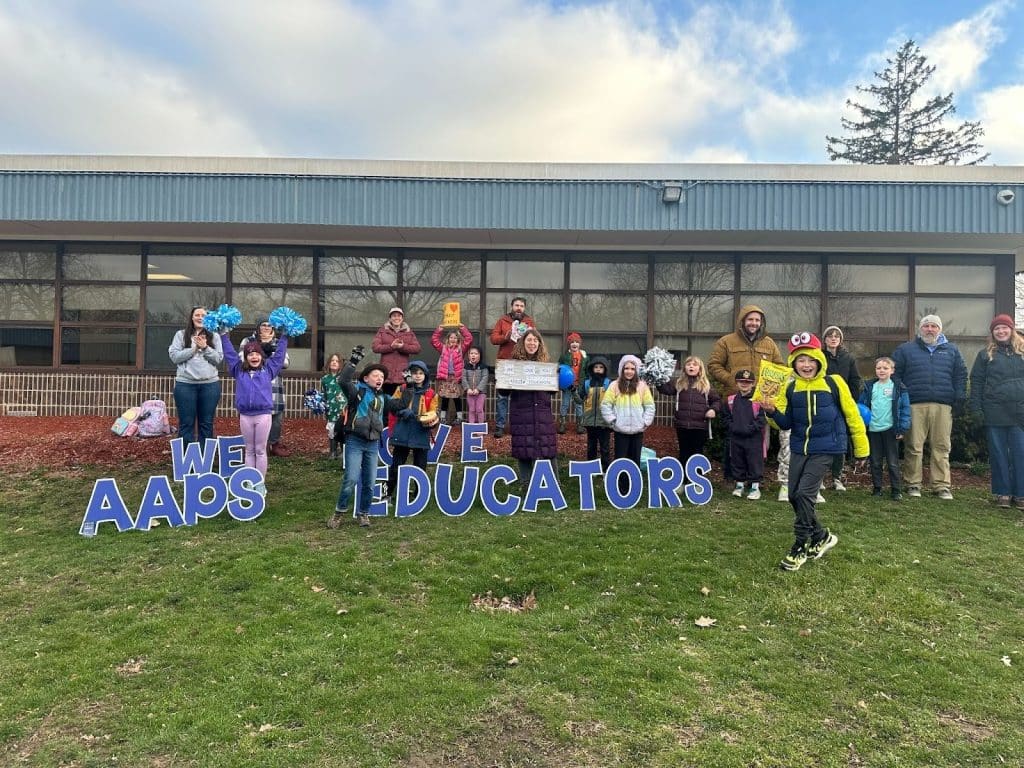
This article is part of Concentrate’s Voices of Youth series, which features stories written by Washtenaw County youth with guidance from Concentrate staff mentors, as well as adult-written stories spotlighting local youth perspective. In this installment, student writer Anna Birchok reports on the mental health impacts of teachers’ union contract negotiations in Ann Arbor.
“One of the first lessons I learned in school is that just because something is difficult doesn’t mean it is not worth doing. So I am asking you: choose what is right, not what is easy. Show us that the people who shape our lives matter.”
These were the words of Community High School sophomore Sadie Palay during an Ann Arbor Public Schools (AAPS) board meeting on March 25. Palay was speaking in support of her teachers, who have been working on an expired contract since the start of the new year. The issue has caused stress, confusion, and frustration in students and teachers alike.
Since the contract expired, the AAPS teachers’ union (AAEA) has urged members to only do work within their contract. This means that many “extra” activities, such as clubs and extracurriculars, have been paused. Additionally, teachers work only within contracted hours rather than putting forth extra effort for their students as many often do.
Sarah Richards, a licensed master social worker and mental health practitioner at Ananda Wellness in Brighton, notes that many AAPS teachers may be going through moral injury, a concept where people go against their values to help what they believe to be the greater good.
“It’s when you have to make a choice that goes beyond your own value system and beliefs,” Richards says. “I think in a lot of ways, adults want to do what’s best for the kids, even if that means that they’re sacrificing something that could be for the greater good of educators in general. But [right now AAPS teachers] have to make choices that go against their own values and moral code. ”
Additionally, as teachers don’t work outside of contracted hours, they have been unable to plan classroom lessons and activities to the extent they had before. The lack of extra time can impact teachers’ mental health.
“Teachers work well before and after their prep hour. The absence of that has really exacerbated the issue of consistency,” Richards says. “They are striving for things that can help them feel grounded, and when there’s a disruption in that, it can definitely impact emotional and physical well-being.”
When asked about the lack of a teachers’ contract, the AAPS communications department responded with the following statement:
“We want to provide competitive wages to attract and retain high quality employees while remaining fiscally responsible to preserve the overall long term health of the district.
Until a new contract is reached, our educators and staff remain covered under the terms of the most recent contracts, as required by law. The current AAEA collective bargaining agreement includes provisions for compensation for after school events and clubs.
The Ann Arbor Public Schools will continue bargaining with all employee groups in good faith.”
In recent weeks, concerned community members have shown up to school board meetings as they continue to see a lack of change in the district. Many students, as young as elementary school-age, take the time to talk about the impact the issue has made on their mental health, education, and community.
For Palay, the lack of a contract has created a stressful school environment. As teachers work within contracted hours, she receives less help and it’s taken longer for her to receive grades on her work. As Palay struggles with anxiety, these slight differences have created added pressure and concern for herself and students similar to her.
In the speech she made on the 25th, Palay highlighted the importance of her teachers’ work and the differences they have made in her life. She urged the district to support teachers and negotiate for a fair contract.
“I really tried to bring my heart out at the school board meeting because I meant every word of it,” Palay says. “It has been really difficult because I can see how hard my teachers are trying and how much it has been affecting them. What is happening isn’t fair at all.”
While they may not understand the complexity of the issue, younger students have also noticed changes within their schools.
Elementary-aged students have lost formative experiences such as field day, kindergarten round up, and after-school activities. For students too young to make sense of what’s happening, they notice differences in school and are left wondering why their teachers are stressed or tired.
Families have noticed trends of AAPS educators leaving the district as a result of the situation. For kids, it is harder to build a community of trust.
“School is a subset of what it’s like to be in a community, and you seek that mentorship, that guidance, the presence of those trusted adults, and in the absence of that, it makes it harder to feel like you’re connected to something,” Richards says. “That can just lead to feeling anxious for younger kids, but it might not come out as anxiety. In the absence of words to say ‘I don’t feel comfortable here,’ or ‘I don’t feel like I have a connection,’ they might feel it in their bodies more than able to articulate it.”
Richards says that anxiety in kids can come out in physical ailments such as stomachaches, headaches and not wanting to go to school. All of these can impact a child’s wellbeing and development, making school feel like an unsafe space.
Becca Hogan, an Abbot Elementary parent and mom of three, has been trying to stay involved at AAPS as she learns about the issue.
One morning, when Hogan told her third grader they were going to school early so they could hold up signs and cheer on her teachers, her daughter asked why.
“They’re working without a contract right now because the district has not been bringing fair negotiations to the table,” she explained. “So teachers are unfortunately not able to do everything they wish that they could do, and we want to show them that we really care, support, and appreciate everything they do.”
Hogan finds it important to start having conversations about such topics as her kids get older so they can better understand what’s happening around them.
“It is really important to build civically engaged kids and adults, who understand unions, the power of unions, the purpose of unions, and collective unity behind them,” Hogan says.
Pioneer High School senior Sam Hunter has noticed change in his school after the exclusion of club days. Hunter leads Club Opportunity, a club where upperclassmen are paired with freshmen to mentor and support them throughout the year. This allows newer students to feel acclimated to the school and bond with others they can trust.
The club makes a difference to many students – mentors and mentees alike. Since the club was paused, Hunter has been constantly approached by students voicing their concerns and asking when they will meet again.
“I’ve seen the worry and frustration,” Hunter says. “Upperclassmen mentors haven’t been able to provide guidance, which undoubtedly is going to add more stress and confusion to students.”
As of April 14, 2026, AAEA and AAPS had signed a tentative agreement. However, after a lack of support from the AAEA, 99.6% of union members voted the contract down. Hunter spoke at a school board meeting in early March about the continuing impact of the stoppage on students.
“Everyone has been noticeably more stressed due to club days not being in effect anymore,” Hunter says. “Whether it’s not having a mentor to lean on, not being able to participate in hobbies, or worrying about activities for college, every student in AAPS is feeling the effects of the stoppage.”
Concentrate staffer Patrick Dunn served as Anna’s mentor on this article.
To read more from the Voices of Youth series, click here.
Related Articles

Washtenaw County school to host new free pre-kindergarten program
A new free pre-kindergarten program will be available to 15 3- and 4-year-olds in the Washtenaw Intermediate School District (WISD) this school year.
Why early childhood belongs on every Michigan voter’s ballot
Why Michigan voters should pay attention candidates’ stands on childcare and early learning.

WCC rolls out new Mobile Classroom for offsite learning
Washtenaw Community College is taking its classes beyond traditional campus borders this summer with a new project: a 48-foot-long mobile unit called the Mobile Classroom.


