
Washtenaw County economic outlook report forecasts measured growth despite national and global risks
A new economic outlook report forecasts that Washtenaw County’s economy will see continued, measured growth through 2028.
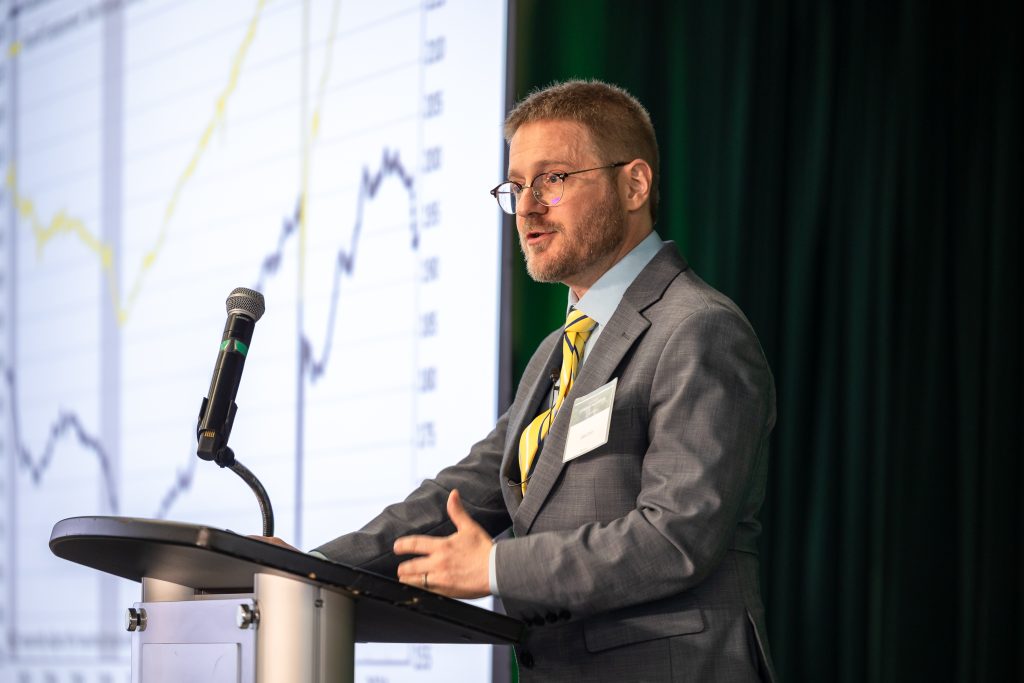
A new economic outlook report released at Washtenaw Community College’s (WCC) President’s Leadership Recognition Luncheon last Friday forecast that Washtenaw County’s economy will see continued, measured growth through 2028.
The 41st annual Washtenaw County Economic Outlook was presented by economists from the University of Michigan’s (U-M) Research Seminar in Quantitative Economics (RSQE). The report highlighted that in the face of risks, such as the war in Iran and ongoing trade and funding concerns, the region is cushioned by a strong local economy.
“I would say the news is not as positive this year. It’s not bad. But what I would say is the data for 2025 honestly paints a little bit of a mixed picture,” says RSQE Director Gabriel Ehrlich.
Ehrlich, who presented the report with economist Donald Grimes, adds that the county’s economy has hit “a little bit of a soft patch.”
“Not that the bottom is falling out or anything like that. I think it’s to be expected, because we had a tough environment last year,” he says.
He stresses that the county is fortunate to have a very knowledge-intensive industry mix, thanks to institutions like U-M, Eastern Michigan University, Michigan Medicine, and WCC.
“The funding situation for university-based research was tough last year. The outlook for higher ed is a little bit tough in terms of funding, and as we look forward, the funding landscape for health care is also looking a little tough,” Ehrlich says. “I think that’s part of why it’s been a little bit of a tougher time for Washtenaw County this past year.”
Local government and private higher-education services account for approximately 70% of the county’s gross domestic product (GDP) and are expected to drive much of the job growth through 2028. By contrast, those sectors account for 50.6% of Michigan’s overall GDP.
By 2028, the county’s unemployment rate is expected to fall to 4.1%, about 1% below the projected state average.
“That’s pretty solid, all things considered,” Ehrlich says.
The report also spotlights that real wages in Washtenaw County remain “a bright spot,” with a projection of $76,600 by 2028 – about 8.2% above the state average. Cost-of-living-adjusted wage growth, however, is a concern.
“Historically, Washtenaw County has been a high-wage county, but when we adjust for the local cost of living, we’ve been seeing that advantage start to be eroded,” Ehrlich says. “… It’s a statewide trend. Michigan is not keeping up in terms of wages with the United States economy.”
Ehrlich says he always strives to emphasize that investing in a highly educated workforce is one of the ways to boost wages in the local economy.
“That’s something that we’re fortunate to have in Washtenaw County. Education really is one of the ways we know to provide people a pathway to higher wages,” he says. “I know that people kind of know that, but we see it in the numbers, too.”
The report also makes a noteworthy prediction that the local labor force will reach just over 209,000 residents in 2028.
“That would take Washtenaw County’s labor force to an all-time high,” Ehrlich says. “It’s encouraging to see that we are continuing to grow the pool of potential workers.”
Ehrlich feels that, overall, the report is “cautiously optimistic.”
“When we look at the county economy, I think most places in America would love to switch places with us,” he says.
Author

Related Articles

Why early childhood belongs on every Michigan voter’s ballot
Why Michigan voters should pay attention candidates’ stands on childcare and early learning.
On-Demand Coaching helps Ypsi’s government and small businesses build a winning team
A Michigan Municipal League program helps Ypsi and other municipalities connect small businesses and entrepreneurs with existing capital and technical assistance.
Ann Arbor DDA expands its boundaries for first time, enabling new projects on city’s North Side
The goal of the Ann Arbor Downtown Development Authority’s expansion is to strengthen connections between downtown, the Huron River, and Ann Arbor’s North Side.


