What’s new at Growing Hope
It’s been a busy year for the nonprofit, with expansions of existing programs, farm updates and renovations, and several awards for the organization.
On the Ground Ypsilanti is an “embedded journalism” program covering the city and township of Ypsilanti. It is supported by Ann Arbor SPARK, the Center for Health and Research Transformation, Destination Ann Arbor, Eastern Michigan University, Engage @ EMU, Washtenaw Community College, Washtenaw County Parks and Recreation Commission, and Washtenaw ISD.
It’s been a busy and productive year for the Ypsilanti-based food justice nonprofit Growing Hope, with expansions of existing programs, updates to the farm, renovations to its incubator kitchen, and several awards recognizing the organization for its many contributions. On top of all these changes, the organization has also found time to focus on advocacy work.
In September, Executive Director Julius Buzzard received the inaugural Cunningham-Limp Washtenaw County Community Builder Award at the Ann Arbor SPARK FastTrack Awards and was named a 2026 awardee of the Young Gifted & Green 40 Under 40 award, which recognizes people working at the intersection of land, policy, and community power. Growing Hope is also a finalist for the Michigan Sustainable Business Forum Michigan Sustainable Business of the Year in the community organization category. Winners will be announced on Nov. 4 in Grand Rapids.
In the meantime, Growing Hope’s Youth & Schools program has continued to flourish.
“This year, we have new partnerships with schools and a growing partnership with Lincoln Consolidated Schools, in addition to Ypsilanti Community Schools. We’ve been working with gardening clubs at the schools. We also had a teen elected to our board,” says Buzzard.
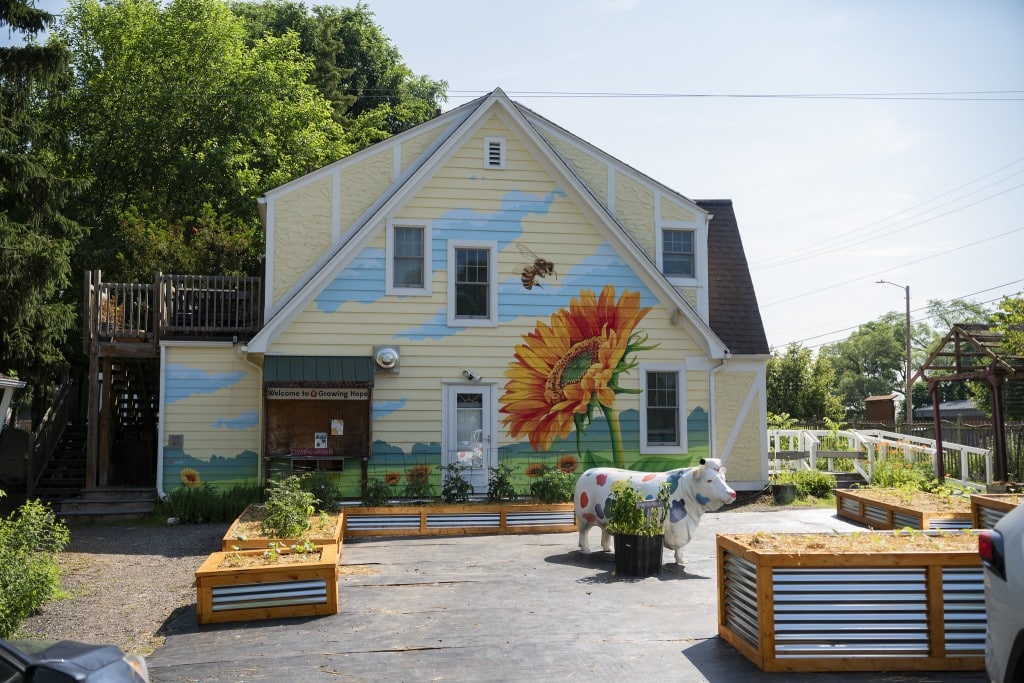
Growing Hope’s farm on Michigan Avenue has seen physical changes, too.
“We’ve been remodeling the sharing garden area at the front of the farm,” says Buzzard. “This is where people can harvest what’s available.”
The organization has added raised beds and increased accessibility by improving access from the sidewalk.
“We want people to come and harvest,” Buzzard says.
In addition, the outdoor kitchen area is being expanded to better function as a gathering space as well as a place for cooking lessons.
“The farm as a whole is a community space where we welcome people in and engage with them,” says Buzzard.
At the same time, the community composting program is also continuing to grow, with between 50 and 60 total participants in 2026.
In partnership with the Washtenaw Tool Bank Collective, Growing Hope is continuing to expand its tool library and is building structural support for more food growing spaces in the community, including working on community gardens with Vertex in Depot Town and in West Willow.
Another new community offering unveiled this year is Growing Hope’s renovated incubator kitchen at the Ypsilanti Farmers MarketPlace, 16. S. Washington St.. The facility provides 24/7 access to commercial-grade equipment for affordable hourly rates, supporting early-stage food entrepreneurs with business coaching, licensing assistance, and market connections. Construction started in early 2026 and was completed in July. The first business to move in was Samosa House.
Growing Hope has also been working on advocacy around the right to food, including advocating for Michigan House Resolution No. 340, which officially established July 1 as Food Day.
The resolution, sponsored by Rep. Emily Dievendorf, aims to affirm that food is a fundamental human right and raise awareness about food insecurity.
Buzzard says Growing Hope is “continuing to remain active and engaged” and is “thinking about how we show up for our community to create a food system that works for them.”
Without Supplemental Nutrition Assistance Program (SNAP) funding, “We’re going to see [the] impacts of efficiency requirements for the state,” Buzzard says.
“We need to figure out how to create a system that will keep our community fed while continuing to advocate to make sure protections remain and the people who represent us know the downstream implications of those decisions.”
Related Articles

Beyond the books: How Toyota and the Ypsi District Library are opening doors to STEM
Since its partnership with the Ypsi District Library began in 2023, Toyota has provided $30,000 annually to expand programming, purchase educational equipment, and introduce young people to STEM professionals.
How Michigan organizations are tackling food insecurity on the local level
Fair Food Network, Groundwork Center for Resilient Communities, and Detroit Food Policy Council increase families’ healthy choices while supporting local growers and retailers.
Washtenaw My Brother’s Keeper hosts annual gala on Sunday
The nonprofit’s fourth annual gala will be held Sunday, Oct. 18, at EMU’s Student Center Ballroom, with the theme Keepers & Kicks.